The deal memo gets the conference room. The trade gets the burner phone.
Federal prosecutors say a ring of lawyers, traders, and tipsters turned the inside of merger negotiations into a private market. Thirty people are charged. The conference room was the leak.
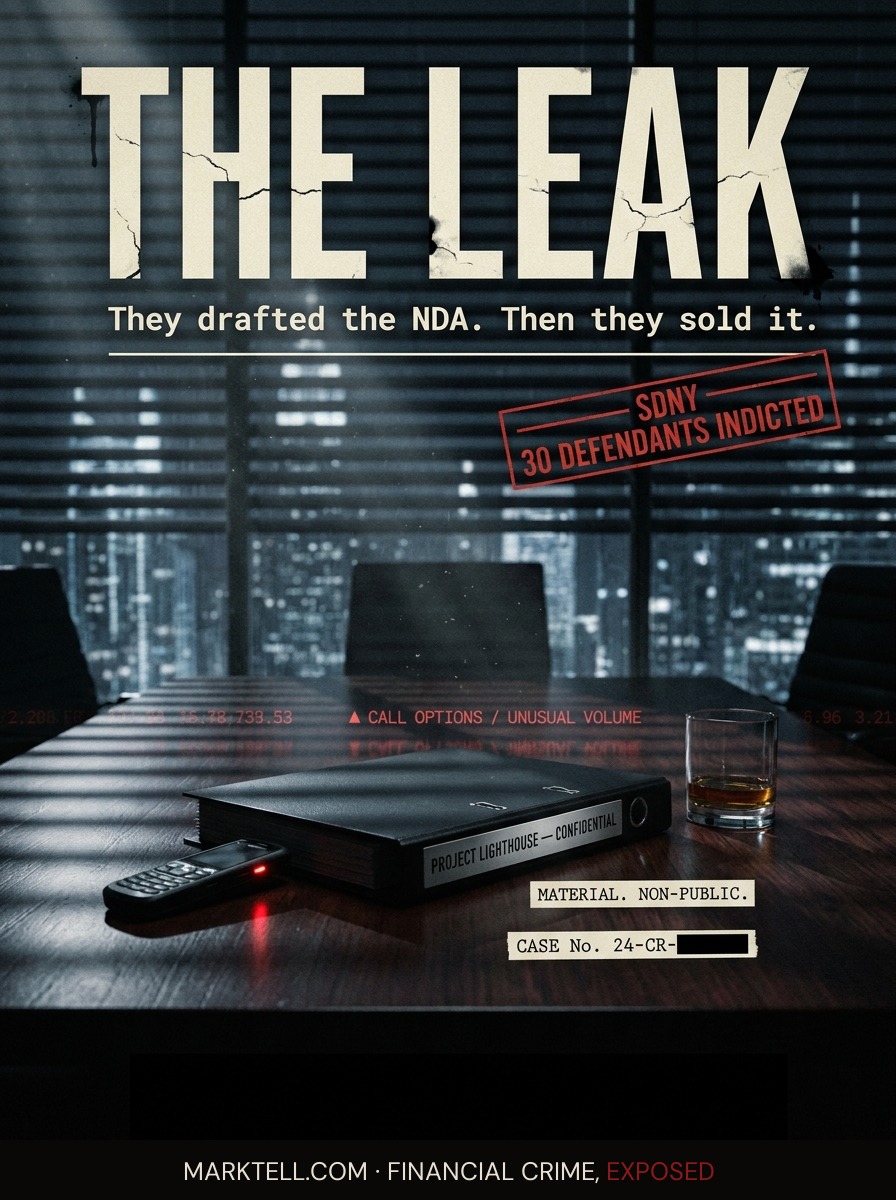
The conference room sits on a high floor in a building most people walk past without looking up. The blinds are drawn at night because the cleaning crew comes through and the firm has rules about what can be left visible. There is a binder on the table. The binder has a code name on the spine. Project Lighthouse. Project Atlas. Something that does not say what the deal actually is, because the name of the deal is the most expensive piece of paper in the building.
A junior associate is still there at eleven. The printer is warm. The hallway is dark except for one motion-sensor strip that clicks on when she walks to the bathroom and clicks off behind her.
This is the room the indictment lives inside.
On Wednesday, federal prosecutors in the Southern District of New York unsealed charges against thirty people in what they describe as an insider trading scheme. Several of the defendants, according to the filings, are lawyers who worked at M&A practices. Mergers and acquisitions. The part of a law firm where companies go to be sold, bought, broken apart, or recombined, and where the negotiations happen in rooms designed to keep what is said inside them.
The allegation is that the rooms leaked.
I.
Start with what the job is supposed to be.
When two public companies are negotiating a merger, the lawyers know before the market does. They have to. Someone has to draft the agreement. Someone has to review the disclosure schedules. Someone has to sit on the call when the price is settled. That someone signs a non-disclosure agreement at the beginning of the engagement, and the agreement is not a formality. It is the spine of the relationship. The client is paying the firm partly for legal work and partly for silence.
The information the lawyers see during that window is what securities law calls material non-public information. Material because if the public knew, the stock price would move. Non-public because the public does not know yet. Trading on it is illegal. Tipping someone else who trades on it is illegal. Receiving the tip and trading on it is illegal. The law is unusually clean here.
The complaint, as reported by Reuters, alleges that defendants did all three.
II.
Insider trading rings, when prosecutors describe them, tend to look like pipes.
One end of the pipe is in the conference room. The other end is at a brokerage screen. In between are the people who carry the information from one end to the other. The lawyer who sees the deal. The friend who places the trade. Sometimes a middleman who introduces the lawyer to the trader and takes a cut. Sometimes a chain of three or four people, each one introducing a layer of distance between the source and the trade.
The distance is the design. If the lawyer trades in his own account, the SEC's surveillance flags it within a week. If the lawyer tells a friend who tells a friend who trades, the link is harder to draw. That is what the layers are for. Not to hide the trade. To hide the relationship between the trader and the room.
Prosecutors in cases of this shape build the case the same way every time. They start with the trades. Unusual options activity in the days before a public announcement. Call options on the target company, bought cheap, paying out when the deal is announced. They run the trades against a list of who knew. They look for overlaps. A name appears on the deal team. The same name appears on a phone log with someone who appears on the brokerage records. The pipe shows itself.
III.
The mark in this story is not a retiree.
It is the rest of the market.
When someone trades on inside information, the person on the other side of the trade is selling at a price that does not reflect what the buyer knows. They are being made into a counterparty by someone who has cheated. Most of those counterparties never know they were cheated. They sold their options. They moved on. The damage is invisible to them and dispersed across thousands of accounts.
That is part of why insider trading is treated as serious even when no specific victim writes a victim impact statement. The injury is to the idea that the price on the screen reflects what the public knows. Every tip that pays off is a small extraction from that idea. Enough extractions and the idea collapses.
The clients of the law firms are also marks here, though the indictment does not frame them that way. They paid for confidential representation. The confidentiality, prosecutors allege, was being resold.
IV.
There is a particular kind of dread in reading an indictment that names lawyers.
Lawyers are the ones who are supposed to know better. They drafted the NDA. They know the case law on tipping. They have sat through the firm's annual compliance training and signed the certification at the bottom. The cases they cite to junior associates as warnings are cases that look exactly like the one they are now allegedly inside.
Prosecutors love these defendants because the knowledge element is easy to prove. You do not have to convince a jury that an M&A lawyer understood what material non-public information was. The lawyer's whole job was knowing.
The defense, when it comes, will look for the seams. Was the information actually material. Was the tip specific or vague. Did the trader know the source. Did the lawyer receive a personal benefit, which the Supreme Court has said matters for tipping liability. These are the gray areas that defense lawyers live in. They are real gray areas. Some of these defendants will win on them. That is how the system works.
But thirty defendants is not a single bad apple. Thirty is a structure.
V.
I have read indictments like this one for fifteen years. They tend to share a feature.
The lawyers charged are almost never the rainmakers. They are mid-level. Senior associates. Junior partners. People with enough access to see the deals and enough debt or ambition or appetite to make the trade-off. Law school is expensive. Manhattan is expensive. The salary at a big firm sounds enormous from the outside and feels constrained from the inside, especially when the person sitting next to you on the deal team just bought a house in Greenwich.
I am not making excuses. I am describing the soil the machine grows in. The firms know it. That is why the compliance training happens every year. The training does not stop the conduct. It establishes the firm's defense if the conduct happens.
VI.
What the public will see in the coming weeks is a press conference. The U.S. Attorney at a podium. The thirty names in a chart behind her. The deals listed. The profits totaled. A number that is large enough to be a headline and small enough that the firms involved will survive it.
What the public will not see is the conference room. The binder. The associate at eleven at night with the printer still warm. The phone face-down. The moment the calculation got made. The text that went out. The trade that cleared the next morning before anyone in the building knew the deal was real.
That part may be the saddest part.
The privilege was the product. The room was the inventory. And the people in the room, prosecutors allege, were the warehouse.
The indictment is allegation. The trial will be the proof or the absence of it. The presumption of innocence belongs to every defendant.
But the pipe was already there. It was there before this case. It will be there after it. The question federal prosecutors keep having to answer is not whether anyone is leaking from the conference rooms. It is which conference room, and which lawyer, and which trader, and how long before anyone notices.
This week, they say they noticed thirty.
- Reuters Finance | May 7, 2026 | "Lawyers at M&A law firms among 30 charged by US in insider trading scheme"
- U.S. Department of Justice | press release on indictment unsealing (referenced in Reuters reporting)
- General context on insider trading law: 17 CFR 240.10b5-1, 10b5-2; Salman v. United States, 580 U.S. 39 (2016) on tipper-tippee personal benefit standard
Editorial Notice
MarkTell is a true crime publication about financial fraud. Some scenes, dialogue, and sequential details are reconstructed from court filings, enforcement actions, news reports, and public records. Where the public record does not provide exact details, editorial reconstruction is used to convey the documented pattern of events. Names of private individuals may be changed to protect identity. All factual claims are sourced to public documents cited in the Evidence Trail above. MarkTell does not provide investment, legal, or financial advice. Nothing published here constitutes a recommendation to buy, sell, or avoid any investment. Allegations described in active cases have not been adjudicated and defendants are presumed innocent until proven guilty. Readers should conduct their own due diligence before making financial decisions.