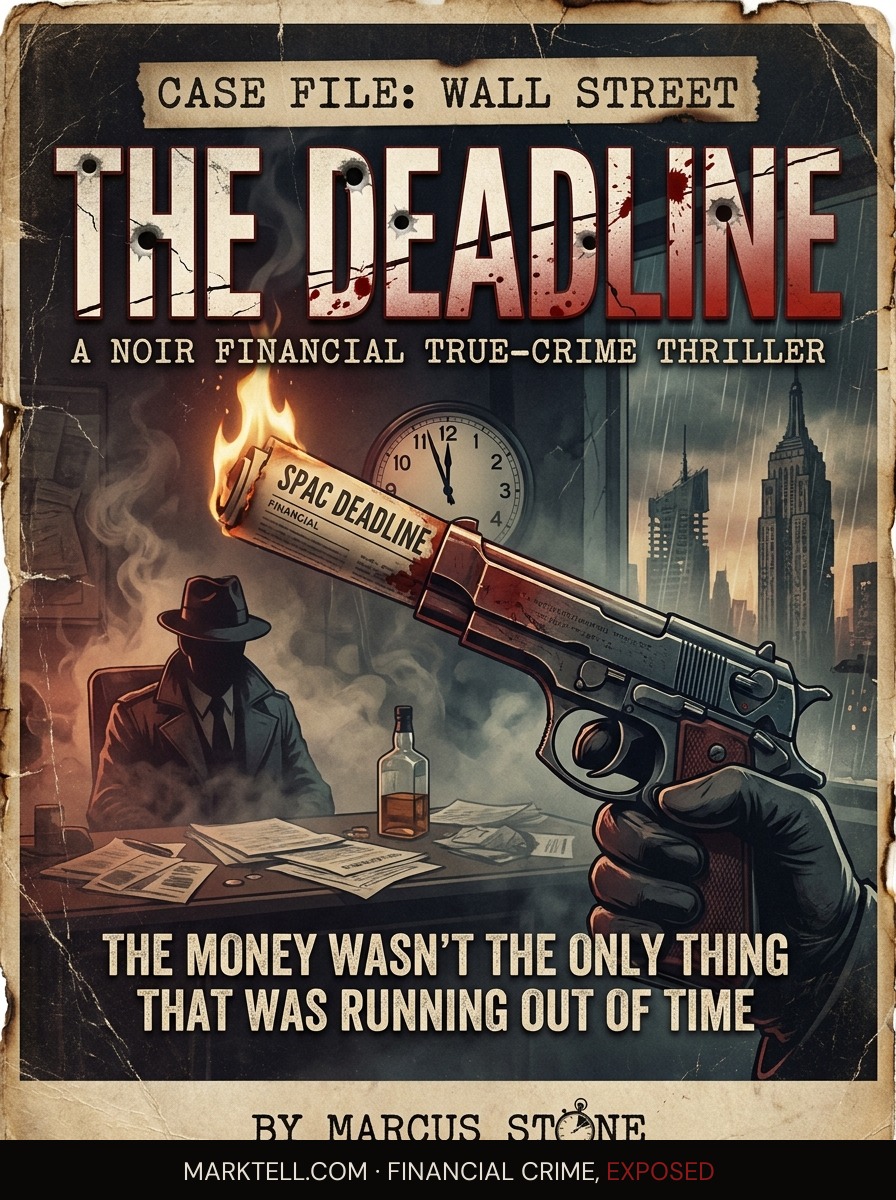
The deadline was the gun. The merger was the trigger.
Vadim Komissarov ran a SPAC into a deadline he could not afford to miss. To get the Lottery.com merger across the line, federal prosecutors say he helped manufacture revenue out of nothing. On June 24, 2026, a federal judge gave him three years.
Marcus heard about Lottery.com from a YouTube video he watched on his lunch break, sitting in his truck on a job site in Phoenix in November 2021. He was fifty-eight. He had a paint contracting business that had survived the pandemic, two grown kids, and a brokerage account he checked more than he checked his email. The video called Lottery.com "the only legal way to buy the lottery." The host used the words "ground floor" and "Nasdaq" in the same sentence.
Marcus bought a thousand shares at thirteen dollars. He bought another seventy at the close. He told himself this was the kind of thing a person his age was supposed to be smart enough to find. A company with real revenue. A real ticker. A real exchange.
The ticker was real. The exchange was real. The revenue, federal prosecutors would later prove, was not.
I.
A SPAC is a special purpose acquisition company. That is the technical name. In plain English it is a shell. A group of sponsors raises money from the public on a promise. The promise is that within two years they will find a real private company, merge with it, and take it public through the back door. If they do not find a target, they have to give the money back.
Trident Acquisitions Corp. was one of these shells. The CEO was a man named Vadim Komissarov. Trident had raised over $60 million from investors and parked it in a trust account. The clock was running. If Komissarov did not find a merger partner and close the deal before the deadline, that $60 million would be returned. The sponsors, including Komissarov, would lose the founder shares they were holding. Those shares were worth millions if the deal closed. They were worth nothing if it did not.
So the deadline was not really a deadline. It was a gun.
II.
The target was AutoLotto, doing business as Lottery.com. The pitch deck said the global online lottery market was growing at 279 percent a year between 2016 and 2019. The pitch deck did not say that Lottery.com's revenue was not growing fast enough to justify the merger price.
That is where, according to the Department of Justice, the fabrication started.
In September 2021, weeks before the merger vote, Lottery.com booked what appeared to be a $30 million sale of advertising credits. According to the indictment and Komissarov's guilty plea, that sale was bogus. It was a paper transaction designed to make the revenue line look strong enough to get the deal approved. The auditors did not see it for what it was. The board did not see it for what it was. The SPAC investors voting on the merger did not see it for what it was.
There was also a $9 million roundtrip. Lottery.com received $9 million for what prosecutors described as valueless customer data. The company booked that $9 million as revenue. Then it turned around and used that same $9 million to overpay for two Mexican businesses. The money left. The money came back. The revenue line grew. Nothing of value was created.
Read that slowly. The same dollars going out the front door and coming back through the side door, dressed as a sale.
III.
The merger closed on October 29, 2021. Lottery.com, ticker LTRY, began trading on Nasdaq on November 1. The stock closed its first day at $13.25.
That was the day Marcus bought.
Trident's stockholders, according to the proxy materials, retained 99.6 percent of their stock through the merger rather than redeeming for cash. Gross proceeds from the transaction exceeded $63 million. The clock had been beaten. The founder shares were worth real money. Komissarov, court records show, sold his Lottery.com stock for $607,028.70 before the fraud became public. That is the exact figure the judge ordered him to forfeit at sentencing.
After the merger, prosecutors say, the fabrication did not stop. Two more bogus sales totaling over $35 million were booked. By the time the smoke cleared, Lottery.com had overstated its 2021 revenues by more than 300 percent and its first quarter 2022 revenues by nearly 800 percent.
Not inflated. Invented.
IV.
Marcus did not know any of this in November. He did not know any of it in December. He did not know it in the spring of 2022 when the stock started to drift. He told himself it was a small-cap. Small-caps moved. He had read that in a comment thread.
In July 2022, the company admitted publicly that it had overstated its cash balance. The CFO, Ryan Dickinson, was terminated. The CEO, Tony DiMatteo, resigned. Nasdaq sent a delisting warning. The stock collapsed. By July 29, 2022, LTRY closed at twenty-nine cents.
Marcus was at his kitchen counter when he saw the number. The coffee was still warm. He refreshed the app. He refreshed it again. He did not tell his wife for two weeks. He kept the app open on his phone in his pocket, glancing at it the way a man checks a wound that he already knows is not going to heal.
His fourteen thousand dollars was, on paper, worth about three hundred.
V.
The federal case against Komissarov moved on its own clock. He pleaded guilty to securities fraud on February 3, 2026. He had also, according to the SEC, obstructed the agency's investigation by lying under oath. On June 24, 2026, a judge in the Southern District of New York sentenced him to thirty-six months in federal prison and ordered him to forfeit the $607,028.70.
Three years. Six hundred seven thousand dollars.
The other names on the case had their own dates. Matthew Clemenson, the former Chief Revenue Officer, pleaded guilty to criminal securities fraud on May 22, 2025. Dickinson pleaded the same day. Both consented to permanent officer-and-director bars from the SEC. DiMatteo was charged civilly by the SEC on January 22, 2026. That matter remains pending. Allegation is not adjudication.
Lottery.com itself was charged by the SEC. The company has since rebranded as SEGG Media Corporation, secured $250 million in new funding, and pivoted into sports media under a different name and a different management team. The ticker that destroyed Marcus's fourteen thousand dollars is gone. The corporate shell that issued it is still alive, under a new name, telling a new story.
That is how the machine survives. The names change. The shell continues.
VI.
The deadline trap is not a Lottery.com problem. It is a SPAC problem. It is the structural problem the SEC began flagging in late 2020, when SPACs flooded the market during the pandemic and took public hundreds of companies that, in the words of one regulator, "were not ready to be publicly traded companies."
The structure puts the gun on the table. A sponsor raises money on a promise. The clock starts. If the clock runs out, the sponsor loses millions in founder shares. The incentive is not to find a good company. The incentive is to find any company and get it closed. If the target's revenue is not strong enough to get shareholders to vote yes, the pressure to make it look strong enough is built into the deal.
That is not a flaw in the SPAC. That is the SPAC.
VII.
Marcus did not lose his house. He lost a vacation he had been planning for his wife's sixtieth. He lost the cushion he had built for a slow winter in the contracting business. He lost the confidence that he was the kind of man who could read a Nasdaq listing and trust what it said.
He thought he was buying a real company. He was buying a SPAC sponsor's deadline.
He thought the revenue line was revenue. It was a roundtrip.
He thought the merger meant the company had been vetted. The merger meant the clock had run out and somebody had to close.
Komissarov got three years. Marcus got a lesson he did not ask for and cannot return.
The pitch said ground floor. The floor was paper. The paper caught fire when the auditors finally looked down.
- U.S. Department of Justice, Southern District of New York | June 24, 2026 | Sentencing of Vadim Komissarov
- U.S. Department of Justice | February 3, 2026 | Komissarov guilty plea
- U.S. Securities and Exchange Commission | January 22, 2026 | SEC charges against Lottery.com, DiMatteo, and related parties
- U.S. Department of Justice | May 22, 2025 | Clemenson and Dickinson guilty pleas
- Bloomberg Tax / Bloomberg News | June 25, 2026 | Ex-Lottery.com SPAC Chief Gets 36 Months in Prison for Fraud
- Lottery.com Inc. (LTRY) public disclosures | July 2022 | Cash balance overstatement disclosure, executive departures
- Trident Acquisitions Corp. proxy materials | October 2021 | Merger vote, redemption figures
- SEGG Media Corporation | July 2025 | Corporate rebranding announcement
Editorial Notice
MarkTell is a true crime publication about financial fraud. Some scenes, dialogue, and sequential details are reconstructed from court filings, enforcement actions, news reports, and public records. Where the public record does not provide exact details, editorial reconstruction is used to convey the documented pattern of events. Names of private individuals may be changed to protect identity. All factual claims are sourced to public documents cited in the Evidence Trail above. MarkTell does not provide investment, legal, or financial advice. Nothing published here constitutes a recommendation to buy, sell, or avoid any investment. Allegations described in active cases have not been adjudicated and defendants are presumed innocent until proven guilty. Readers should conduct their own due diligence before making financial decisions.