The cousin sent a text. The retired trader sent in the orders.
Gerard Ryan, 62, spent decades on a trading floor before retiring to Mississippi. Then a family member at a New York biotech told him what the FDA was about to do, and he could not leave it alone.
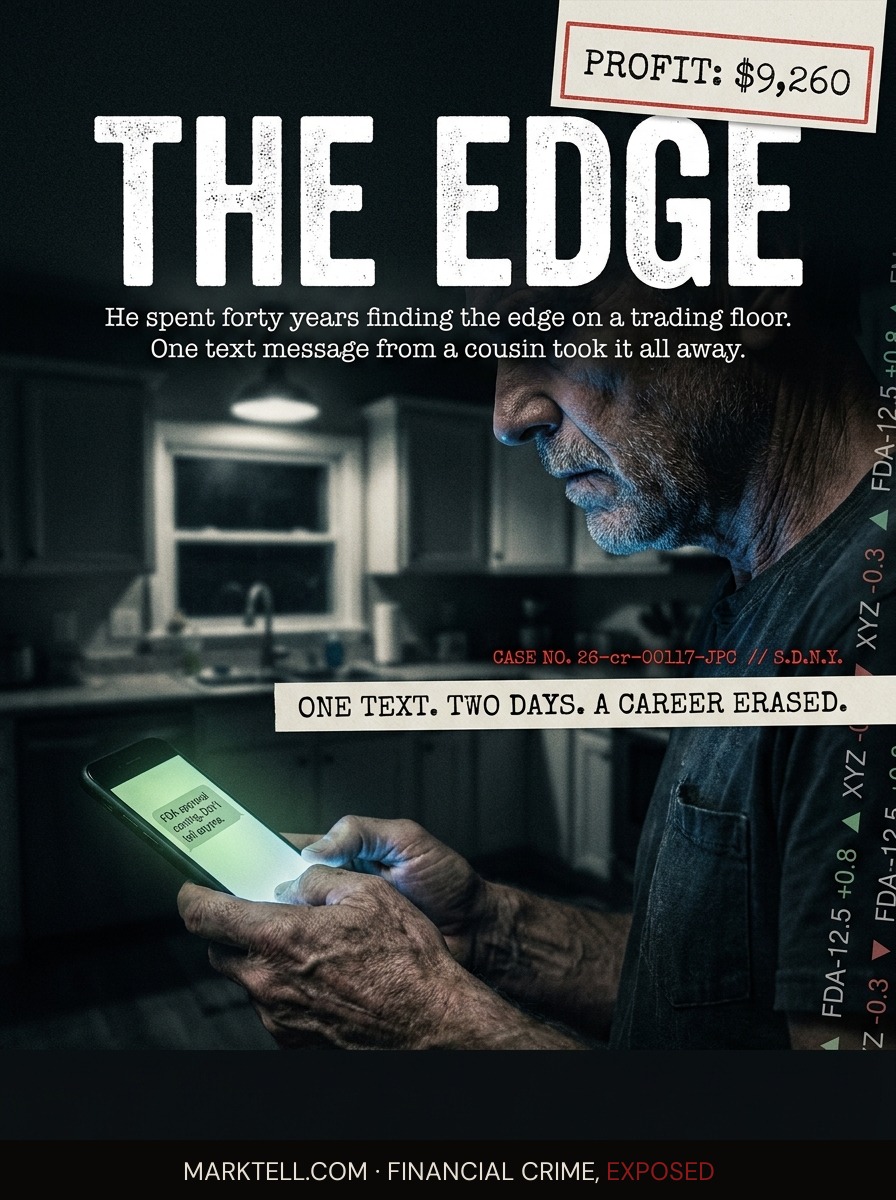
On the evening of July 14, 2021, in a house in Oxford, Mississippi, a sixty-two-year-old retired trader named Gerard Ryan got a piece of information he was not supposed to have.
It came from his cousin. The cousin worked at a New York biotech called Kadmon Holdings as an Immune Hematology Manager, which is the kind of title you give someone who sells doctors on a drug. The drug was called Rezurock. It was for chronic graft-versus-host disease, a condition that hits patients after bone marrow transplants. Kadmon had been waiting on the FDA. Everyone at Kadmon had been waiting on the FDA.
That morning, at 8:47 a.m., the FDA had quietly emailed Kadmon's regulatory affairs team to say the approval was coming. The company had not expected the answer until August. The email was confidential. Kadmon employees were under written confidentiality policies. The sales team was not supposed to know yet, and the cousins of the sales team were not supposed to know at all.
By that evening, Gerard knew.
Picture him. Sixty-two, retired off the NYMEX floor, where for years he had stood in a pit and shouted prices at other men in colored jackets. The kind of guy his friends called the "stock guy." The guy you ask when you do not know what to do with your 401(k). Phone in his hand. The screen still glowing. A number in his head that was not yet a number anyone else could see.
He bought the next morning.
I.
According to the SEC complaint filed June 4, 2026, in the Southern District of New York, Ryan acquired approximately 16,480 shares of Kadmon stock on July 15 and July 16, 2021. He did not stop at common stock. He sold put options on Kadmon at a $5 strike when the stock was trading below $4, which is a bet that the stock will not fall. He bought call options at a $5 strike, which is a bet that it will rise above five.
A put option. That is a contract that pays out if a stock drops below a set price. When you sell one, you are collecting a premium for promising to buy the stock if it falls. You only do that if you are very, very sure the stock is not going to fall.
A call option. That is a contract that pays out if a stock rises above a set price. When you buy one, you are paying a premium for the right to buy the stock cheap if it goes up. You only do that if you are very, very sure it is going to go up.
Gerard was very, very sure.
He also called a longtime friend. The SEC says the friend then bought Kadmon stock too.
II.
On the afternoon of July 16, 2021, at 2:20 p.m. Eastern, Kadmon issued the press release. The FDA had approved Rezurock. The stock closed roughly twenty percent higher than the prior day. It closed at $4.28.
Gerard had predicted, internally, the stock could run to $16.69. It did not. It made him about $9,260 anyway. His friend made about $1,170. Read those numbers slowly.
$9,260.
$1,170.
For that, a forty-something-year working life ends in a federal courtroom.
This is one of the strange truths of the floor. Guys who moved billions in their careers will throw the whole career away for the price of a used car. It is not about the money. It is about being right. It is about having something nobody else has and not being able to sit on it. That part may be the saddest.
III.
The SEC's Market Abuse Unit runs data analytics across suspicious trades around news events. A retired Mississippi trader buying sixteen thousand shares of a small-cap biotech and writing puts forty-eight hours before an FDA decision is exactly the silhouette those tools are built to find. The unit had already been looking at Kadmon. According to the SEC's description of its investigation, this was not the only insider-tied trading in Kadmon stock during that twelve-month window.
The machine that catches the machine had a name on its screen.
On March 26, 2026, Gerard Ryan walked into the courtroom of U.S. District Judge John P. Cronan in the Southern District of New York. He pleaded guilty to securities fraud. Case number 26-cr-00117-JPC. The U.S. Attorney's office, then under Jay Clayton, handled the criminal case. The FBI's James C. Barnacle, Jr. announced it. Three Assistant U.S. Attorneys were on the prosecution: Nicholas W. Chiuchiolo, Peter J. Davis, and Sarah Mortazavi.
On June 4, 2026, the SEC filed its civil complaint. On June 12, the court entered a bifurcated consent judgment. That means Ryan agreed to be permanently enjoined from violating Section 10(b) of the Exchange Act and Rule 10b-5, which are the federal rules against trading on inside information. The money piece, disgorgement, prejudgment interest, civil penalty, was left for the court to set later.
His criminal sentencing has not been scheduled.
IV.
Look at the shape of this.
The press release gets the light. The 8:47 a.m. email gets the shadows. The FDA approval gets the headline. The kitchen call gets the indictment. The stock pop gets the chart. The $9,260 gets the case number.
There was no boiler room here. No promoter. No Telegram pump. Just a family member at a company doing what the confidentiality policy said not to do, and a retired trader on the other end of the line who could not let it pass.
That is the misappropriation theory of insider trading, in a sentence. You do not have to work at the company. You have to take information that someone with a duty handed you, and trade on it. The duty was the cousin's. Gerard inherited it the moment he picked up.
Kadmon, for what it is worth, did not survive as Kadmon. Sanofi acquired it in November 2021 for about $1.9 billion, four months after the Rezurock approval. The drug is still on the market. The cousin's name is not in the public filings reviewed for this piece. Whether any action has been taken against the tipper is not something the record here shows.
V.
There is a version of this story where Gerard does nothing. The cousin calls. Gerard listens. He hangs up. He pours a drink. He waits two days. He reads the press release like everybody else. He keeps his retirement. He keeps his name off a docket. He keeps being the "stock guy" his friends call when they do not know what to do.
That version costs nothing. The version he chose cost everything for $9,260.
He spent forty years on a floor where the edge was the whole job. Then someone he trusted handed him an edge for free, and the floor was gone, and he could not tell the difference.
He thought he was getting a tip.
He was the trade the system was built to find.
- U.S. Department of Justice, SDNY | March 27, 2026 | Press release on guilty plea, U.S. v. Ryan, 26-cr-00117-JPC
- U.S. Securities and Exchange Commission | June 4, 2026 | Civil complaint, SEC v. Ryan, 26-civ-4724 (S.D.N.Y.)
- U.S. Securities and Exchange Commission | June 15, 2026 | Litigation Release regarding bifurcated consent judgment
- Sanofi | September 2021 / November 2021 | Public announcements of Kadmon Holdings acquisition (~$1.9B)
- Kadmon Holdings, Inc. | July 16, 2021 | Press release announcing FDA approval of Rezurock (belumosudil)
- FDA | July 16, 2021 | Approval announcement for Rezurock for chronic graft-versus-host disease
- hannahhowell.com (via Google News) | June 2026 | Source article on Ryan plea
Editorial Notice
MarkTell is a true crime publication about financial fraud. Some scenes, dialogue, and sequential details are reconstructed from court filings, enforcement actions, news reports, and public records. Where the public record does not provide exact details, editorial reconstruction is used to convey the documented pattern of events. Names of private individuals may be changed to protect identity. All factual claims are sourced to public documents cited in the Evidence Trail above. MarkTell does not provide investment, legal, or financial advice. Nothing published here constitutes a recommendation to buy, sell, or avoid any investment. Allegations described in active cases have not been adjudicated and defendants are presumed innocent until proven guilty. Readers should conduct their own due diligence before making financial decisions.