The courier knocked twice. The second time, the sheriff was waiting.
A Rusk County retiree clicked a pop-up and lost $47,000 in cash handed to a stranger at the door. The stranger drove up from Illinois. He was twenty-four. He came back a second time because the script told him to.
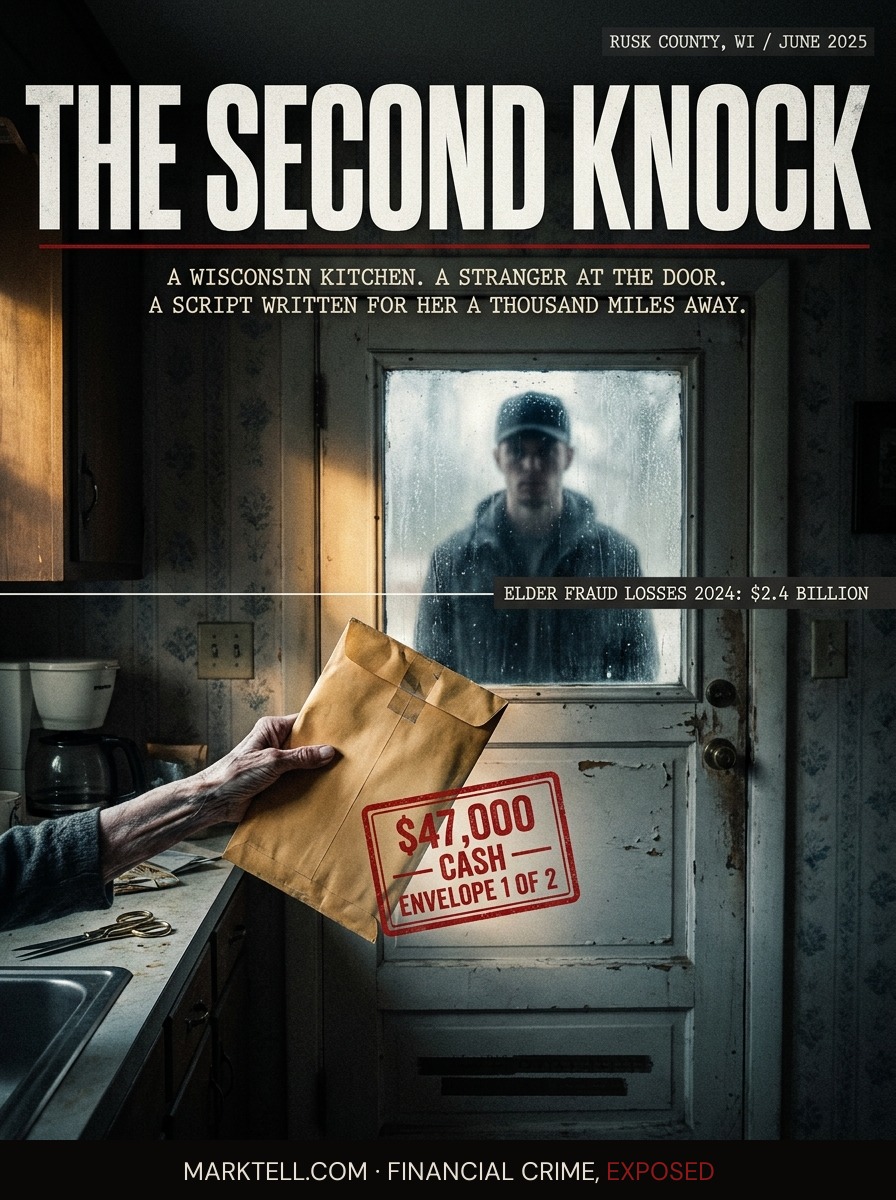
Marlene was making coffee when the screen made the noise.
She is seventy-eight. She lives alone in a small house outside Ladysmith, Wisconsin, the kind of house where the kitchen and the living room are really one room with a counter between them. Her late husband's recliner still faces the television. The checkbook is in the drawer next to the coupon scissors, where it has been since 1994.
The computer was on the kitchen table because that is where she does her email. A grandson in Eau Claire. A church newsletter. A coupon site she clicks on Tuesdays.
The noise was a kind of alarm. A box on the screen, blue and white, would not close. The box said her computer had been compromised. The box said to call a number. The box had the Microsoft logo on it, or something that looked enough like the Microsoft logo that a person who has trusted Microsoft for thirty years would not stop to ask.
She called the number.
A man answered. He was patient. He was polite. He used her name after she gave it to him and he used it often after that. He told her there were people inside her bank account. He told her the only safe thing to do was move the money out of the account before they could take it. He told her not to tell the bank, because the bank was where the breach was. He told her a federal agent would come to her home to collect the cash and hold it in a secure vault until the investigation was complete.
Read that slowly. The danger, he said, was inside her account. The safe place, he said, was a stranger at her door.
She drove to the bank. She withdrew money. She came home. She put the envelope on the kitchen counter, near the coupon scissors, and she waited.
A car pulled into her driveway. A young man got out. He was twenty-four years old. He had driven up from Oak Forest, Illinois, a suburb south of Chicago, roughly seven hours by interstate. His name, according to the Rusk County Sheriff's Office, was Miteshkumar Chaudhari.
She handed him the envelope.
He left.
I.
This is the machine. It has a name in the trade. Call centers overseas run the front end. A script. A pop-up. A voice that calls itself Microsoft or the IRS or a federal agent. The script identifies a victim. The script keeps the victim on the phone long enough to get them to the bank. The bank teller, if she is lucky, asks a question. If the script has worked, the victim has an answer ready. The answer is always some version of "it is for me, I am fine, please just process the withdrawal."
Then the front end calls the back end. The back end is a dispatcher. The dispatcher has a list of couriers. The couriers are young men, often in their twenties, often recent arrivals to the United States, often driving rental cars. The dispatcher sends one of them an address. The courier shows up. He collects the envelope. He delivers it up the chain. He gets paid a cut.
The Federal Trade Commission has been tracking the courier model for years. Tech support scams alone cost older Americans roughly $159 million in 2024, according to FBI Internet Crime Complaint Center data. Total reported elder fraud losses in 2024 hit $2.4 billion. In Wisconsin, seniors reported $92 million in losses in 2025, up eighty-two percent from the year before, according to FBI figures cited in regional reporting.
Those are the numbers in the press release. The number in Marlene's drawer was $47,000.
II.
There is a moment in every one of these cases that the prosecutors call the "second contact." It is the moment the script tells the victim that more money is needed. The vault, the agent says, requires a secondary deposit. Or the first envelope did not contain enough. Or a related account also needs to be cleared.
The second contact is where the machine usually breaks. Because by the second contact, somebody else has noticed. A daughter. A neighbor. A bank teller who saw the same withdrawal pattern last month from a different elderly customer and remembered the training. Somebody, somewhere in the chain of people around the victim, has finally said the word out loud.
In Marlene's case, somebody did. The Rusk County Sheriff's Office was contacted. Detectives, working with the Wisconsin Department of Justice Division of Criminal Investigation, set up for the next pickup.
Chaudhari drove back. Same car. Same porch. Same script.
He was arrested on the front step.
The arrest happened in June 2025. The investigation continued through the summer. By July, additional details had emerged in court filings, including the allegation that Chaudhari was unlawfully present in the United States at the time of the arrest. DrydenWire, a regional outlet covering northern Wisconsin, reported on June 9, 2026, that a prison sentence had been ordered. The length of the sentence was not detailed in the available reporting.
III.
The arrest is the part that makes the local news. The arrest is not the case.
The case is the call center. The case is the dispatcher. The case is the seven or eight people between the man on the porch and the man who wrote the script. None of them were on Marlene's porch. None of them will be in the Rusk County courtroom. The courier is the only piece of the machine that touched the ground in Wisconsin, and the courier is the piece the machine considers replaceable.
That is why the model works. The call center is in one country. The dispatcher is in another. The courier is a twenty-four-year-old in a rental car who can be replaced by next Tuesday. The money moves up the chain. The risk stays at the bottom of it.
Rusk County Sheriff Phillip Grassmann, in public statements after the arrest, urged residents to talk to their elderly family members about the warning signs. It is the right thing to say. It is also a confession of where the defense has to live, because the offense will keep running. There will be another envelope on another counter in another kitchen by the end of the week. The machine does not stop because one courier got caught. The machine reassigns the route.
IV.
Marlene's daughter came up from Madison the weekend after the arrest. She sat at the kitchen table where the computer had been. She made her mother a list of phone numbers. The real number for the bank. The real number for Microsoft, which is to say no number at all, because Microsoft does not call you. The number for the Sheriff's Office. The number for Adult Protective Services.
The list is taped to the inside of the cabinet above the coffee maker.
Marlene does not talk about the money much. The money is in some sense the smallest part. What she talks about, when she talks about it at all, is the part where she opened the door. The part where she walked across the kitchen with the envelope and handed it to a young man she had never seen before in her life, and said thank you, because the voice on the phone had told her he was helping her.
That may be the saddest part. Not the $47,000. The thank you.
V.
The thing to understand about the courier model is that it is engineered around a specific human decision. The victim is not stupid. The victim is being asked, in a moment of manufactured panic, to trust the calm voice over the loud alarm. The calm voice is the script. The loud alarm is the pop-up. The script has been refined over thousands of calls. The pop-up has been refined over thousands of clicks. The victim is meeting the script for the first time. The script has met ten thousand victims.
That is not a fair fight. It was not designed to be.
The courier knocks because the script needs a body at the door. The body at the door is the only part of the machine that can be arrested. Everything else lives somewhere a Rusk County deputy cannot drive to.
Marlene let him in because the voice on the phone told her he was safe. He came back because the script told him to. The sheriff was waiting because, for once, the second knock landed in a county that was ready for it.
A prison sentence was ordered. One courier. One county. One envelope.
The dispatcher is already on the next call.
- DrydenWire.com | June 9, 2026 | "Insider: Prison Sentence Ordered in Rusk $47,000 Elder Fraud Scheme"
- DrydenWire.com | July 2025 | reporting on Chaudhari arrest and immigration status allegation
- Rusk County Sheriff's Office | June 2025 | public statements on arrest by Sheriff Phillip Grassmann
- Wisconsin Department of Justice, Division of Criminal Investigation | June-July 2025 | investigation participation
- FBI Internet Crime Complaint Center (IC3) | 2024 Elder Fraud Report | $2.4B total elder fraud losses; $159M tech support scam losses for older Americans
- FBI / regional reporting | 2025 Wisconsin elder fraud figures | $92M in reported losses, 3,014 victims aged 60+
- Federal Trade Commission | ongoing | courier-based tech support fraud pattern documentation
- DrydenWire.com | June 8, 2026 | related Sawyer County in-home care elder exploitation case (Lasieur)
Editorial Notice
MarkTell is a true crime publication about financial fraud. Some scenes, dialogue, and sequential details are reconstructed from court filings, enforcement actions, news reports, and public records. Where the public record does not provide exact details, editorial reconstruction is used to convey the documented pattern of events. Names of private individuals may be changed to protect identity. All factual claims are sourced to public documents cited in the Evidence Trail above. MarkTell does not provide investment, legal, or financial advice. Nothing published here constitutes a recommendation to buy, sell, or avoid any investment. Allegations described in active cases have not been adjudicated and defendants are presumed innocent until proven guilty. Readers should conduct their own due diligence before making financial decisions.