The contractor kept coming back after the house was sold
A Naples man was sentenced to four years for draining $1.26 million from an elderly Hurricane Ian victim through a contractor scheme that kept running after her husband died, after she sold the house, after she moved into assisted living.
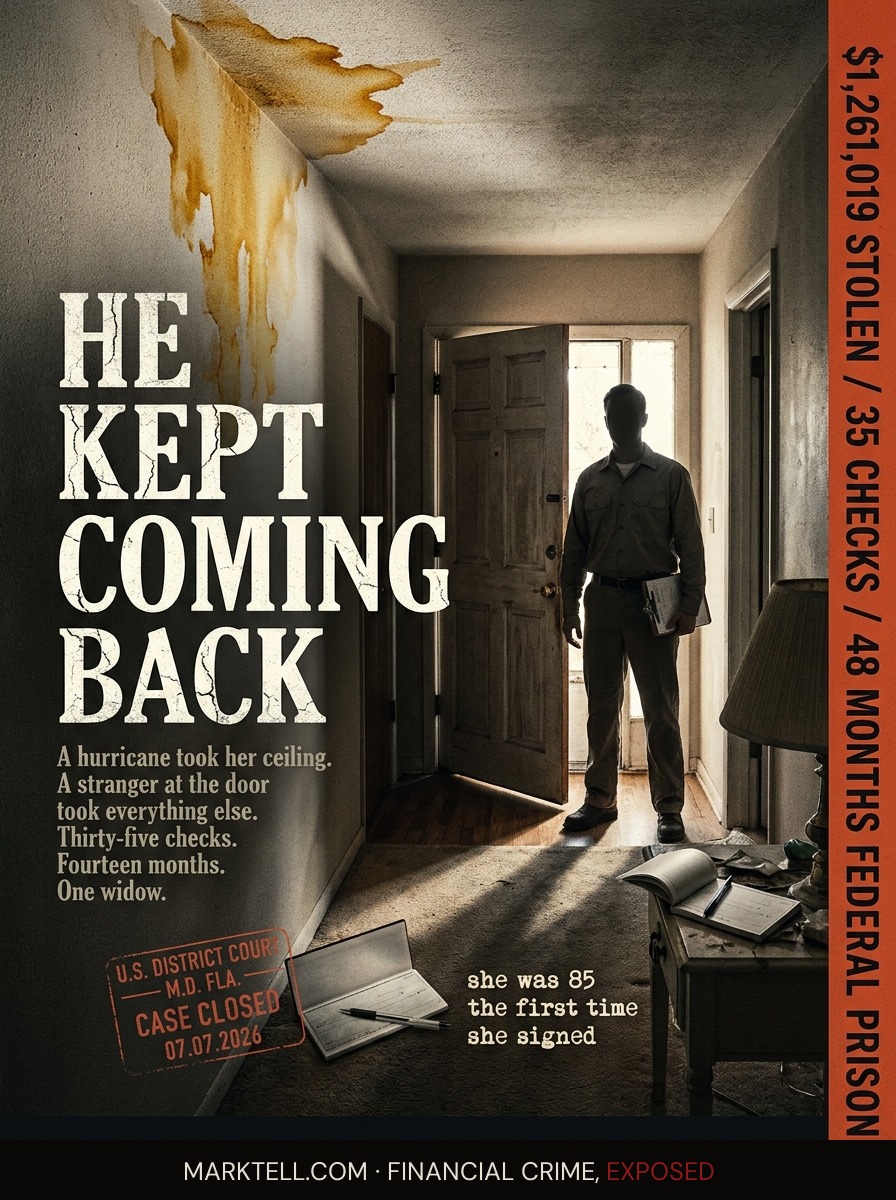
Doris was eighty-five the first time she signed a check to the man who said he was a contractor.
The house in Fort Myers had held for forty years. It did not hold for Hurricane Ian. The storm came through in September 2022 and left the ceiling in the back bedroom stained the color of weak tea. Water had come in somewhere. Water was still coming in somewhere. Her husband was still alive then, sitting in the living room with the television on low, and the two of them had agreed that they needed someone who knew what he was doing.
The man who came to the door said he knew what he was doing.
He was polite. He was patient. He used the words a licensed contractor uses. He talked about permits and inspections and material costs and the way the county had gotten slow after the storm because everybody needed everything at once. He said he could start right away. He said supplies were the problem. He said if she could just cover the materials, he could get moving before the next rain.
She wrote the first check at the kitchen table. The checkbook was the same one she had used for thirty years. The pen was a ballpoint from a bank that no longer existed under that name.
That was November 2022.
By February 2024, she had written thirty-five of them.
II. The Return Trip
According to the U.S. Attorney's Office for the Middle District of Florida, Luis Emilio Hernandez, 45, of Naples, was not a licensed contractor. He never pulled a permit on the house. He never did the work. He cashed the checks. He drove to car dealerships around Florida and bought vehicles with the money, then sold the vehicles, which is what money laundering looks like when it is not wearing a suit. It looks like a man buying a used sedan on a Tuesday and selling it on a Thursday and doing that again the week after.
The total, according to the DOJ, was $1,261,019.
Read that number slowly. It is not round. It is not the number a person would make up. It is the number thirty-five checks add up to when a man keeps coming back to a kitchen table for fourteen months.
That is the machine here. The return trip. Contractor fraud, when it works, is not a single lie told at a single door. It is a relationship. The predator is not a stranger by the third visit. He is the man who is fixing the roof. He is the man who said he would be here Thursday and was here Thursday. He is the man who called back. The trust builds because the visits keep happening. The visits keep happening because the money keeps coming out.
The construction never starts. That is the only thing that is missing.
III. What Kept Happening
Her husband died. Hernandez kept coming.
She sold the damaged house because she could not stay in it. Hernandez kept coming.
She moved into an assisted living facility. Hernandez, according to prosecutors, visited her there and asked for more.
Picture that. Picture the parking lot of an assisted living facility in Florida in 2023 or 2024. Picture a man walking in through the automatic doors, past the front desk, to the room of an eighty-five-year-old widow whose house is no longer her house, whose husband is no longer her husband, and asking her for money for materials for a home she no longer owns.
That part may be the saddest.
The house was gone. The husband was gone. The premise of every check she had ever written him had been gone for months. And he was still standing in the doorway.
IV. What A Contractor Actually Is
A licensed contractor in Florida has a number. The number is issued by the Department of Business and Professional Regulation. You can look it up in about ninety seconds on a state website. A licensed contractor pulls permits before major work, and those permits are also public. A licensed contractor's insurance is verifiable. His business address is verifiable. His prior jobs, if he has been working for any length of time, will show up in the permitting record of the county he claims to be working in.
Hernandez, according to the record, had none of this. He had a story and a way of speaking and a willingness to keep showing up.
That was enough for fourteen months.
It was enough because Doris was not stupid. Doris was tired. Doris was eighty-five, her ceiling was stained, her husband was dying or dead, and a man in her doorway was telling her he could make one of those problems go away. The pitch was not sophisticated. The pitch was proximity. The pitch was the fact of him standing there, again, saying he had it handled.
Wire fraud, in federal terms, means using electronic communication or the banking system to execute a scheme to defraud. Money laundering means moving the proceeds through legitimate-looking transactions to hide where they came from. Buying a car with fraud money and reselling it is a textbook example. The cars were the wash. Each vehicle sale generated a paper record that made the deposit look like the sale of an asset instead of the harvest of an old woman's checkbook.
Six counts of money laundering. Two counts of wire fraud. Hernandez pleaded guilty to all eight on March 30, 2026.
V. The Courtroom
On July 7, 2026, U.S. District Judge Sheri Polster Chappell sentenced Hernandez to forty-eight months in federal prison, to be followed by three years of supervised release. She ordered him to forfeit and pay back $1,261,019, the full amount taken.
Hernandez had submitted a letter to the court expressing remorse. That is what the letters usually say. The record does not tell us what Doris said, or whether she was in the room, or whether at eighty-nine she was still well enough to travel to Fort Myers to watch a man be sentenced for the fourteen months he spent taking her money.
The Lee County Sheriff's Office and the United States Secret Service investigated the case. Assistant U.S. Attorneys Patrick L. Darcey and Jesus M. Casas prosecuted it. U.S. Attorney Gregory W. Kehoe announced the sentence and said what U.S. Attorneys say in these cases, which is that the office will continue to prioritize the protection of elderly victims.
The office will. There will be more cases. The Government Accountability Office, in a report published in May 2026, noted that no one actually knows how often disaster fraud happens because most of it never gets reported. The American Institute of CPAs surveyed Americans in 2025 and found that thirty-seven percent of people affected by a natural disaster had also encountered fraud in the aftermath. Contractor fraud was near the top of the list.
The storm brings the damage. The damage brings the contractors. Some of the contractors are contractors.
VI. What Is Actually Gone
The restitution order is $1,261,019. The odds of an eighty-nine-year-old woman in assisted living seeing that money returned in her lifetime, from a man about to spend four years in federal prison, are not high. Restitution is a legal instrument. It is not a refund.
What Doris lost is not $1,261,019.
She lost the equity in a house she sold under duress because the ceiling would not stop leaking. She lost the money her husband had spent forty years earning and putting away. She lost the assumption that the man at her door was who he said he was, and she lost it thirty-five times, in her own handwriting, one check at a time.
She lost the storm twice. Once from the sky. Once from the doorway.
The machine did not need a boiler room. It did not need a website. It did not need a Telegram channel or a private placement memorandum or an SEC-registered anything. It needed a hurricane, a ceiling stain, an eighty-five-year-old widow, and a man willing to come back.
He kept coming back. That was the whole scheme.
- U.S. Attorney's Office, Middle District of Florida | July 7, 2026 | Sentencing announcement, U.S. v. Luis Emilio Hernandez
- U.S. Department of Justice | March 30, 2026 | Guilty plea, two counts wire fraud and six counts money laundering
- Gulf Coast News and Weather | July 2026 | "Man sentenced to prison for $1.2M fraud, money laundering scheme targeting Hurricane Ian victim"
- Government Accountability Office | May 19, 2026 | Report on disaster assistance scams and underreporting
- American Institute of CPAs | 2025 | Survey on fraud experienced by natural disaster victims
- Socure | December 2025 | Report on organized fraud rings exploiting disaster relief
- Florida Department of Business and Professional Regulation | Licensed contractor lookup, public record
Editorial Notice
MarkTell is a true crime publication about financial fraud. Some scenes, dialogue, and sequential details are reconstructed from court filings, enforcement actions, news reports, and public records. Where the public record does not provide exact details, editorial reconstruction is used to convey the documented pattern of events. Names of private individuals may be changed to protect identity. All factual claims are sourced to public documents cited in the Evidence Trail above. MarkTell does not provide investment, legal, or financial advice. Nothing published here constitutes a recommendation to buy, sell, or avoid any investment. Allegations described in active cases have not been adjudicated and defendants are presumed innocent until proven guilty. Readers should conduct their own due diligence before making financial decisions.