The compound ran for ten months. Americans lost $7.2 billion.
Inside a walled facility in rural Burma, trafficked workers sat at laptops and called American retirees pretending to be JPMorgan. The DOJ has now charged the men who built that room and ran it. The room is gone. The machine is not.
I. The Call
The phone rang at 10:22 on a Tuesday morning.
Gloria Hecht, seventy-one years old, retired school librarian, living in a two-bedroom house in Mesa, Arizona, picked it up because the number on the screen had a 212 area code and her daughter was traveling in New York.
It was not her daughter.
The voice on the line was professional, unhurried, and specific. The man said he was calling from JPMorgan's fraud prevention department. He said her checking account, the one she had held for thirty-one years, had been flagged. He said a purchase had been made in her name at a firearms retailer in Scottsdale. He used the retailer's real name. He asked if she had made that purchase.
She had not.
He said that was what he was afraid of.
The details in this account are drawn from the fraud method described in federal charging documents filed April 23, 2026. Gloria Hecht is a composite built from the type of victim the DOJ's complaint describes. Her name is not in the court record. The machine that found her is.
What happened next has a structure. It is the same structure every time. The fake bank representative transfers the call to a fake detective, identified in the complaint as an "NYPD detective." The detective tells the victim the situation is serious and that there is an active investigation. The detective transfers the call to someone at what is described as the "New York Supreme Court," a purported prosecutorial official who explains that the victim's accounts are at risk of seizure unless she cooperates with a temporary funds transfer to a protected holding account.
The call never ends. Not really. It migrates to WhatsApp, then to Microsoft Teams. The voices are patient. They have scripts. They have supervisors. They have quotas.
By the time Gloria transferred her savings, she believed she was protecting them.
She was not.
II. The Factory
Nobody outside that compound has seen the full interior. Not really.
What we know comes from what the FBI found after November 2025, when the Karen National Liberation Army, a militia operating in the borderlands of eastern Burma, overran and seized the Shunda compound in the town of Min Let Pan. FBI agents arrived later and went through what was left. They reviewed thousands of mobile devices and hard drives. They interviewed former workers.
The compound was called Shunda. It operated, according to federal charging documents, from at least January 2025 until it was seized that November. It was run by Chinese nationals. The workers inside were not there voluntarily.
This is the part the phone call does not show you.
An estimated 300,000 people have been trafficked into scam operations across Southeast Asia, drawn from at least 66 countries, according to a February 2026 United Nations human rights report. The Telegram channel seized last week, the one with 6,000 followers, was used for exactly this purpose: advertising jobs abroad, decent pay, no experience required. Workers who arrived found their identification confiscated. They were put at desks. They were given scripts. They were told who to call and what to say.
According to the criminal complaint, Huang Xingshan, one of the two men now charged, served as a high-level manager and enforcer. The complaint alleges he participated in the physical punishment of workers who did not meet their targets. His co-defendant, Jiang Wen Jie, supervised a team whose job was specifically to target Americans. One victim, according to the complaint, lost more than $3 million under Jiang's direct supervision.
These are allegations. Huang and Jiang were arrested in Thailand on immigration charges in early 2026. The United States is seeking their extradition. They have not been convicted.
But the compound existed. The devices and drives are in FBI custody. The workers the FBI interviewed have described what the room was like.
What it was like was a factory.
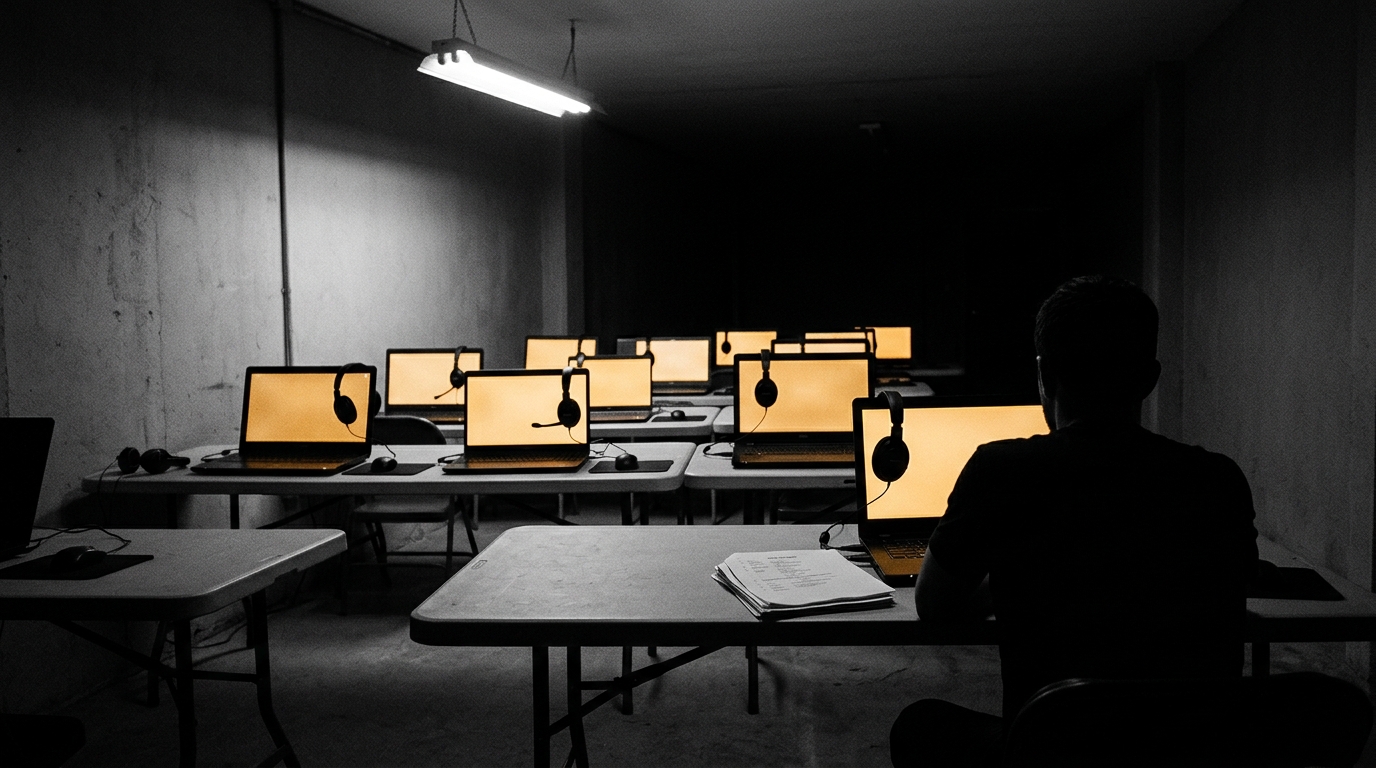
Rows of people at laptops. Supervisors walking the aisles. Scripts for every answer a victim might give. Shift schedules. Performance reviews. A management structure as organized as any call center, except that the product being manufactured was deception, and the raw material being consumed was the savings of American retirees.
The compound ran for approximately ten months.
Do the math.
III. The Infrastructure
The Shunda compound was one address. The operation it represented has many addresses.
On April 23, 2026, the DOJ's Scam Center Strike Force announced the seizure of 503 fake investment websites. Five hundred and three. Each one was a domain dressed to look like a legitimate investment platform. Some mimicked the visual language of real cryptocurrency exchanges. Some looked like brokerage sites the reader would recognize. Each one existed for the same purpose: to receive deposits that would not come back.
This is how the money moved after the phone call ended.
The law enforcement impersonation scam, the one that found Gloria, is one variant. In another, described by the DOJ and the FBI, the approach is slower. A stranger contacts a victim on social media or a dating app. They build a relationship over weeks. They mention, casually, an investment platform they use. They show the victim their own returns, the numbers on their screen. They offer to help the victim get started. They are warm. They are patient. They remember the victim's birthday.
This is called pig butchering. The name comes from the Chinese phrase sha zhu pan. The idea is that you fatten a pig before slaughter. The fattening is the relationship. The slaughter is the moment the victim deposits money and the platform stops responding.
The 503 websites seized last week were the infrastructure for the slaughter end of that operation.
The FBI's Operation Level Up, running since January 2024, has been identifying and contacting victims of these cryptocurrency investment frauds before the moment of maximum loss. The operation found those domains by working backward from victim complaints and on-chain transaction records, meaning the trail of cryptocurrency wallet activity that the fraud leaves in publicly visible blockchain data.
That trail is how the DOJ also got to the number.
$701,962,392.15.
That is the amount of cryptocurrency seized from accounts the government alleges are connected to money laundering from these operations. That number was restrained in a single court action on April 23, 2026. It is not the total taken. It is what the government found before it moved.
Americans lost an estimated $7.2 billion to Southeast Asia-based scam operations in 2025. That is the FBI's estimate. In 2024, the estimate was $10 billion. The number is moving in the wrong direction.
$701 million seized against $7.2 billion lost is a ratio. Read it that way.
IV. The Architecture of Trust
Here is what the compound was selling.
Not investments. Not protection. Trust.
The woman who answered the phone in Mesa was not naive. Gloria worked for thirty years in a public school. She raised two children. She managed her own accounts, kept her own records, paid her own taxes. She answered the phone because a 212 number could have been her daughter, and she picked up because that is what you do when someone might need you.
The machine that called her was designed by people who understood exactly that.
The complaint describes how the callers used the name of a real JPMorgan fraud prevention line, a real U.S. gun retailer's website, and the institutional language of law enforcement. They used WhatsApp and Microsoft Teams because those platforms feel more official than a voice call. They used sustained pressure, meaning the calls continued over days, sometimes weeks, because isolation from outside advice is the operating condition. If Gloria had mentioned the call to her daughter, the spell would have broken. So the callers kept her on the line, or called back, or followed up on Teams, and maintained the fiction until the transfer was complete.
This is not a failure of intelligence. It is a failure of a system built to exploit the specific things that make people decent: the willingness to answer the phone, the desire to protect what you have, the trust extended to an institution you have used for thirty years.
The compound did not need Gloria to be foolish. It needed her to be human. She was. She is.
The mark is never the problem. The machine that found her is.
V. The Network Behind the Wall
The compound in Burma did not operate alone.
On the same day the DOJ announced charges against Huang and Jiang, the Treasury Department's Office of Foreign Assets Control sanctioned Cambodian Senator Kok An, along with his business empire and 28 other individuals and entities, including casinos and a Cambodian bank, for their roles in housing and facilitating human trafficking and cyber-enabled fraud.
A senator.
The sanctions allege that Kok An's properties and businesses provided the physical and financial infrastructure through which scam operations ran. The Treasury action is a sanctions designation, not a criminal conviction. The allegations have not been adjudicated. But the architecture they describe, a sitting legislator's real estate and banking infrastructure serving as the foundation for compounds that traffick workers and defraud Americans, is the architecture that makes these operations durable.
You cannot bomb a compound and kill the operation. The Shunda compound was seized by an armed militia in November 2025. By the time the FBI arrived, the managers were already across the border in Thailand. The DOJ is now seeking extradition. The operation itself, the scripts, the cryptocurrency laundering chains, the fake websites, the Telegram channels advertising jobs, had already dispersed.
The Scam Center Strike Force was established in November 2025, the same month the Shunda compound was seized. It is an interagency operation combining the DOJ, Department of Homeland Security, State Department, Treasury, FBI, and Secret Service. The Department of State has announced reward offers of up to $10 million for information leading to the seizure or recovery of proceeds tied to the Tai Chang scam center in Burma, a separate operation from Shunda but the same model.
The President signed an executive order on March 6, 2026, directing prioritization of cybercrime and fraud schemes that drain American families of their life savings. The apparatus of government is now oriented toward these compounds in a way it was not three years ago.
That matters. It is also not enough.
The UN report from February 2026, the one that catalogued 300,000 trafficked workers and called the industry "a wicked problem," found that scam centers are spreading beyond Southeast Asia. New compounds have been identified in Africa, the Middle East, and Eastern Europe. The model is not geography. The model is the compound itself: walled, staffed by coercion, supervised by managers who answer to organized crime networks that have demonstrated they can rebuild under new names in new countries faster than enforcement can follow.
The FBI found hard drives in Burma. The people who designed what was on those hard drives have had six months to move.
VI. The Phone That Keeps Ringing
There is a Telegram channel that no longer exists. The DOJ seized it last week. It had 6,000 followers. It advertised jobs. It promised good pay and easy work in Southeast Asia.
Six thousand people were following that channel. Some of them were potential workers, recruited into the pipeline that would eventually put them at a desk in a compound. Some of them were people who knew someone else who might need a job. The channel was a funnel, and the funnel was always open.
There are other channels. There are other funnels.
The 503 websites seized last week are dark now. The machine that built 503 fake investment platforms can build 503 more. The infrastructure cost is low. The domain registrations are cheap. The servers are often overseas. Operation Level Up found those domains by working backward from victim reports and blockchain data. The people who lost money first, before the operation identified the sites, do not get that money back because a domain was seized.
This is not a criticism of the investigation. The investigation is real, the seizures are real, and $701 million in cryptocurrency has been restrained in a way that may eventually allow some of it to return to victims. That matters enormously to the people who lost those specific funds.
But the reader who needs to understand what happened to Gloria needs to understand something the press release does not say directly.
The compound in Burma is gone. The men who ran it are in Thai custody awaiting extradition proceedings. The fake websites are seized. The Telegram channel is dark.
And somewhere right now, a phone is ringing in a kitchen.
Maybe it is a 212 number. Maybe it is a local number that has been spoofed to match the number on the back of a credit card. Maybe it is a message on WhatsApp from someone who invested in the wrong thing six months ago and wants to tell a friend about the platform that saved them.
The call is coming from a room. The room has rows of desks. The people at those desks have scripts and supervisors and quotas. The room has a different name now and it is located somewhere that the Scam Center Strike Force has not yet mapped.
The call sounds exactly like the last one.
Gloria answered because it could have been her daughter.
She was the raw material. She was the entire point.
That is what the compound was for.
- U.S. Department of Justice | April 23, 2026 | Press release: Scam Center Strike Force announces charges, seizures, and coordinated actions against Southeast Asian criminal organizations | justice.gov
- U.S. Department of Justice | April 23, 2026 | Criminal complaint: United States v. Huang Xingshan and Jiang Wen Jie, wire fraud conspiracy, U.S. District Court for the District of Columbia
- U.S. Department of the Treasury, OFAC | April 23, 2026 | Sanctions designation: Kok An and 28 associated individuals and entities | treasury.gov
- U.S. Department of State | April 23, 2026 | Reward announcement: Tai Chang scam center, Burma | state.gov
- FBI Internet Crime Complaint Center (IC3) | 2026 | Annual estimates: American losses to Southeast Asia-based scam operations, $7.2 billion in 2025
- United Nations Human Rights | February 20, 2026 | Report: "A wicked problem" | ohchr.org
- The Conservative Treehouse (The Last Refuge) | April 23, 2026 | "DOJ Takes Down Massive Chinese Financial Fraud Ring Operating Out of Southeast Asia" | theconservativetreehouse.com
- Executive Order, President Donald J. Trump | March 6, 2026 | Prioritizing cybercrime and fraud schemes targeting American families
- FBI Operation Level Up | January 2024 (established) | Joint FBI/USSS initiative to identify and notify victims of cryptocurrency investment fraud
Editorial Notice
MarkTell is a true crime publication about financial fraud. Some scenes, dialogue, and sequential details are reconstructed from court filings, enforcement actions, news reports, and public records. Where the public record does not provide exact details, editorial reconstruction is used to convey the documented pattern of events. Names of private individuals may be changed to protect identity. All factual claims are sourced to public documents cited in the Evidence Trail above. MarkTell does not provide investment, legal, or financial advice. Nothing published here constitutes a recommendation to buy, sell, or avoid any investment. Allegations described in active cases have not been adjudicated and defendants are presumed innocent until proven guilty. Readers should conduct their own due diligence before making financial decisions.