The collateral was a PDF. The loan was ninety-nine million dollars.
Federal prosecutors say a Newport Beach borrower used edited PDFs to convince Western Alliance Bank his collateral was clean. The deeds of trust said otherwise. By the time the bank looked underneath, the properties were already in foreclosure.
Diane is fifty-one and works the credit desk at a regional bank that is not Western Alliance. She has been pulling loan files for twenty-six years. She knows what a title insurance policy is supposed to look like because she has looked at thousands of them.
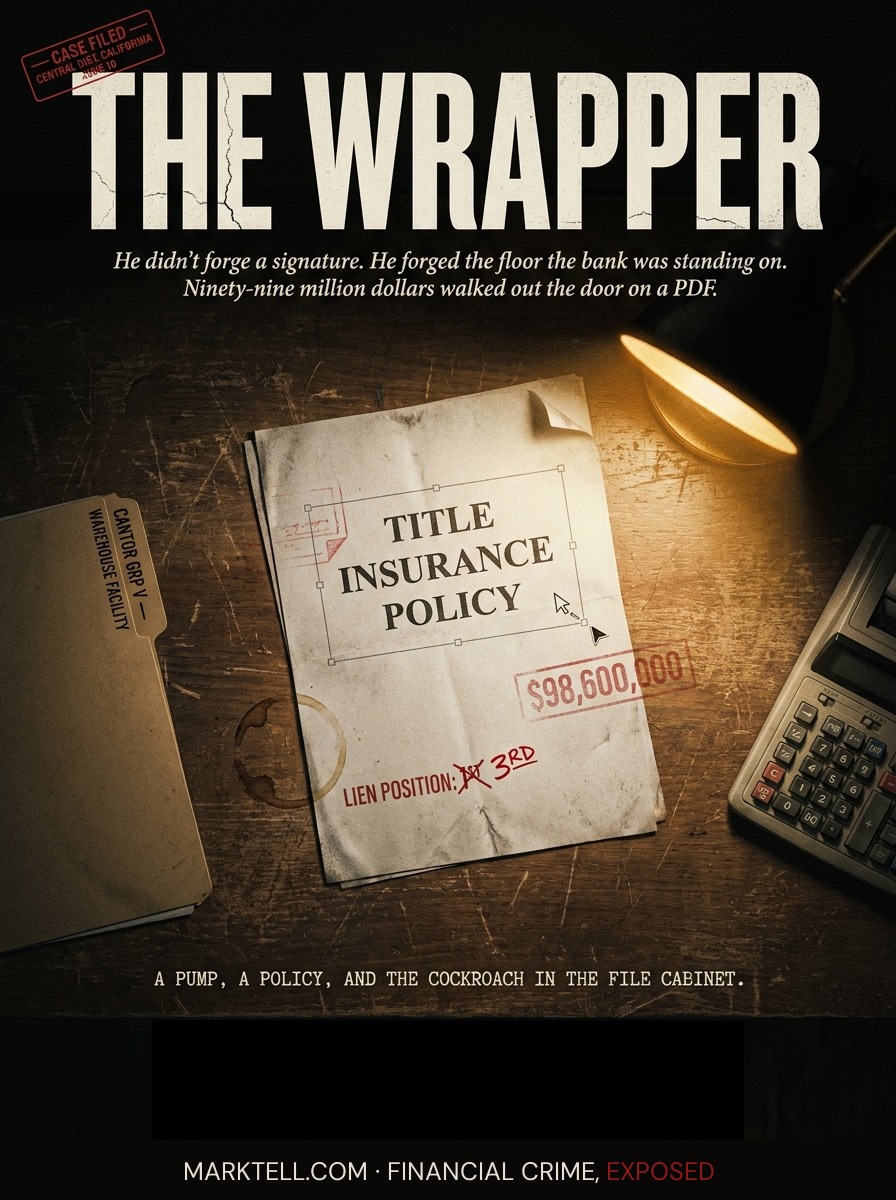
A title insurance policy is the document a lender relies on to confirm that the property pledged as collateral is actually clean. That nobody else has a claim on it. That if the borrower stops paying, the bank can foreclose and there is nobody standing in line ahead of them. The policy is issued by a title insurance company. It carries a number. It carries a date. It carries a schedule of any prior liens against the property.
For most of Diane's career, the policy was the floor. You stood on it. You did not look under it.
What federal prosecutors alleged on Wednesday, June 10, in the Central District of California, is that someone in Newport Beach figured out you did not have to stand on the floor. You could print one.
The defendant is Mahender Makhijani, 44. The charging documents were announced by First Assistant U.S. Attorney Bill Essayli in Los Angeles. The alleged victim is Western Alliance Bancorp, the Phoenix-based regional bank that just last week, on June 9, was named Phoenix Business of the Year by the Greater Phoenix Chamber. The two events sit one day apart on the calendar like a paired contrast you would invent if it were not real.
The amount, in a related civil suit Western Alliance filed in August 2025, is $98.6 million.
Call it the wrapper.
I.
The wrapper is what this whole case is about. A wrapper is a piece of paper that makes a thing look like a different thing. A title insurance policy that says the bank's lien is first when an older lien is already recorded. A schedule of exceptions that does not list the foreclosure already filed on the property. A PDF that looks clean because someone allegedly used Adobe to make it look clean.
The mechanism, as prosecutors describe it, was not exotic. The borrower allegedly took real title insurance policies, edited them, and submitted the edited versions to the bank to support a $100 million warehouse revolving credit facility. A warehouse line is the short version of a long story. It is a revolving loan a bank gives to a non-bank lender so the non-bank lender can fund its own loans. The collateral for the warehouse line is the pool of loans the borrower is making. The collateral behind those loans is the actual real estate.
The bank does not visit the real estate. The bank reads the file.
The file is the wrapper.
Western Alliance opened the warehouse line to Cantor Group V, LLC in October 2024. Nine months later, in July 2025, the bank converted the warehouse line to a term loan with a maturity date of May 16, 2026.
That conversion is a tell. You convert a warehouse line to a term loan when the warehouse line is not behaving like a warehouse line. The loans inside it are not turning over. The borrower is sitting on the money. The bank is restructuring its way out of a position it does not want.
One month later, in August 2025, Western Alliance sued.
II.
Diane has never met Mahender Makhijani. She has met dozens of him. Not him specifically. The structure. The borrower who shows up with a clean stack of paper and a smooth answer for every question. The pitch that is not really a pitch because the borrower is not selling you anything. He is just answering your questions in the order you ask them, and every answer is the answer you wanted to hear.
A good credit desk does not just read the title policy. A good credit desk pulls the deed of trust from the county recorder. A deed of trust is the publicly recorded document that says who has a claim on the property. The county recorder's office is the source of truth. The title policy is supposed to summarize the source of truth. It is not supposed to replace it.
According to the civil complaint Western Alliance filed in August 2025, when independent analysts finally pulled the recorded deeds, many of the loans inside the Cantor Group V pool were not in first-lien position. They were junior. Older deeds of trust were already recorded against the same properties. Some of the underlying properties were already in foreclosure.
Read that again.
The bank thought it had first-priority liens on commercial real estate worth roughly $100 million. What it actually had, on those properties, was a junior position behind someone else's older claim. On some, it had a position behind a foreclosure already in motion.
The wrapper said first. The recorder said second. Or third. Or already gone.
III.
The financial impact moves in a chain.
In Q3 2025, Western Alliance booked an $80 million loan-loss provision tied to its Cantor Group exposure. A loan-loss provision is the bank's way of saying we do not think we are getting this money back. It is a number on the income statement that reduces earnings to reflect a loan the bank now expects to lose.
In October 2025, when Western Alliance and Zions Bancorp both disclosed fraud-related credit problems within days of each other, Western Alliance shares fell 10.81% in a single trading session. The KBW Nasdaq Regional Banking Index fell nearly 4%. JPMorgan CEO Jamie Dimon, asked about it, said there would be more "cockroaches" in the banking system. That was the word. Cockroaches.
In late April 2026, Western Alliance disclosed that a $99 million commercial real estate loan had been downgraded to non-accrual status. Non-accrual means the bank has stopped recognizing interest income on the loan because it does not believe the interest is real. The disclosure did not name Cantor Group V. The math did.
EPS estimates for the bank fell 37% over two months following a separate $126.4 million charge-off in March 2026 on a trade finance loan tied to the bankrupt auto parts company First Brands Group. Different fraud. Same year. Same bank. CEO Ken Vecchione told an investor day in May 2026 that the bank had identified weaknesses in its practices and improved its guidelines.
That is the polite version. The impolite version is that two separate alleged frauds, totaling more than $225 million in disclosed exposure, hit the same bank inside six months.
Then, on June 10, the criminal charge.
IV.
Here is the part Diane keeps thinking about, the part she will think about for weeks.
The prosecutors said something interesting in their announcement. They said Western Alliance has not incurred a financial loss from this specific criminal charge. They said this because the bank may recover from guarantors. A guarantor is a person or entity that signed paperwork agreeing to personally make the loan whole if the borrower defaulted.
So the bank may get its money back. Eventually. From someone. After litigation. After collection. After years.
But the loan is non-accrual. The provision is booked. The stock fell. The EPS estimates were cut. The CEO had to stand in front of investors and explain weaknesses. The cockroach line is in the record.
This is what people who have never worked inside a bank do not understand about fraud against a bank. The bank does not have to lose a dollar for the fraud to do enormous damage. The fraud damages the bank's confidence in its own underwriting. It damages the sector's confidence in collateral verification. It damages every regional bank's cost of capital because investors now have to price in the possibility that the next file is also a wrapper.
The cost is not the loan. The cost is the doubt.
V.
The Cantor Group story is bigger than Makhijani. According to public reporting and filings, the broader alleged fraud has ensnared Zions Bancorp, Banc of California, Enterprise Bank & Trust, Nano Banc, and Preferred Bank. Total troubled debt across the network is estimated around $270 million. Individuals named in related civil actions include Andrew Stupin and Gerald Marcil, both linked to Cantor Group funds. Their attorney, Brandon Tran, has denied the allegations against them.
None of this has been adjudicated. The criminal case against Makhijani was filed yesterday. It is at the beginning. He is presumed innocent. His representatives, and Cantor Group V, have not publicly commented on the criminal charges, or have denied wrongdoing in the civil matters. Allegation is not adjudication.
But the pattern is the pattern.
A non-bank lender raises money from regional banks by pledging pools of commercial real estate loans. The regional banks rely on title insurance policies to confirm the collateral is clean. The title insurance policies, prosecutors allege in at least one case, were edited.
That is a machine. Not a single bad actor. A machine. One borrower with a PDF editor can hit five banks in a row if the banks all read the wrapper and none of them pull the deeds.
VI.
Diane closes the loan file on her second monitor and stares at the blank wallpaper behind it for a long time.
She is not at Western Alliance. She has never seen Mahender Makhijani's paperwork. She is thinking about her own files. The ones she has approved. The ones she has stood on. The floor she assumed was a floor.
She is thinking that for twenty-six years she has read title insurance policies as if they were the source of truth, when they were always just a wrapper around the source of truth. She is thinking that the source of truth lives in the county recorder's office, where you have to actually go look, and that nobody has time to actually go look on every deal, which is the entire reason the wrapper exists.
She is thinking that the next file on her desk could be the same machine wearing a different name.
She turns off the monitor.
The floor is still there. Probably. She will pull the deeds in the morning.
That part may be the saddest. Not that the bank got taken. That every credit officer at every regional lender in the country woke up Thursday morning and had to ask whether the floor under their last ten deals was a floor or a PDF.
The wrapper is the machine. The machine is still running. The next file is already on someone's desk.
- Reuters | June 10, 2026 | "California man charged with defrauding Western Alliance bank out of nearly $100 million"
- U.S. Attorney's Office, Central District of California | June 10, 2026 | Criminal charging announcement by First Assistant U.S. Attorney Bill Essayli
- Western Alliance Bancorp v. Cantor Group V, LLC | August 2025 | Civil complaint alleging $98.6M unpaid debt
- Western Alliance Bancorp | Q3 2025 earnings disclosure | $80M loan-loss provision tied to Cantor Group exposure
- Western Alliance Bancorp | April 24, 2026 | Disclosure of $99M commercial real estate loan downgraded to non-accrual
- Western Alliance Bancorp | March 2026 | Disclosure of $126.4M charge-off on First Brands trade finance loan
- Western Alliance Bancorp Investor Day | May 12, 2026 | CEO Ken Vecchione remarks on lending practices
- Greater Phoenix Chamber | June 9, 2026 | Phoenix Business of the Year announcement
- KBW Nasdaq Regional Banking Index | October 16, 2025 | Market reaction data
- JPMorgan Chase | October 2025 | Jamie Dimon "cockroaches" public remarks
Editorial Notice
MarkTell is a true crime publication about financial fraud. Some scenes, dialogue, and sequential details are reconstructed from court filings, enforcement actions, news reports, and public records. Where the public record does not provide exact details, editorial reconstruction is used to convey the documented pattern of events. Names of private individuals may be changed to protect identity. All factual claims are sourced to public documents cited in the Evidence Trail above. MarkTell does not provide investment, legal, or financial advice. Nothing published here constitutes a recommendation to buy, sell, or avoid any investment. Allegations described in active cases have not been adjudicated and defendants are presumed innocent until proven guilty. Readers should conduct their own due diligence before making financial decisions.