The coin had a name. The men who sold it had a plan to disappear.
A Mandi village teacher put her road-compensation money into a coin called Korvio. The man who sold it to her bought a flight to Dubai. The Enforcement Directorate is still tracing the wires.
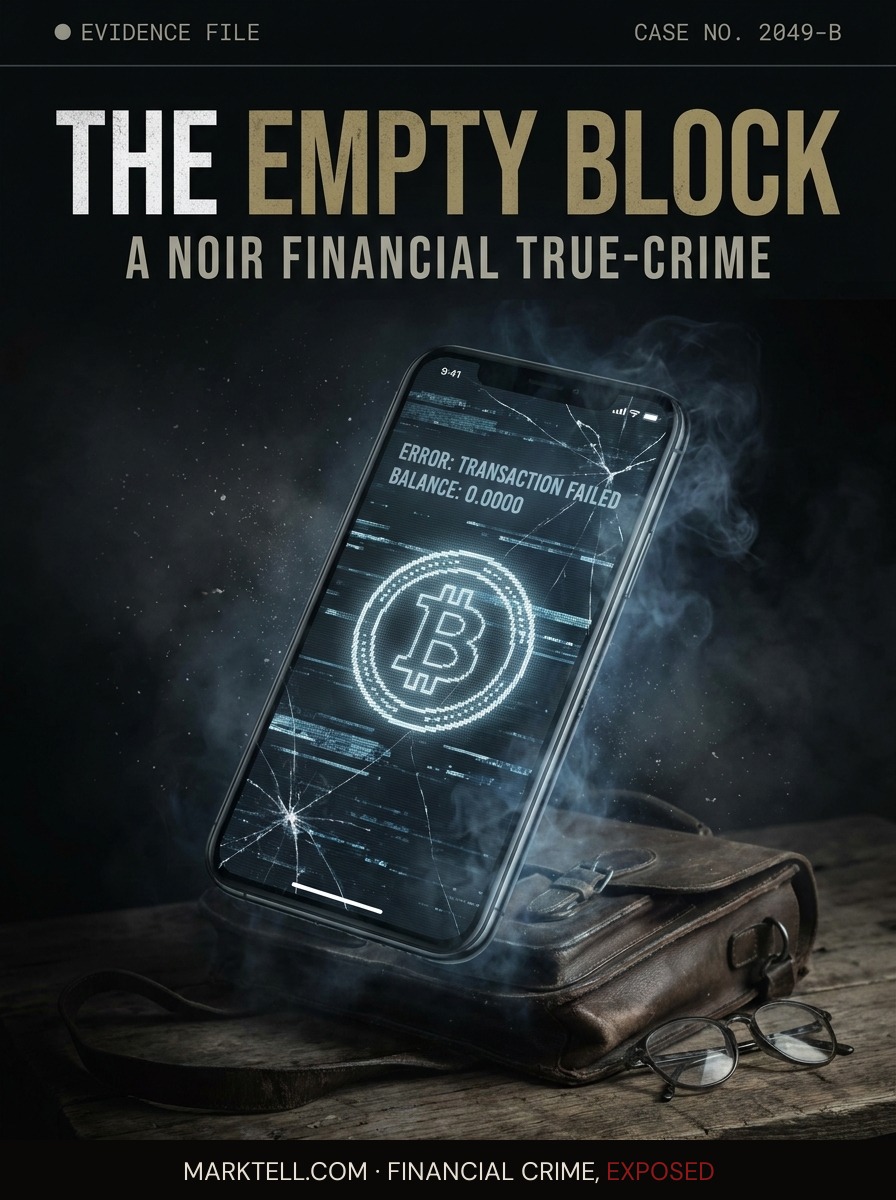
Kamla counted the money twice. Both times it came to six lakh rupees. About seven thousand dollars in a currency she had never thought in. The state had widened the road through her family's terraced field outside Sarkaghat and this was what the field was worth on paper. She put the envelope in the steel almirah behind the rice tin and closed the door.
She was fifty-four. She taught Hindi and basic mathematics at the primary school down the slope. Her husband had been gone four years. Her son was in Chandigarh studying for the bank exam. The money in the almirah was not for her. It was for him, for the dowry her daughter-in-law's family had not yet demanded but would, for the roof that leaked above the kitchen.
The boy who came to her door was someone she had taught. His name does not matter here. He had been good at fractions. He was wearing a clean white shirt and carrying a laminated folder, and he sat at her kitchen table the way her son used to sit at her kitchen table, and he opened an app on his phone and showed her a number.
The number was going up.
He called it Korvio Coin. He said KRO. He said the price had doubled in six months and would double again. He said the village headman had put in two lakh. He said the sub-inspector at the Sarkaghat station had put in five.
He was not lying about the sub-inspector. About five thousand serving government employees and police personnel across Himachal Pradesh would eventually be counted among the marks, according to the state police Special Investigation Team.
Kamla asked the boy if it was safe.
He said the word back to her. Safe.
I.
The man who built the machine was named Subhash Sharma. He was from Sarkaghat too. That mattered. In a hill district where everyone is a cousin of someone, the fact that the kingpin spoke the local dialect was the first lock on the door. You do not run from your own people. Until you do.
Sharma launched the scheme in 2018, according to the police chronology later filed by the Himachal SIT. The pitch was straightforward and very old. Put money in. Recruit two people. Earn a percentage of what they put in. Recruit two more under each of them. The math, drawn on a brochure, looked like a tree growing sideways. The structure has a name the brochure did not use. It is called multi-level marketing when it is legal and a Ponzi when it is not. The line between the two is whether real money is being made somewhere outside the recruitment chain. In Korvio's case, the Enforcement Directorate would later allege, it was not.
The coin gave the scheme its modern clothes. Korvio Coin, KRO, was a token that existed on a platform the operators ran. Voscrow. Hypenext. DGT. A-Global. The names changed. The architecture did not. The price of KRO on the platform was a number the operators chose. There was no outside exchange where the coin traded. There was no liquidity pool funded by real buyers and real sellers. The screen Kamla looked at in her kitchen showed a price. The price was a decision made in an office she would never see.
That is the part that needs to land before anything else. The coin was real in the sense that a database entry is real. The coin was not real in the sense that an apple is real. You could not sell it to anyone who was not already inside the machine. The price could not fall, because the operators would not let it fall. The price could not rise either, in any sense that meant something. It could only display.
II.
Kamla put in fifty thousand rupees first. About six hundred dollars. The number on the app rose the next morning. It rose the morning after that.
The boy came back. He did not pressure her. That is how it works. He let her watch the number for two weeks and then he sat at her kitchen table again and asked if she had thought about the rest.
She put in two lakh more. Then another lakh after her brother heard about it and asked her to add his savings. By the autumn of 2021 she had moved most of the road money into the app. Her brother had moved his pension lump sum. Two cousins had taken out informal loans against their land to buy in.
The app showed about eleven lakh rupees. About thirteen thousand dollars. The number was growing every day.
In December 2021 the withdrawals stopped.
This is the part the boy did not have an answer for. Kamla pressed the button to take out fifty thousand to send to her son for the bank-exam fees. The button spun. The button did not resolve. The boy said the platform was upgrading. He said it would be back in two days.
The number on the app kept going up.
That detail is worth sitting with. The withdrawals froze, but the price display did not. People could still see their balance growing. They could not touch it. For some marks in Himachal, this state continued for months. They watched the number rise and could not move it. A debit no one could honor. A credit no one could collect. A receipt with no door.
III.
While Kamla pressed the button, the money was moving through a structure she could not have drawn.
The Enforcement Directorate has alleged that investor funds were layered through five shell companies registered between February 2020 and May 2021. Soymans India Pvt Ltd. UBB Associates LLP. UBB Records LLP. Subro Technologies Pvt Ltd. Him Jan Sewa Foundation. The last name translates roughly as "people's service trust." Read that slowly. The vehicle used to move money out of the hands of village teachers and pensioners was registered as a public-service foundation.
From the shell companies, the ED alleges, the money split. Some was converted into actual cryptocurrency on exchanges outside the Korvio platform. Bitcoin and Ethereum, the real ones, traded on real markets. That portion left India through wallets the investigators are still tracing. Other portions were parked in property. The ED filings describe immovable assets purchased at registered values significantly below their actual consideration. The difference was paid in cash. The cash was the investor money laundered into brick.
By the time the music stopped, the police would estimate total funds collected as somewhere between Rs 1,740 crore and Rs 2,500 crore. That is roughly 210 million to 300 million dollars. The figure the ED has formally pinned to direct investor loss is Rs 500 crore. About 60 million dollars vanished from the hands of 2.48 lakh people. Do the math. That averages around twenty thousand rupees per investor. About 240 dollars. In Sarkaghat that is a month of teacher's salary. In Sarkaghat that is the roof.
IV.
In May 2023, Subhash Sharma boarded a flight to Dubai.
Police chronology says he had been planning it for weeks. He did not come back. He has not come back. The Himachal SIT, led by DIG Abhishek Dhullar, has been pursuing extradition through the Ministry of External Affairs since late 2023.
In September 2023, an Independent MLA raised the scam on the floor of the Himachal Pradesh Vidhan Sabha. That was the moment the matter became a thing the state could no longer not see. Deputy Chief Minister Mukesh Agnihotri made a public appeal in November 2023 asking citizens not to invest in unregulated cryptocurrency. The appeal was correct. It was also two years late for Kamla.
The arrests began. Hem Raj and Sukhdev Thakur from Mandi. Abhishek Sharma from Una, described in filings as a close associate of the kingpin. The Himachal Pradesh High Court denied his bail on April 30, 2026, citing the gravity of the economic offense. On June 15, 2026, the ED's Shimla office searched the premises of Vijay Kumar Juneja and Masoom Juneja. Masoom Juneja was arrested under the Prevention of Money Laundering Act the same day.
In December 2025, ED investigators opened three safes belonging to accused parties. They froze bank balances and fixed deposits totaling approximately Rs 1.2 crore. About 145 thousand dollars. Set that against the Rs 500 crore loss. It is less than three-tenths of one percent. That is what recovery looks like at this stage. That may be what recovery looks like at every stage.
V.
Kamla still has the phone. She does not open the app anymore. The number it shows is meaningless and she has known this for a long time, but she has not deleted the app, because deleting the app would be an admission she is not ready to write down.
Her brother does not speak to her. The cousins who borrowed against their land are paying interest on loans that funded a database entry. Her son passed the bank exam on his second try. The roof still leaks above the kitchen.
The boy who came to her door is in custody now, or he is not, depending on whether you believe the rumors at the tea stall. Kamla does not ask. He was good at fractions, once. The fraction he sold her was the percentage of the number on the screen that corresponded to anything in the world.
The fraction was zero.
VI.
This is the part the next pitch will not tell you.
The Korvio machine had every part a modern fraud needs. A coin with a name. A platform with a price feed. A recruitment tree. A small army of local agents who looked like neighbors because they were neighbors. A laundering structure built from shell companies with civic-sounding names. A founder with a passport and a plan to use it. The blockchain vocabulary was the new paint. The frame underneath was a 1990s pyramid sold on graph paper.
The Reserve Bank of India and SEBI have said for years that cryptocurrency in India is unregulated and unauthorized. They have said it in language that is technically correct and operationally useless to a fifty-four-year-old teacher whose neighbor's son is sitting at her kitchen table.
The machine does not need the technology. It needs the trust. The technology is the costume.
It will run again. It is running now, under a different coin name, in a different district, in a different language. The man at the kitchen table will be wearing a clean white shirt. The number on the screen will be going up.
Watch his hands when you ask if it is safe.
- ANI News | June 2026 | Himachal cryptocurrrency scam: Fugitive kingpin Subhash Sharma defrauds over 2.48 lakh investors worth Rs 500 crore
- Enforcement Directorate (ED), Shimla | June 15, 2026 | Search and arrest operation, Juneja premises (PMLA)
- Enforcement Directorate (ED) | December 2025 | Safe-opening and asset freeze, Rs 1.2 crore in balances and fixed deposits
- Himachal Pradesh High Court | April 30, 2026 | Order denying bail to Abhishek Sharma
- Himachal Pradesh Police / SIT (DIG Abhishek Dhullar) | November 2023 | Initial chronology, asset seizure of Rs 8.5 crore in property
- Himachal Pradesh Vidhan Sabha | September 2023 | Independent MLA floor statement raising the scam
- Statement of Deputy Chief Minister Mukesh Agnihotri | November 2023 | Public appeal on unregulated crypto
- RBI and SEBI public guidance | ongoing | Regulatory position on cryptocurrency in India
Editorial Notice
MarkTell is a true crime publication about financial fraud. Some scenes, dialogue, and sequential details are reconstructed from court filings, enforcement actions, news reports, and public records. Where the public record does not provide exact details, editorial reconstruction is used to convey the documented pattern of events. Names of private individuals may be changed to protect identity. All factual claims are sourced to public documents cited in the Evidence Trail above. MarkTell does not provide investment, legal, or financial advice. Nothing published here constitutes a recommendation to buy, sell, or avoid any investment. Allegations described in active cases have not been adjudicated and defendants are presumed innocent until proven guilty. Readers should conduct their own due diligence before making financial decisions.