The cocoa was Ivorian. The receipts said Ghanaian. The money was already spent.
Ghana's cocoa regulator says some licensed buyers took government money meant to pay local farmers and used it to buy cheaper beans smuggled across the Ivorian border. The farmers are still waiting. The receipts will say what the receipts need to say.
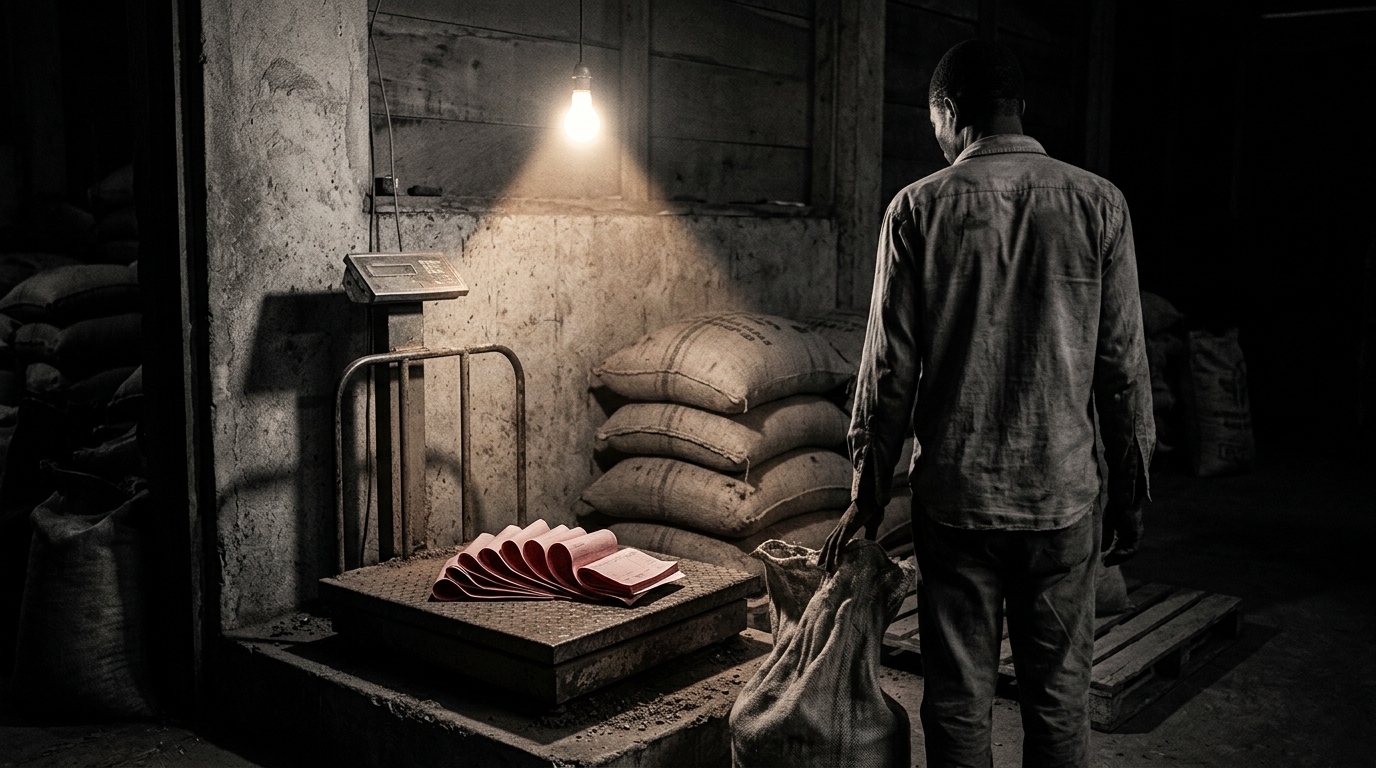
Kwame had been waiting since November.
That is not his real name. The man is composite, drawn from the farmers across Ghana's Western North, Bono, Ahafo, and Western regions who delivered cocoa beans to their village buying clerk last harvest and have not been paid as of this week. Six months. The mid-crop is coming in now. The bills from the last one have not closed.
He keeps the receipt in a plastic sleeve in a tin box under the bed. The receipt is a small slip of paper with a weight in kilograms and a stamp and a clerk's signature. In a functioning system, the slip turns into cedis. In this system, the slip stays a slip.
He still has the slip. That part may be the saddest.
I.
On Thursday, April 30, 2026, the Ghana Cocoa Board did something regulators rarely do in public. It named the leak.
Jake Kudjo Semahar, COCOBOD's Director of Special Services, told reporters that officials at some Licensed Buying Companies, the firms authorized by the state to purchase cocoa from Ghanaian farmers, had been taking government money intended for those purchases and using it to buy something else. Cheaper beans. Smuggled beans. Beans crossing the Ivorian border in the wrong direction.
Read that slowly.
The state hands an LBC a sack of cedis and says: pay our farmers. The LBC, per the regulator, hands part of that sack to a runner and says: bring me Ivorian beans at the bush price. The runner does. The beans get logged as Ghanaian. The Ghanaian farmer keeps holding the slip.
The Licensed Cocoa Buyers Association of Ghana has denied company-wide involvement and pointed at individual clerks. That denial is on the record. So is the accusation. Allegation is not adjudication. But the regulator naming the practice in four regions at once is not nothing. It is a valve being publicly identified.
II.
You have to understand what changed for this to make sense.
For most of the last decade, Ghanaian cocoa moved the other way. Farmers on the Ghana side, squeezed by the fixed producer price COCOBOD set in cedis, would slip their beans across the border into Ivory Coast or Togo where the buyer paid in stronger currency. Ghana lost product. Ghana lost foreign exchange. Between the 2021/22 and 2024/25 seasons, Ghana lost more than $1.1 billion to cocoa smuggled out, according to COCOBOD's own estimates. In 2023 and 2024 alone, more than 160,000 tonnes left the country through bush paths, valued at roughly £1.28 billion (about $1.6B USD).
Then the math flipped.
Global cocoa prices peaked above $10,000 per tonne in March 2024 and then collapsed. By April 2026 the world price was around $3,000 to $3,400 per tonne. The World Bank, on the same day Semahar made his accusation, projected a further drop of more than fifty percent for 2026, to roughly $3.80 per kilogram from $7.80 the year before.
In February 2026, COCOBOD did something unusual. It cut the producer price mid-season. From 58,000 cedis per tonne to 41,392 cedis per tonne. A 28.6 percent cut, announced by Finance Minister Cassiel Ato Forson. Farmers who had planned a year on one number woke up to a different number.
Across the border, in CFA franc territory, the Ivorian price was now, in places, lower than the Ghanaian price. Suddenly the cheaper bean was the foreign one. Suddenly the smuggling pointed inward.
A buyer holding government money to pay Ghanaian farmers at 41,392 cedis a tonne could, the regulator alleges, source a tonne cheaper than that across the border and pocket the spread. The farmer he was supposed to pay would be told the cedis had not arrived yet. Which, from the farmer's seat, was true. They had not arrived. They were never coming. They had been spent on someone else's beans.
III.
Here is the machine.
COCOBOD opens the valve. In one tranche this season, 4.2 billion cedis (about $385M USD) was disbursed to LBCs to clear arrears owed to farmers since November 2025. That is the number the state announced. The farmers and purchasing clerks I would point you to, through the reporting of Ghanaian outlets across March and April, say the money did not reach them.
The valve opens at the top.
Somewhere downstream the pipe is cut and re-soldered.
Money goes one way. Beans come in from a different direction. The receipts get written so that the two sides match on paper.
This is not a sophisticated fraud. It does not need to be. The Ghanaian cocoa supply chain is built on a chain of trust that runs from farmer to clerk to LBC to COCOBOD to port. If you compromise the LBC layer, the layers above and below cannot easily see through it. The clerk knows. The farmer suspects. The state, until last Thursday, said little out loud.
COCOBOD itself is not in good shape. The board carried 60 billion cedis (about $5.6B USD) in liabilities for the 2025/26 season. It targeted a $1.5 billion syndicated loan in 2023/24 and only secured $600 million of it. The Licensed Cocoa Buyers Association has acknowledged its members owe local banks roughly $750 million in pre-financing debts. Every party in this chain is short of cash. Every party is leaning.
When every party is leaning, the cheap bean across the border looks like oxygen.
IV.
The thing about smuggled beans is they do not stay smuggled.
They get poured into the same sacks. They get loaded onto the same trucks. They reach the same port. By the time the bean is on a ship out of Tema, the manifest says Ghana. The buyer in Hamburg or Amsterdam pays the Ghana premium. Ghana cocoa has, for decades, been graded as some of the cleanest, most consistent cocoa in the world. That reputation is a price.
If the regulator's accusation is right, that reputation is being diluted bean by bean, and the dilution is being paid for with the money that was supposed to keep Ghanaian farmers planting next season.
The farmer who does not get paid in November does not buy fertilizer in March. The tree he does not feed in March does not yield in October. The yield he does not get in October is the yield Ivory Coast is happy to supply, at a price, through a bush path, to a clerk holding cedis that were meant for him.
That is not a market. That is a snake eating its tail and being told to smile for the photo.
V.
COCOBOD has announced an anti-smuggling task force. It has offered informants one-third of the value of any confiscated cocoa. Board chairman Samuel Ofosu Ampofo has spoken about the rising smuggling problem. Public Affairs head Fiifi Boafo has cited smuggling, illegal gold mining, and weather as pressures on the sector.
Those are the moves the state makes when the state can see the leak but cannot yet name who turned the valve.
Last Thursday, Semahar named the layer. Officials at some LBCs. Across four regions. Diverting funds. Buying smuggled beans.
He did not name the companies. He did not name the clerks. The Licensed Cocoa Buyers Association said it was not them, institutionally, and might be individuals, locally. Those cases, if they become cases, remain ahead of us.
Here is what we know on the day of writing.
A regulator publicly accused its own licensees of stealing from its own farmers to buy beans smuggled from a country its farmers used to smuggle to.
A producer price was cut mid-season.
A 4.2 billion cedi disbursement was announced and, from where the farmers stand, did not arrive.
Six months of receipts sit in tin boxes.
VI.
Picture Kwame again. The composite. The receipt under the bed.
He is not a category. He is a man who delivered a weight of beans on a specific Tuesday in November and was told the cedis would come. He has called the clerk. The clerk has been polite. The clerk has said COCOBOD has not paid out yet. That sentence, in the clerk's mouth, may even be true. The clerk does not necessarily know what happens at the LBC office in the regional capital. The clerk knows the farmer is angry. The clerk knows the next harvest is coming.
Somewhere above the clerk, per the regulator, somebody decided that the cheapest sack of beans this season was the one that did not require paying Kwame. Somebody decided the receipt in his tin box was the safest place for that debt to sit. Quiet. Not on a balance sheet. Not on a wire. Just folded paper in a plastic sleeve, in a box, under a bed, in a country whose second-largest export is being sold partly under a flag that is not its own.
He still has the slip.
The slip was never the problem. The slip was working as designed.
The valve was the problem. The valve is still open.
- Reuters | April 30, 2026 | "Ghana cocoa buyers divert funds to purchase smuggled beans, regulator says"
- Ghana Cocoa Board (COCOBOD) | April 30, 2026 | Public statement by Jake Kudjo Semahar, Director of Special Services
- COCOBOD | 2024-2026 | Smuggling loss estimates, 2021/22-2024/25 seasons
- World Bank Commodity Markets Outlook | April 2026 | Cocoa price projection
- Ghana Ministry of Finance | February 2026 | Producer price reduction announcement, Finance Minister Cassiel Ato Forson
- COCOBOD | 2025/26 season | 4.2 billion cedi disbursement to LBCs
- Licensed Cocoa Buyers Association of Ghana | April 2026 | Public denial of company-wide involvement
- COCOBOD | 2023/24 | Syndicated loan disclosure ($600M of $1.5B target)
- Ghanaian press reporting | March-April 2026 | Farmer payment delays, mid-crop harvest reporting
Editorial Notice
MarkTell is a true crime publication about financial fraud. Some scenes, dialogue, and sequential details are reconstructed from court filings, enforcement actions, news reports, and public records. Where the public record does not provide exact details, editorial reconstruction is used to convey the documented pattern of events. Names of private individuals may be changed to protect identity. All factual claims are sourced to public documents cited in the Evidence Trail above. MarkTell does not provide investment, legal, or financial advice. Nothing published here constitutes a recommendation to buy, sell, or avoid any investment. Allegations described in active cases have not been adjudicated and defendants are presumed innocent until proven guilty. Readers should conduct their own due diligence before making financial decisions.