The clinic billed Medicaid $1.7 billion. The ledger says the math never worked.
A Kentucky addiction treatment company built itself into the state's largest provider by billing Medicaid more than a billion dollars. Federal investigators, two creditors, and former employees are now describing the same machine from different doors.
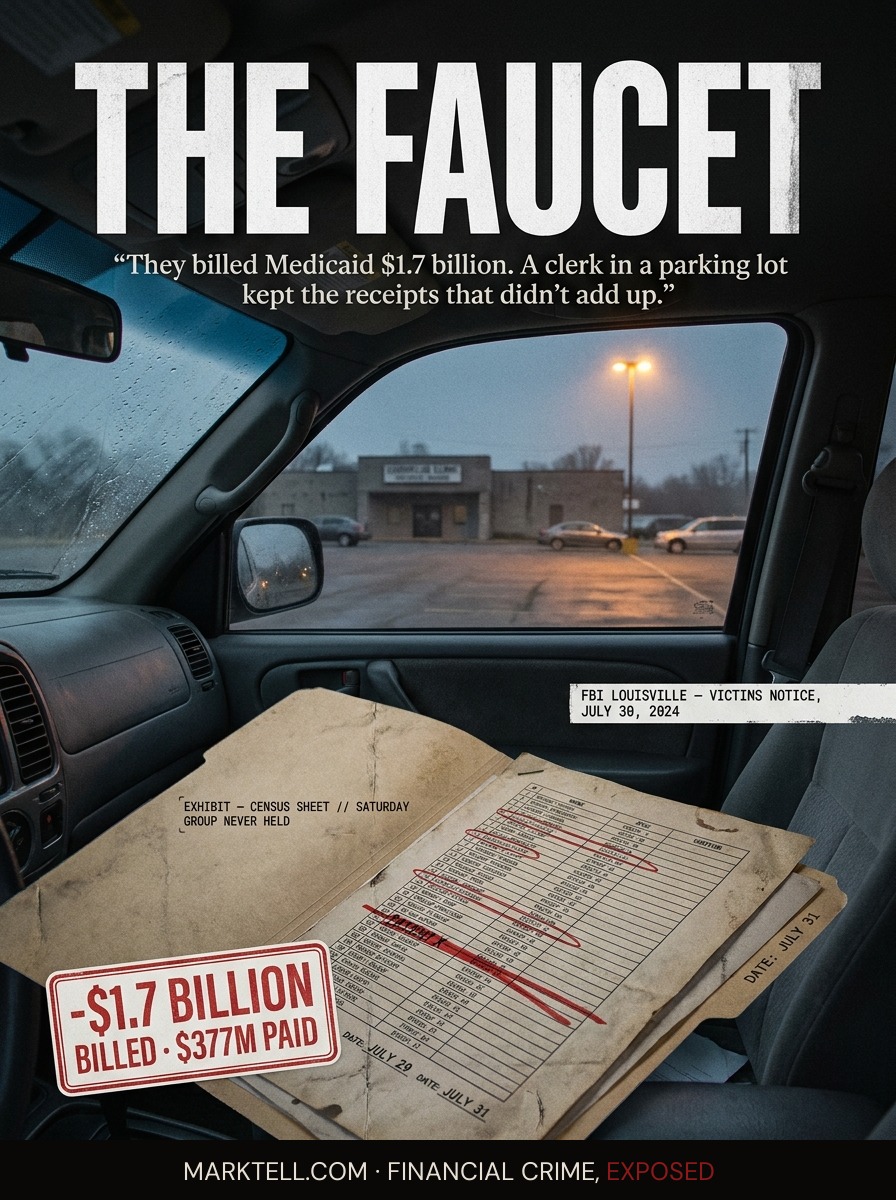
EDITOR'S NOTE: This is an Open File. The Federal Bureau of Investigation has publicly confirmed it is investigating Addiction Recovery Care for possible healthcare fraud. Civil lawsuits filed in federal court allege loan fraud and the pledging of the same tax credits to two different lenders. A draft civil settlement with the U.S. Department of Justice has been reported but not finalized. The headline that brought this story to our desk references a criminal indictment of CEO Tim Robinson on wire fraud and money laundering charges. We have not been able to locate the underlying indictment in the public record as of the writing of this chapter. Where the record is allegation, we say so. Where it is filing, we cite it. Marlene is a composite drawn from the descriptions former employees have given to reporters and federal investigators.
I.
The parking lot in Pikeville is half empty at 7:14 in the morning. Marlene is fifty-eight. She has been a medical billing clerk for thirty-one years, the last four at one of the outpatient clinics that flies the Addiction Recovery Care flag in eastern Kentucky. She is sitting in her Equinox with the engine off and a manila folder open on her lap.
The folder has census sheets in it. The census sheet is the document that tells the clinic which patients came in for which services on which day. It is the thing the billing codes are supposed to be built from. Marlene prints hers and keeps them. She did not start doing that because she was suspicious. She started doing it because once, years ago, a chart had gotten misfiled and she had been the one to catch it, and after that she kept her own copies the way some people keep receipts.
This morning's sheet does not match yesterday's. There are names on it she does not remember seeing on the schedule. There are group therapy sessions listed for a Saturday she worked, and she worked the front desk that Saturday, and she does not remember those groups running.
She closes the folder.
She has been carrying this folder, or one like it, in her car for about eleven months.
II.
Addiction Recovery Care is the largest addiction treatment provider in Kentucky. It was founded in 2010 in Louisa by Tim Robinson, a former prosecutor who has described himself as a recovering alcoholic. The company grew into a network of more than thirty programs across the eastern and central parts of the state. It sold a model called Crisis to Career, a sequence that took someone from detox through residential treatment, outpatient care, medication-assisted treatment, vocational training, and into a job.
The model is real. The patients are real. Many of them got better. That part needs to sit on the table before anything else does, because the people who walked through ARC's doors in the worst week of their lives are not abstractions and the staff who held those doors open are not abstractions either. Marlene believed in the work. Most of the people she worked with believed in the work.
Between 2019 and 2024, ARC billed the Kentucky Medicaid program $1.7 billion and was paid more than $377 million, according to state data cited in federal court filings and in reporting on the company.
Read that slowly.
A billing operation that put $1.7 billion in front of Medicaid in five years. A reimbursement of roughly twenty-two cents on the billed dollar, which is not unusual for Medicaid, but the gross number is the one that tells you the size of the faucet.
The faucet is the metaphor. There is one inflow. The state pays the bill. The valve sits inside the company. Nobody outside the company can see the valve. The question federal investigators are now asking, in plain English, is whether the valve was turned in places where there was no patient on the other end.
III.
The first crack in the wall was a whistleblower suit filed in 2023 under the federal False Claims Act. The False Claims Act is the law that lets a private person sue a contractor on behalf of the United States when that contractor has billed the government for things that did not happen. The person who files the suit is called a relator. If the government recovers money, the relator gets a cut. The suits are filed under seal, which means the public does not see them for a long time.
That seal is what kept this story below the surface for over a year.
On July 30, 2024, the FBI's Louisville Division did something it does not do often. It went public. It put out a notice asking patients and employees of ARC who believed they had been victimized between January 1, 2019 and the present to come forward.
When the FBI asks the public for victims by name, the case is no longer quiet.
ARC said it was cooperating. Tim Robinson, in a statement to staff that summer, used the phrase "turbulent times." That is the kind of phrase a former prosecutor reaches for. It does not concede anything. It acknowledges the weather.
The weather kept getting worse.
IV.
The allegations former employees have given to reporters describe a culture in which billing was treated as a production line. Staff have described being given quotas. Staff have described being instructed to bill for services that were not provided, to bill peer-to-peer support sessions that were not real sessions, to bill under the credentials of staff who were not the ones who saw the patient, and to bill for services that were not eligible for reimbursement at all. The window the allegations cover is 2018 to 2021.
If those allegations are proven, that is the valve.
For Marlene, in her car in the parking lot, the valve looks like a census sheet that does not match the schedule. It looks like a name she does not remember. It looks like a Saturday group that did not happen on a Saturday she worked.
She has not told anyone yet. She has thought about it. She has a son who works in town. She has a mortgage. The clinic is the largest employer for thirty miles in some directions. The FBI notice is on her phone, screenshotted. She has not called the number.
That part may be the saddest. The people who are inside the machine, who can see it most clearly, are also the ones with the most to lose by saying so.
V.
The second crack came from a direction nobody at ARC seems to have planned for.
In January 2026, a Delaware investment firm called Angelica Capital Trust filed a federal lawsuit against ARC, Tim Robinson, and his wife Lelia Robinson. The complaint alleges that ARC borrowed $8 million from Angelica and defaulted. It alleges, in plain language, "massive fraud."
The mechanism the complaint describes is the part you have to read twice.
ARC, according to the lawsuit, had been awarded federal income tax credits. Tax credits are a kind of future money. The federal government has said: when you owe tax, we will let you use these credits instead of cash. They have value. They can be sold or pledged.
ARC, the lawsuit alleges, pledged those credits as collateral for the $8 million loan from Angelica.
Then, a second creditor showed up.
A firm called Clear Cove Opportunities Fund LLC intervened in the case, claiming a prior right to the same $8 million in tax credits, pledged for its own $8 million loan.
The same credits. To two lenders. For $8 million each.
That is not turbulence. That is two receipts for the same car.
In January 2026, a federal judge issued a temporary injunction freezing most of ARC's assets. The Robinsons were scheduled to appear in federal court on January 29, 2026, to answer a civil contempt motion alleging they had violated the freeze. Reporting at the time described Robinson telling staff that the company accounts were not, in fact, frozen, and that it was business as usual.
The court order said one thing. The internal message said another.
Marlene, by then, had stopped printing the census sheets. There was no point. The folder was full.
VI.
The press release version of this company and the filing version are not the same company.
The press release gets Crisis to Career. The filing gets the qui tam.
The website gets the testimonials. The court docket gets the contempt motion.
The conference talk gets the model. The FBI notice gets the victims.
The 2024 statement gets "turbulent times." The 2026 docket gets "massive fraud."
The Medicaid billing report gets $1.7 billion. The proposed civil settlement, as reported, gets $27.7 million, with roughly $16 million as restitution, and would let ARC keep billing Medicaid if finalized.
Look at that last pair for a second. The structure of a settlement that pays the government back some of what the government allegedly overpaid, and in exchange lets the company keep standing at the same faucet. That is not a verdict. It is a deal. Deals are how things end without ever being adjudicated. The settlement, as of this writing, is a draft. It has not been signed.
VII.
In October 2025, ARC announced it had agreed to sell itself to a company called Ethema Health Corp. By December 31, 2025, that deal had fallen through. A sale is one of the ways a company in distress looks for a door. When the door closes, the creditors arrive. The Angelica lawsuit came three weeks later.
There is a sequence here that anyone who has worked enough fraud files will recognize. The whistleblower files. The federal investigation opens. The company looks for a buyer. The buyer walks. The creditors who were quiet while the buyer was at the table suddenly file. The court freezes the assets. The settlement gets drafted. The criminal question, if there is one, takes longer than any of it.
The headline that brought this case to my desk says CEO indicted on wire fraud and money laundering charges. I have looked for that indictment. I have not found it in the public record as of this writing. If it exists, it will be the next piece of furniture in this room. If it does not yet exist, the room is still the room.
The civil filings are filed. The FBI notice is public. The two-lenders-one-collateral allegation is on the docket. The former employees are talking. The Medicaid numbers are real.
VIII.
Marlene is still in her car. It is a different morning. The folder is in the glove compartment now. She has the FBI number written on the back of a Kroger receipt.
She is not deciding whether what she saw was real. She decided that months ago.
She is deciding whether she is the one who calls.
The faucet is still on while she sits there. Patients are walking through the door behind her. Some of them will get better. Some of the billing for what happens to them today will be correct and some of it, if the allegations are proven, will not be. The machine does not stop running because someone in a parking lot is holding a phone.
That is the part the headlines do not say. The investigation is open. The civil suits are filed. The settlement is a draft. And the clinic is open at eight.
Allegation is not adjudication. The machine described here is the machine the public record describes. If the machine is real, it will be named in court. If it is something else, that will be named too.
Marlene puts the receipt back in her purse.
Then she takes it out again.
- LEX 18 News | June 2026 | "Addiction Recovery Care CEO indicted on wire fraud, money laundering charges" (source article; underlying indictment not independently verified at time of writing)
- FBI Louisville Division | July 30, 2024 | Public notice seeking ARC patients and employees who believe they were victimized between January 1, 2019 and present
- U.S. District Court | January 2026 | Angelica Capital Trust v. Addiction Recovery Care et al., civil complaint alleging $8M loan default and fraud
- U.S. District Court | January 2026 | Clear Cove Opportunities Fund LLC motion to intervene, alleging prior right to pledged federal tax credits
- U.S. District Court | January 2026 | Temporary injunction freezing ARC assets; civil contempt hearing scheduled January 29, 2026
- U.S. Department of Justice | reported late 2025 | Draft civil settlement with ARC, approximately $27.7M total, approximately $16M restitution (not finalized)
- Federal qui tam complaint | filed 2023, under seal | False Claims Act action initiating federal Medicaid fraud investigation
- Kentucky Medicaid data | 2019-2024 | $1.7B billed; over $377M paid to ARC entities
- ARC corporate statements | August 2024 and subsequent | Statements by Tim Robinson and Chief Legal and Government Affairs Officer Jessica Burke
- Reporting on former employee allegations | April 13, 2026 | Accounts of alleged invoice falsification and overbilling instructions
- Ethema Health Corp. announcement | October 2025 | Agreement to acquire ARC, terminated December 31, 2025
Editorial Notice
MarkTell is a true crime publication about financial fraud. Some scenes, dialogue, and sequential details are reconstructed from court filings, enforcement actions, news reports, and public records. Where the public record does not provide exact details, editorial reconstruction is used to convey the documented pattern of events. Names of private individuals may be changed to protect identity. All factual claims are sourced to public documents cited in the Evidence Trail above. MarkTell does not provide investment, legal, or financial advice. Nothing published here constitutes a recommendation to buy, sell, or avoid any investment. Allegations described in active cases have not been adjudicated and defendants are presumed innocent until proven guilty. Readers should conduct their own due diligence before making financial decisions.