The checkbook on the couch was the whole pitch.
When the ambulance pulled away from a Great Falls house on the last day of August 2023, the door was unlocked and the checkbook was on the couch. The neighbors next door took the easy door, and a federal judge took four years from one of them.
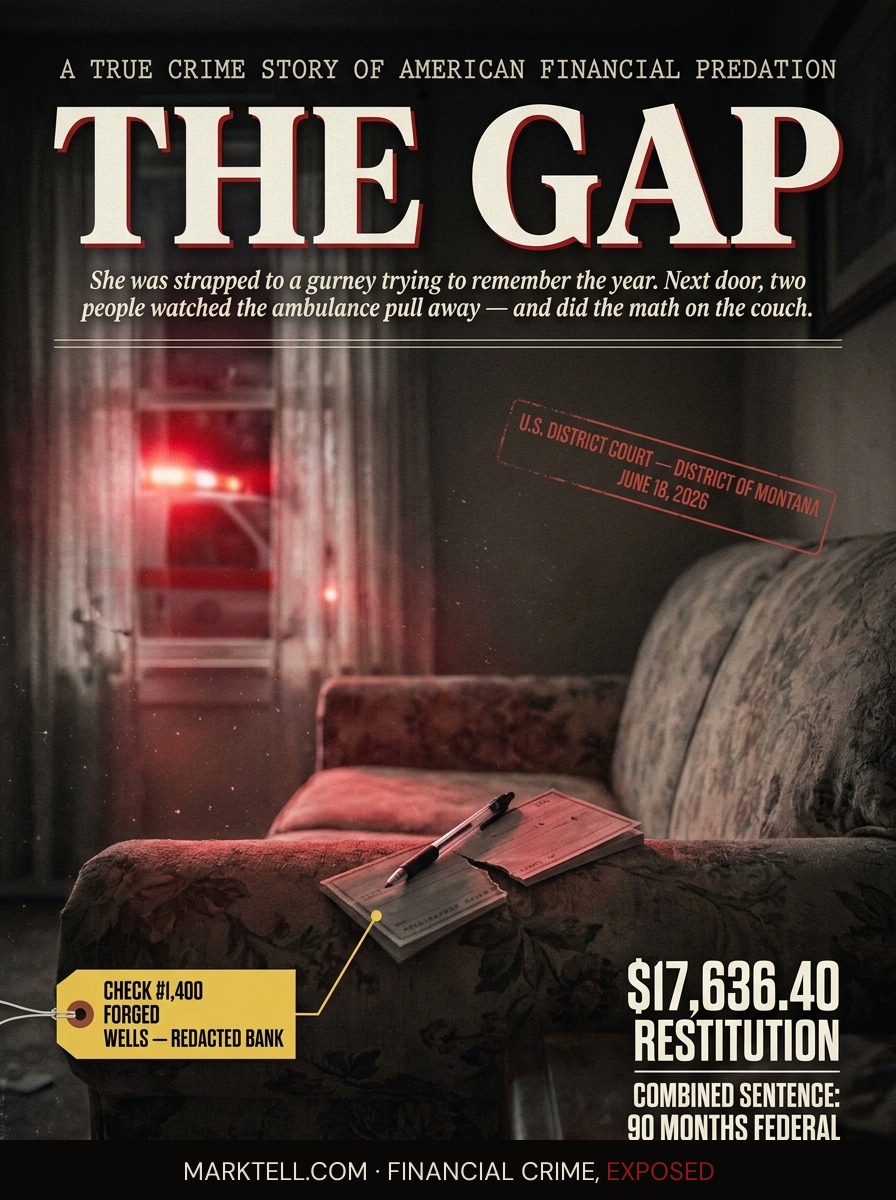
The paramedics came through the front door on the last day of August 2023. Marlene was seventy-one. She had been a bookkeeper for thirty-four years at a feed company on the north side of Great Falls and her hands had gotten bad enough by retirement that she kept her checkbook on the arm of the couch instead of in the kitchen drawer. The drawer stuck. The couch did not.
She does not remember telling anyone to lock the door. She remembers the ceiling of the ambulance and the strap across her chest and a man asking her what year it was. She got the year right. She also got the president right. She was proud of that later, in a way that did not help her.
The door stayed unlocked. The checkbook stayed on the couch.
Next door, two people watched the ambulance pull out of the driveway. Their names are Andrew Dwayne Johnson and Carrie Jeanine Johnson. He was forty-six at the time. She was forty-three. They were brother and sister and they lived in the house beside Marlene's house and they had waved at her from the yard.
This is the part of the story you have to sit with for a minute. Not the cashing. Not the forgery. The driveway. The moment the ambulance backed out and two people who had nodded at her on trash day looked at the empty house and did the math on the couch.
That is the whole machine. That is the entire pitch. There is no boiler room here. There is no Telegram channel. There is no token. There is a door that is not locked and a checkbook that is not moved and two people who decided that the quiet of the street after the ambulance left was an opportunity.
The check that the federal record names by amount was for $1,400. Andrew cashed it. The bank was Wells Fargo. The signature on the line was a forgery of a woman who at that moment was in a hospital bed trying to remember the name of the street she had lived on for nineteen years.
There were others. The total restitution that Judge William W. Mercer ordered on June 18, 2026, came to $17,636.40. That is the number the court arrived at when it added everything up. Picture it as a stack. Not a wire. Not a crypto address. Paper. Each one carrying the handwriting of a woman who was not there.
Wells Fargo flagged it. That is how these things tend to surface. The bank sees a pattern in the check images, the signature drift, the cashing locations, the timing. The reports moved up the chain to the Great Falls Police Department and then to the Federal Bureau of Investigation, because once a forged check crosses certain wires it becomes a federal matter. Wire fraud. That is the polite legal name for what happens when a stolen instrument moves through the banking system.
The FBI eventually searched Andrew Johnson's room. Court records say the stolen checks were found there. Carrie Johnson, according to the U.S. Attorney's office, admitted to taking and using the checks without permission.
Read that sentence again. Without permission. As if the question of permission had ever been on the table. As if Marlene, strapped to the gurney, had been asked.
In January 2026 they both pleaded guilty. One count of wire fraud each. One count of aggravated identity theft each. Aggravated identity theft carries a mandatory two-year prison sentence that runs after whatever else you got, not at the same time as it. Congress wrote it that way on purpose. Congress wanted the number to hurt.
On June 18 of this year, in U.S. District Court for the District of Montana, the numbers were read out. Andrew Johnson: twenty-seven months on the wire fraud count, twenty-four months on the identity theft count, consecutive. Fifty-one months. Four years and three months. Three years of supervised release after that.
Carrie Johnson: fifteen months on the wire fraud, twenty-four months on the identity theft, consecutive. Thirty-nine months. Three years and three months. Three years supervised after.
Acting U.S. Attorney Mark Steger Smith announced the sentencing. The FBI and the Great Falls Police Department had run the case.
Now go back to the couch.
There is a reason this story belongs in a book about financial crime even though there are no shareholders here and no token launch and no SEC complaint. The machine that took Marlene's money is the same machine that takes every mark's money. The pitch is just shorter. The pitch is: the door is open. The pitch is: nobody is watching. The pitch is: the person who should be saying no is in a hospital bed and cannot say it.
Every boiler room you will ever read about is a version of this. The five-hour timeshare presentation with the pen uncapped at hour five is a version of this. The reverse-split parade is a version of this. The romance scam targeting a widow at a Nebraska kitchen table is a version of this. Find the moment the person who would normally say no is not present, and you have found the trade.
In the metals rooms in Chicago in the 1980s we used to call it the gap. The gap was the distance between the customer's normal judgment and the version of the customer who answered the phone at seven o'clock on a Tuesday night. We were not looking for stupid people. We were looking for people whose guard was down for a reason we did not need to understand. A bad day at work. A husband who had died. A grandson who had not called. Anything. The gap was the product.
The Johnsons did not need a phone. They had a driveway and a sight line and a watch they could check while the ambulance backed out.
When Marlene came home, the house was the way she left it. That is the part that I keep coming back to. Nothing was kicked over. Nothing was broken. The checkbook was still on the arm of the couch. Whoever had been in the house had been careful. Careful is its own kind of insult. Careful means they planned to come back.
She would not have noticed the checks were missing for a while. People who write checks at her age do not flip through the book every morning. The bank statement would have arrived in an envelope she trusted. The signature on the line would have looked enough like hers to anyone who was not looking hard. The fraud lived in the gap between the time the check was cashed and the time the statement arrived. That is always where the fraud lives. The mailbox is the murder weapon in half of these cases. The mailbox and the calendar.
Marlene is a composite. The record does not give us her name. The record gives us the date the ambulance came, the unlocked house, the checkbook on the couch, the bank, the amount, the names of the people next door, and the number the judge wrote down. The record does not give us what she said when somebody finally told her.
That part is not in the file.
What is in the file is $17,636.40 in restitution and ninety months of federal time split between a brother and a sister who watched their neighbor get loaded into an ambulance and saw, in that moment, a checkbook on a couch.
That is the machine. It does not need a boiler room. It does not need a token. It needs a door that did not get locked because the woman who would have locked it was strapped to a gurney trying to remember the year.
She got the year right.
That part did not help her.
- U.S. Attorney's Office, District of Montana | June 18, 2026 | Press release announcing sentencing of Andrew Dwayne Johnson and Carrie Jeanine Johnson
- The Electric (Great Falls) | June 2026 | "Great Falls siblings sentenced to federal prison for stealing, cashing neighbors checks"
- U.S. District Court, District of Montana | June 18, 2026 | Sentencing before Judge William W. Mercer
- Federal Bureau of Investigation | 2023-2026 | Investigation record referenced in U.S. Attorney announcement
- Great Falls Police Department | 2023 | Initial investigation referenced in U.S. Attorney announcement
Editorial Notice
MarkTell is a true crime publication about financial fraud. Some scenes, dialogue, and sequential details are reconstructed from court filings, enforcement actions, news reports, and public records. Where the public record does not provide exact details, editorial reconstruction is used to convey the documented pattern of events. Names of private individuals may be changed to protect identity. All factual claims are sourced to public documents cited in the Evidence Trail above. MarkTell does not provide investment, legal, or financial advice. Nothing published here constitutes a recommendation to buy, sell, or avoid any investment. Allegations described in active cases have not been adjudicated and defendants are presumed innocent until proven guilty. Readers should conduct their own due diligence before making financial decisions.