The CFO sent the report. The report was the lie.
For seven years, prosecutors say, a Danbury software company's chief financial officer moved money from the company's accounts into her own and sent her CEO a weekly report that made the numbers behave. On June 4, 2026, she pleaded guilty.
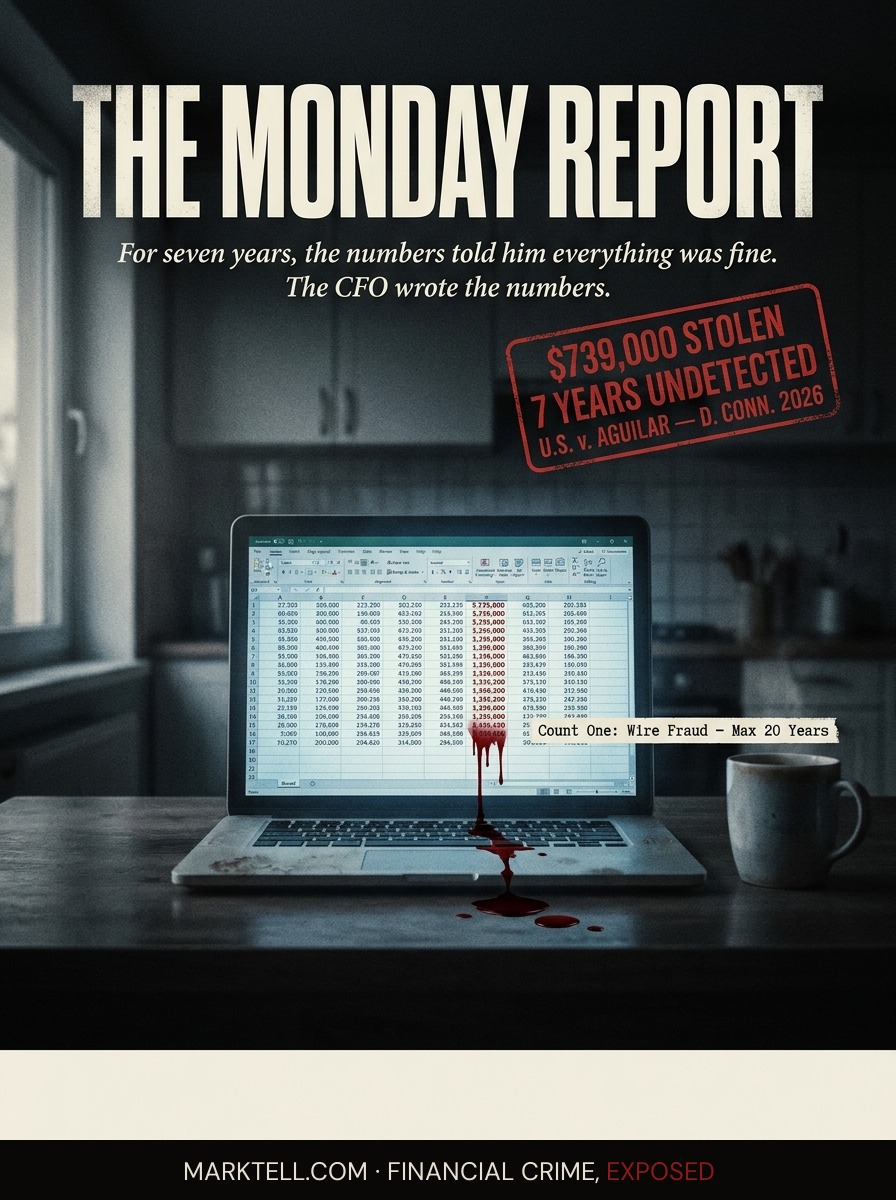
The report arrived every Monday.
Picture it. A CEO at a Danbury software company opens his laptop at the kitchen counter, or maybe at the desk in the back office, and the first thing he checks is the cash position. That is what a small-company CEO does on Monday morning. He looks at the money. He wants to know what is in the accounts before the week starts spending it.
The report was a spreadsheet. The numbers reconciled. The closing balance on Friday matched the opening balance on Monday minus the disbursements the CEO already knew about. Payroll. Vendor payments. The AWS bill. The numbers behaved the way numbers are supposed to behave when a competent CFO is doing her job.
The CFO's name was Pamela Aguilar. She was the company's chief financial officer. She was, on paper, very good at her job. The reports were always on time. The monthly financial statements always closed. When the CEO had a question, she had the answer before he finished asking.
According to the indictment returned by a federal grand jury in New Haven on October 15, 2025, and confirmed by her guilty plea on June 4, 2026, the reports were the crime.
Not a side effect of the crime. The crime itself.
I.
The company is identified in court documents as Company A. One source has named it as MaxQ Technologies Inc., a Danbury-based software firm. For the purposes of this chapter, what matters is that it was the kind of company most American workers actually work for. Not a Fortune 500. Not a startup with a press team. A company with a CEO who reads his own cash reports on Monday morning because there is no one else to read them for him.
Aguilar was 65. She lived in Shelton, Connecticut, about half an hour down I-84 from the office. She had access. That is the word the record keeps returning to. Access.
Access to the bank accounts. Access to the ACH system. That is the system that moves money between U.S. bank accounts electronically. The same system that pays your direct deposit. Access to the wire transfer authority. Access to the company's PayPal. Access to the company's credit card. Access to the checkbook.
And access to the report that told the CEO what was happening in all of those places.
II.
The scheme, according to federal prosecutors, ran from approximately 2018 to 2025. Seven years.
Read that slowly. Seven years.
Here is how the U.S. Attorney's Office for the District of Connecticut, working with the FBI's New Haven Division, described the mechanism. Aguilar made unauthorized ACH transfers from the company's accounts to her personal bank accounts. She made unauthorized wire transfers from the company's accounts to her personal bank accounts. She wrote checks. She took cash withdrawals. She used the company's PayPal to pay personal expenses. She used the company's credit card to pay personal expenses.
The total, according to the plea agreement: more than $739,000. An earlier filing in November 2025 put the figure at approximately $700,000. The number grew as investigators traced more transactions. That is how these numbers usually move. Up.
The cover, according to the same filings: false weekly cash reports and false monthly financial statements provided to the company's chief executive officer.
That part may be the saddest. The CEO was not ignoring the books. The CEO was reading them. The books were reading back to him in the voice of the person who was emptying them.
III.
This is the machine. Give it a name. Call it the inside job, but understand what makes the inside job different from every other fraud in this archive.
In a Ponzi scheme, the operator builds a fake business and recruits strangers. In a private placement fraud, the operator sells a fake security to investors who never set foot in his office. The marks are outside the room. The operator has to manufacture an entire stage set to convince them the room exists.
The inside job does not need a stage set. The room is real. The CFO already works there. The CEO already trusts her. The bank accounts are already hers to sign on. The reports are already hers to write. The only thing the operator has to manufacture is the gap. The gap between what is happening and what the report says is happening.
The report is the entire fraud.
If the report tells the truth, the scheme collapses on the first Monday. If the report tells a different truth, the scheme can run for seven years.
Aguilar's reports told a different truth for seven years.
IV.
Now picture the CEO. Call him Mark. The court record does not name him beyond his title, so I will not either, but someone sat in that chair. Someone hired her. Someone read her reports.
He is 52. He started the company or bought into it or runs it for someone who did. He understands the product. He probably understands the sales pipeline. He may even understand the engineering well enough to ask hard questions in a code review. What he does not understand, in the granular way a forensic accountant understands, is the bank reconciliation. That is what the CFO is for.
Every Monday for seven years, he opened the report. Every month for seven years, he read the financial statements. Every quarter for seven years, the numbers told him the company was healthy enough to keep going.
Somewhere in those seven years, the company paid for things that were not company things. A personal credit card balance. A PayPal charge. A wire to a personal bank account. Each one was a thread that, if he had pulled it, would have unraveled the whole sweater. He did not pull it. He had no reason to. The report said the sweater was fine.
That is not negligence. That is what trust looks like when it is installed in the wrong place.
V.
The case became visible the way these cases usually become visible: when something forced the books open to someone who was not the CFO.
The public record does not yet say what that something was. It could have been an audit. It could have been a bank notice. It could have been a vendor calling about an unpaid invoice that the report said had been paid. It could have been a new hire in the finance department asking an innocent question.
What the public record does say is this. On October 15, 2025, a federal grand jury in New Haven returned a five-count indictment against Pamela Aguilar. On October 22, 2025, she appeared in court and pleaded not guilty. She was released on a $50,000 bond.
On June 4, 2026, she came back. This time she pleaded guilty to one count of wire fraud. She was released again on the same bond, pending sentencing.
The maximum exposure on a single count of wire fraud is 20 years in federal prison. Sentencing is scheduled for August 27, 2026, in Bridgeport, before U.S. District Judge Kari A. Dooley. The actual sentence will be less than the maximum. It almost always is. The federal sentencing guidelines for a loss of more than $739,000 by a defendant with no prior record and a guilty plea will produce a range, and the judge will choose a number inside that range or near it. The number will land somewhere that feels both serious and survivable.
What it will not undo is the seven years.
VI.
Here is the ugly question. Not the exciting question. Not the television question. The ugly question.
How does a company survive losing $739,000 over seven years without noticing? The answer is that small and mid-sized companies survive things like this all the time, and they survive them because the CFO is the person who would normally notice, and the CFO is the person who is taking it. Segregation of duties is the formal term. It means the person who moves the money should not be the same person who reports on the money. In a company with twenty employees and a finance team of two, segregation of duties is a luxury. The CFO does everything because there is no one else to do it. The CEO trusts the CFO because the alternative is to do the CFO's job himself.
The fraud lives in that gap. Every inside job lives in that gap.
The press release gets the headline. The indictment gets the docket number. The plea agreement gets the signature. The seven years of Monday morning reports get the file cabinet.
VII.
Mark, the composite CEO, is still running the company. The court filings suggest that the company cooperated with the investigation, which is how these cases usually surface in indictable form. Someone inside the company found something. Someone inside the company called the FBI. Someone inside the company sat for an interview and explained what the reports had said and what the bank records actually showed.
That person is not named in the public record. He or she may never be named. But there was a Monday morning, somewhere in 2025, when someone opened a bank statement next to one of Aguilar's reports and saw that the two documents were describing different companies.
That is the moment the machine became visible.
Not the indictment. Not the plea. The Monday morning when two pieces of paper stopped agreeing.
VIII.
The lesson, if there is one, is not that CFOs are dangerous. Most CFOs are exactly what they appear to be. The lesson is that the report is not the thing. The report is a description of the thing. When the same person controls both the thing and the description, the description is whatever that person needs it to be.
Pamela Aguilar will be sentenced on August 27, 2026. Whatever number Judge Dooley chooses, the seven years are already spent. They were spent in the gap between the report and the bank statement. They were spent in a Monday morning ritual that meant nothing because the document being read had been written by the person being trusted to write it honestly.
The CEO read the report every Monday.
The report was the lie every Monday.
- U.S. Attorney's Office, District of Connecticut | June 4, 2026 | Press release on guilty plea of Pamela Aguilar
- U.S. District Court for the District of Connecticut | October 15, 2025 | Five-count federal indictment of Pamela Aguilar (New Haven grand jury)
- U.S. District Court for the District of Connecticut | October 22, 2025 | Initial not-guilty plea and $50,000 bond
- Patch (via Google News) | June 4, 2026 | "Shelton Woman Pleads Guilty To Wire Fraud Charge In Connection To $730K Embezzlement Scheme: Feds"
- FBI New Haven Division | 2025-2026 | Investigative agency of record, SAC P.J. O'Brien
Editorial Notice
MarkTell is a true crime publication about financial fraud. Some scenes, dialogue, and sequential details are reconstructed from court filings, enforcement actions, news reports, and public records. Where the public record does not provide exact details, editorial reconstruction is used to convey the documented pattern of events. Names of private individuals may be changed to protect identity. All factual claims are sourced to public documents cited in the Evidence Trail above. MarkTell does not provide investment, legal, or financial advice. Nothing published here constitutes a recommendation to buy, sell, or avoid any investment. Allegations described in active cases have not been adjudicated and defendants are presumed innocent until proven guilty. Readers should conduct their own due diligence before making financial decisions.