The certificate said covered. The job site said cash. The gap was the business.
For nearly nine years, an Orlando plastering company sold a paper promise to hundreds of subcontractors: insurance certificates that looked real and a payroll channel that ran in cash. On May 6, 2026, a federal judge put numbers on what it cost.
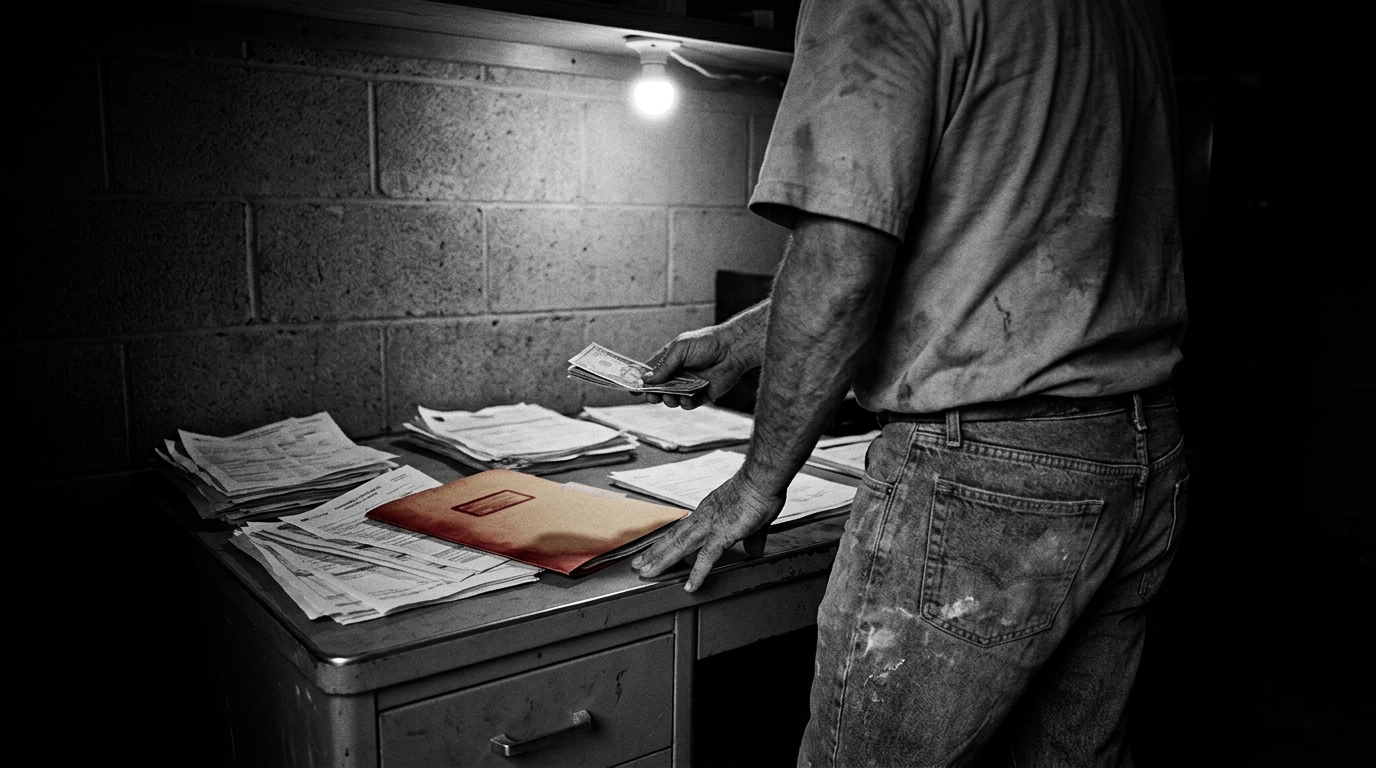
The certificate was a single page. It came over by email, sometimes by fax to a job-site trailer, and it carried the kind of language general contractors are trained to look for. Named insured. Policy number. Effective dates. Workers' compensation, employer's liability, the right limits in the right boxes. A general contractor in Central Florida who needed to staff a stucco crew for a subdivision could open that PDF, see Escobar Plastering at the top, and check a box on his own paperwork that said the labor on his job was covered.
That box being checked is what kept the job moving.
That box being checked is what the federal government, on Wednesday, said was a lie that ran for almost nine years.
On May 6, 2026, in the federal courthouse in Orlando, U.S. District Judge Wendy W. Berger sentenced Rene Mauricio Escobar, fifty-five, to four years and nine months in prison. She sentenced his co-defendant, Juana Nelida Escobar, thirty-six, to two years. The court ordered them, jointly, to pay $37,174,388 in restitution to the Internal Revenue Service. That is the unpaid payroll tax number. It is the smaller of the two numbers in this case.
The larger number, the one DOJ used to describe the scope of the operation, is $148 million. That is the total construction payroll the Justice Department says moved through Escobar Plastering between December 2015 and August 2024. Almost nine years. Hundreds of subcontractors. A workforce, on paper, that was tiny. A workforce, in fact, that was not.
I.
The polite name for what Escobar Plastering sold is "payroll services."
The real name is a certificate machine.
Here is how the machine worked, according to the indictment and the DOJ's sentencing announcement. A construction subcontractor in Florida, somebody framing or plastering or finishing on a residential job, needed two things to keep working. He needed workers, and he needed proof that those workers were insured. Workers' compensation insurance is what pays a man's hospital bill when he falls off a scaffold. General contractors will not let a sub on the site without it. The state will not let a sub bid without it. The premium is calculated on payroll, which means the more people you employ, the more you pay.
For a sub running a real crew, that premium is a serious line item. For a sub running a crew of undocumented workers he wants to pay in cash, it is impossible. The application asks how many employees. The honest answer ends the business.
Escobar Plastering offered a different answer.
The subcontractor would write a check to Escobar Plastering for his weekly payroll. Escobar Plastering would keep seven or eight percent as a fee. The rest came back to the subcontractor in cash, ready to hand out at the job site on Friday. In exchange, Escobar Plastering issued a certificate of insurance in its own name, listing the subcontractor's job, and represented to the general contractor that the workers on that job were covered by Escobar Plastering's policy.
They were not. Escobar Plastering's actual insurance applications, according to the government, declared a minimal number of employees. The premium was priced for a small crew. The certificate was issued for hundreds.
The fee was the product. The certificate was the wrapper. The cash was the point.
II.
Picture the job site at six in the morning.
A framer in his forties, work boots already dusty, coffee in a gas-station cup, waiting near a pickup truck for the foreman to walk down the line with envelopes. No pay stub. No withholding. No line on a W-2 next year because there will be no W-2. The number in the envelope is the whole number. It is also the only number. There is no Social Security credit accruing for this week of work. There is no Medicare contribution. There is no unemployment insurance fund being fed in his name. If he falls today, the certificate of insurance the general contractor has on file says he is covered. The reality is that the policy was written for a company that told the carrier it had almost no employees.
He is the worker the certificate is concealing.
He is also the worker the certificate is failing.
That part may be the saddest part of the file. The fraud is usually framed, correctly, as a tax case. The IRS gets the restitution number because the IRS can measure what was stolen. But the man waiting for the envelope is owed something the IRS cannot calculate. He is owed the entry on his record that says he worked. He is owed the coverage that says if the scaffold gives, somebody pays for the ambulance.
He got cash. The fee took the rest.
III.
Read the structure slowly.
The general contractor gets a clean certificate.
The subcontractor gets cheap labor and a paper alibi.
The Escobars get seven to eight percent of $148 million.
The insurance carrier gets a premium priced for a company that does not exist.
The IRS gets nothing.
The worker gets an envelope.
That is the machine. Six positions. Five winners on paper. One loser who never saw the paper. The last position is the one the case is named after on the IRS side. It is not the position the case was actually about.
IV.
The chronology is in the public record.
In November 2024, a federal grand jury in the Middle District of Florida indicted five Orlando residents, including Rene and Juana Escobar, on wire fraud charges connected to the scheme. The indictment sought forfeiture of at least $19 million and five residential properties as proceeds of the alleged offenses. That filing is what made the operation visible. Until then it was a plastering company with a small declared workforce, an unremarkable insurance policy, and a steady stream of subcontractor checks.
Juana Escobar pleaded guilty on July 8, 2025.
Rene Escobar pleaded guilty on November 20, 2025.
Sentencing came on May 6, 2026.
In the same district, the same week of news cycles, a parallel case told the same story under a different name. Mario Lisandro Flores Moradel, also of Orlando, pleaded guilty on March 23, 2026, to running an off-the-books payroll scheme that the government said caused over $38 million in losses to the United States and involved cashing approximately $89 million in subcontractor checks between 2015 and 2022. Different defendant. Different company. Same shape.
That is the part the reader should sit with. The certificate machine is not a one-name fraud. It is a regional pattern. FinCEN, the Treasury Department's financial-crimes unit, issued a notice in August 2023 specifically warning about increases in payroll tax evasion and workers' compensation fraud in the U.S. construction sector, often involving shell companies and fraudulent documents. The notice was not theoretical. It was a description of cases like this one, written before this one was charged.
V.
A note on the legal posture, because Elena's training is to keep the lines clean.
The Escobars pleaded guilty. The sentence was handed down by a federal judge. The restitution number is in a court order. None of that is alleged. All of it is adjudicated.
What remains in the allegation column is the forfeiture sought against the five named residents in the November 2024 indictment, the role of the additional defendants, and the precise count of workers and subcontractors touched by the scheme. Those numbers will move. The shape will not.
Juana Escobar, a legal permanent resident from Mexico, is likely to face deportation after her sentence, according to DOJ. Rene Escobar, fifty-five, a naturalized U.S. citizen from Ecuador, will serve his term in federal custody. The U.S. Attorney for the Middle District of Florida, Gregory W. Kehoe, framed the prosecution as a cooperative effort with IRS Criminal Investigation, Homeland Security Investigations, and the Florida Department of Financial Services. Ron Loecker of IRS-CI said the scheme disadvantaged honest contractors and cost taxpayers. Tim Hemker of HSI said the schemes fuel the underground economy and exploit workers.
Both statements are true. They describe two different victim columns in the same ledger.
VI.
The honest contractor is the harder victim to see.
He is the man who priced the same job, with the same square footage, in the same subdivision, and lost the bid by a margin that did not make sense to him. He paid his premium. He carried his crew on payroll. He withheld. He matched. He paid the unemployment line and the workers' comp line and the Medicare line. His number, when he handed it to the general contractor, was the real number. The other number, the one that beat his by the margin of the certificate machine's fee, was a number that did not include any of that.
He did not lose the bid because he was less efficient. He lost the bid because the other guy was selling a wrapper.
Multiply that across hundreds of subcontractor agreements over nine years and you have a regional construction market quietly tilted against the people doing it correctly. That is the part of the case that the restitution order does not reach. There is no line item for the bids the honest contractor did not win.
VII.
The certificate is what the system trusts.
A general contractor who does his job carefully will request the certificate, file it, and keep it on the project record. If something goes wrong, the certificate is what he points to. He did due diligence. The paper said covered.
The Escobar case is a long demonstration that the paper is only as honest as the policy underneath it. The policy was sold on an application that, the government says, declared a minimal workforce. The certificate was issued, again and again, naming jobs the underlying policy could not have carried. The wrapper kept saying yes. The contents kept being no.
That is the renaming this case deserves. The certificate of insurance, in the hands of the certificate machine, is not insurance. It is a permission slip to pay people in cash and tell the general contractor it has been handled.
The fee was seven to eight percent. That was the price of the lie.
The IRS measured one slice of what the lie cost. The court ordered $37,174,388 in restitution to that one slice.
The worker on the job site at six in the morning was not in the courtroom. He never is. He was the position in the machine that did not get a number.
He was the fuel.
The certificate said covered. The envelope said cash. The sentence said almost five years. The machine, under another name, in another company, in another part of the same state, is already running.
- U.S. Department of Justice, U.S. Attorney's Office, Middle District of Florida | May 6, 2026 | Sentencing announcement, United States v. Escobar
- Federal grand jury indictment, Middle District of Florida | November 2024 | Wire fraud charges, five Orlando defendants, forfeiture allegation
- DOJ plea announcements | July 8, 2025 (Juana N. Escobar); November 20, 2025 (Rene M. Escobar)
- DOJ announcement, Mario Lisandro Flores Moradel guilty plea | March 23, 2026 | Middle District of Florida
- FinCEN Notice on payroll tax evasion and workers' compensation fraud in U.S. construction sector | August 2023
- ABC7 WWSB | May 6, 2026 | "Two Orlando residents sentenced in $37 million construction payroll fraud scheme"
- Public statements: U.S. Attorney Gregory W. Kehoe; Ron Loecker, IRS-CI; Tim Hemker, HSI
Editorial Notice
MarkTell is a true crime publication about financial fraud. Some scenes, dialogue, and sequential details are reconstructed from court filings, enforcement actions, news reports, and public records. Where the public record does not provide exact details, editorial reconstruction is used to convey the documented pattern of events. Names of private individuals may be changed to protect identity. All factual claims are sourced to public documents cited in the Evidence Trail above. MarkTell does not provide investment, legal, or financial advice. Nothing published here constitutes a recommendation to buy, sell, or avoid any investment. Allegations described in active cases have not been adjudicated and defendants are presumed innocent until proven guilty. Readers should conduct their own due diligence before making financial decisions.