The certificate looked real. The insurance covered four men. The crews were two hundred.
A 32-year-old Honduran national pleaded guilty to running a rented-insurance scheme through an Orlando shell company, cashing roughly $3 million in payroll checks for cash crews while contractors looked the other way. The certificate of insurance was the lock. The cash was the door.
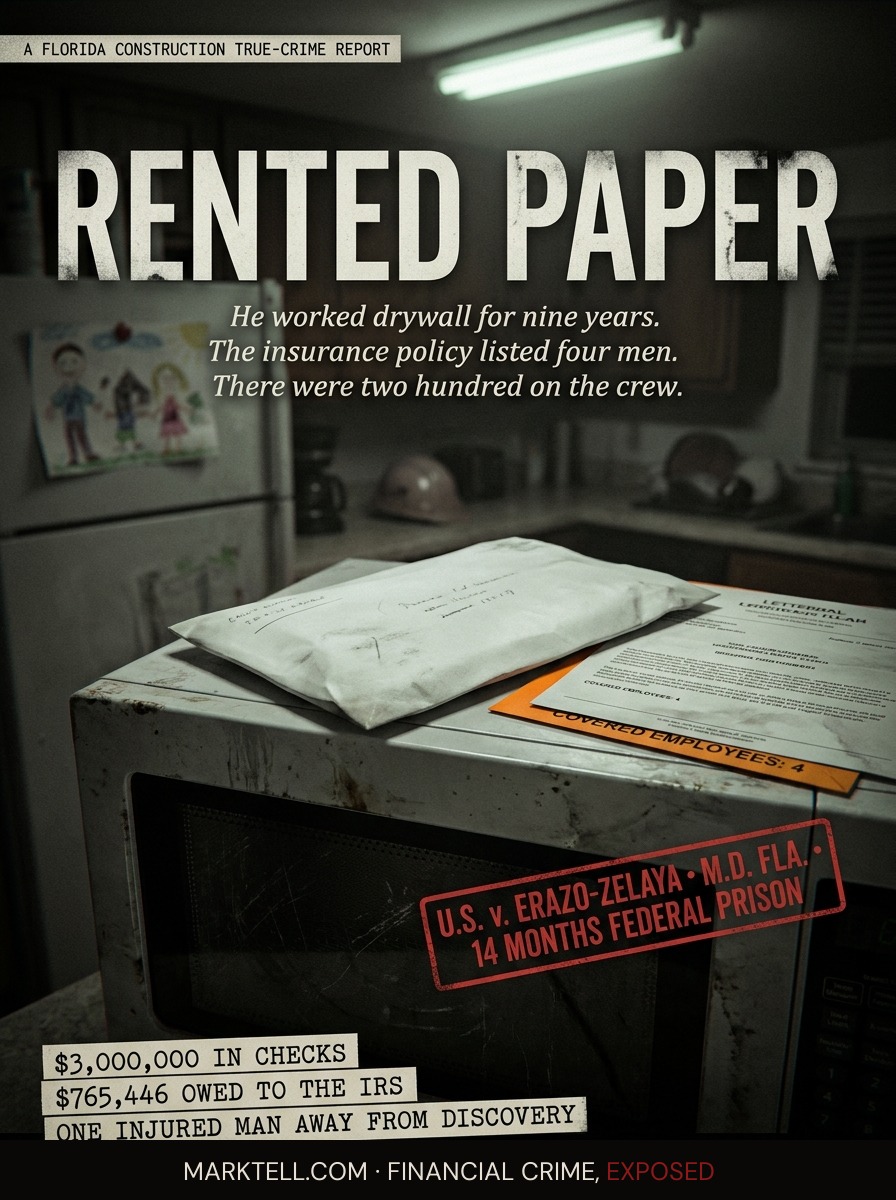
Marisol kept the envelope on top of the microwave because she did not know what else to do with it.
Her husband Hector worked drywall. He had worked drywall in Florida for nine years. On Friday afternoons he came home with cash. Sometimes a rubber band around the bills. Sometimes a white envelope from the check-cashing place on Orange Blossom Trail. Never a pay stub. Never a number she could write down.
She had asked, in the early years, who he worked for. He told her the name of the crew boss. Then the name of a company she could not pronounce. Then he stopped telling her, because she stopped asking. The cash came. The rent got paid. The boy started kindergarten. The cash kept coming.
She did not know that the company her husband technically worked for existed only on a piece of paper. She did not know that the workers' compensation policy that was supposed to cover him if he fell from a ladder was written for four men. She did not know that her husband and the forty other men on his crew were not on it.
She found out the way these things get found out. Slowly. Then all at once.
I.
The Shell
On June 10, 2026, a federal judge in the Middle District of Florida sentenced a 32-year-old Orlando man named Santiago Humberto Erazo-Zelaya to fourteen months in federal prison. He had pleaded guilty four months earlier, on February 9, to two conspiracy counts: tax fraud and wire fraud. The court ordered him to pay $765,446 in restitution to the Internal Revenue Service. It ordered another $26,720.12 to an insurance company. It entered a money judgment against him for $181,529, which the government identified as his cut of the proceeds.
His co-defendant, Gregorio Jose Fuentes-Zelaya, had already been sentenced. Thirty-three months.
The case, as the U.S. Attorney's Office described it, involved cashing roughly $3 million in payroll checks through a shell construction company. That is the number that goes in the headline. It is not the number that explains what happened.
The number that explains what happened is four. Or maybe six. The minimal payroll on the insurance policy. A handful of names listed as employees of a company that existed mostly as a registered agent address and a bank account that could accept checks.
That policy was the asset. The whole scheme ran on it.
II.
The Rented Certificate
Here is how the work actually moved.
A general contractor in Florida wins a job. Framing, drywall, concrete, whatever. The contractor needs subcontractors. The subcontractors need to show two things: a tax ID and proof of workers' compensation insurance. Florida law requires it. The general contractor's own insurance requires it. Nobody writes a check to a crew that cannot produce a certificate.
Workers' comp is expensive. In construction, it can run fifteen to twenty percent of payroll. Payroll taxes add another seven and a half percent on the employer side. A legitimate subcontractor running a crew of twenty men is paying out a quarter of every payroll dollar before any worker takes home a wage.
Erazo-Zelaya and Fuentes-Zelaya, according to the prosecution, found a way around the quarter.
They incorporated a shell company. They got it a workers' compensation insurance policy. The policy covered a small payroll. A few employees. Whatever number the underwriter would write without sending anyone out to look at a jobsite.
Then they rented the certificate.
A crew boss running framers in Polk County needs paper. The shell company provides paper. A certificate of insurance with the crew boss's job listed as covered work. The general contractor sees the certificate. Writes the payroll check to the shell company. The check gets cashed. Erazo-Zelaya keeps six percent. The crew boss gets the rest in cash and pays his men.
No payroll taxes withheld. No Social Security contributions. No Medicare. No unemployment insurance premiums. No real workers' comp coverage for the men actually swinging hammers, because they are not on the policy. The four names on the policy are doing nothing. The two hundred men whose wages are passing through the shell are invisible to every system that is supposed to count them.
The certificate of insurance, the prosecution alleged, was the entire machine.
Read that slowly. One PDF, passed crew to crew like a library card. One policy covering a fictional payroll while a real payroll of millions ran underneath it.
III.
What Marisol Did Not Know
Hector did not work for the shell company. He had never heard the name of the shell company. He worked for a crew boss named Beto who picked him up at five in the morning at a Wawa parking lot off Semoran.
Beto carried the certificate. When a general contractor asked, Beto produced it. The certificate said Hector was an employee of a company in Orlando that had a workers' comp policy. The certificate was true on its face. The certificate was a lie about the world.
On Fridays, the general contractor wrote a check to the company on the certificate. Erazo-Zelaya, according to the prosecution, took those checks to a check-cashing storefront. The kind with plexiglass and fluorescent light and a line at four in the afternoon. He cashed them. He kept six percent for himself and his co-defendant. He handed the rest to Beto. Beto handed envelopes to his men.
Marisol's envelope went on top of the microwave.
She thought it was a normal job. She thought the IRS would eventually send a letter about taxes Hector owed and she would figure out how to pay them. She thought if Hector fell from a ladder, there was insurance.
The math the federal government did, after the fact, found that approximately $3 million in checks moved through this shell. The conspirators kept approximately $181,500. The IRS was out an amount the court set at $765,446. An insurance company was out $26,720.12, which is the size of a single workers' comp claim. One claim. One injured man. That is how this kind of scheme tends to surface.
Someone falls. Someone gets hurt. Someone files a claim. The insurer pulls the policy and looks at it for the first time in detail and sees four names where the claim says there should be eighty. The insurer denies the claim. Then the insurer makes a phone call.
That is the moment the machine becomes visible.
IV.
The Bigger Room
Erazo-Zelaya's scheme is small. Three million dollars is a rounding error in the Florida construction economy. Three weeks before his sentencing, on May 23, two other Orlando residents were sentenced in a separate scheme that prosecutors valued at $148 million. Same structure. Shell labor arrangements. Tax evasion. Workers' comp evasion.
Two weeks before that, federal prosecutors announced a seventeen-year sentence in a $38 million off-the-books payroll case.
On June 8, two days before Erazo-Zelaya's sentencing, the Treasury Department's Financial Crimes Enforcement Network issued an advisory. The advisory warned banks and insurers about labor broker fraud in construction. It noted that financial institutions had filed suspicious activity reports flagging more than $2.5 billion in payroll-broker activity in 2025 alone.
Estimated federal tax losses from construction payroll fraud, by some measures, exceed two billion dollars a year. State workers' comp funds face similar shortfalls.
The shell company is the wrapper. The certificate is the lock. The check-cashing storefront is the door. The cash is what passes through.
It is the same machine. It has been the same machine for a long time. Erazo-Zelaya's contribution was small. He cashed checks. He kept six percent. He went to federal prison for fourteen months and will be deported to Honduras when he gets out.
The crew bosses who rented his certificate are mostly not named in the file. The general contractors who accepted the certificate are not named either. Whether they knew, whether they should have known, whether the certificate looked real enough that a reasonable person would not have asked: those are the questions the indictment does not answer.
V.
What Hector Lost
Hector did not fall from a ladder. He was lucky.
But the years he worked through that shell company are years that do not exist in the federal record. No Social Security credits accrued for those wages. When he retires, the benefit will be smaller than the work he did. If he applies for unemployment when a project ends, the system will show no employer. If he gets hurt next week on a job covered by the same kind of certificate, he will discover that the policy did not include him.
Marisol, on the Friday after the news of the sentencing crossed her phone in Spanish, did not connect it to her husband. The name of the company in the press release did not match the name on any document she had ever seen. There was no document. There was only the envelope.
That part may be the saddest. The men whose wages passed through that shell are not victims in the indictment. The indictment names the IRS. The indictment names an insurance company. The indictment does not name the workers, because in the eyes of the system the workers were never there.
The shell company existed. The men did the work. Only one of those two facts is in the federal record.
The fourteen months Erazo-Zelaya will serve is the price the government attached to making the men invisible. The men are still invisible. The next certificate is already in someone's pocket.
The envelope is still on top of the microwave.
- U.S. Attorney's Office, Middle District of Florida | June 10, 2026 | Sentencing announcement, United States v. Santiago Humberto Erazo-Zelaya
- U.S. Department of Justice | February 9, 2026 | Plea agreement, Erazo-Zelaya
- U.S. Department of Justice | Prior sentencing | United States v. Gregorio Jose Fuentes-Zelaya (33-month sentence)
- FinCEN | June 8, 2026 | Advisory on labor broker and payroll fraud in the construction industry
- U.S. Attorney's Office, Middle District of Florida | May 23, 2026 | Sentencings in $148M Orlando construction payroll scheme
- U.S. Department of Justice | June 7, 2026 | $38M off-the-books payroll scheme sentencing (17-year sentence)
- Orlando-News.com | June 2026 | "Orlando man sentenced to federal prison for $3M construction payroll scheme"
Editorial Notice
MarkTell is a true crime publication about financial fraud. Some scenes, dialogue, and sequential details are reconstructed from court filings, enforcement actions, news reports, and public records. Where the public record does not provide exact details, editorial reconstruction is used to convey the documented pattern of events. Names of private individuals may be changed to protect identity. All factual claims are sourced to public documents cited in the Evidence Trail above. MarkTell does not provide investment, legal, or financial advice. Nothing published here constitutes a recommendation to buy, sell, or avoid any investment. Allegations described in active cases have not been adjudicated and defendants are presumed innocent until proven guilty. Readers should conduct their own due diligence before making financial decisions.