The CEO who chased his losses with a clinic's checkbook
Patrick Bucknum ran a network that paid the bills for eleven Washington clinics. For six years, the federal complaint says, he ran the clinics' money through his own brokerage account instead.
Marisol got to the front desk at 7:14 on a Tuesday in October 2023, the way she had for twenty-one years. Lanyard around her neck. The photo of her granddaughter clipped behind the badge. She turned on her monitor and opened the schedule. Twelve well-child visits. Four prenatals. A diabetes follow-up at 11:30 with a man who always brought his own pen.
The regional director walked in at 9:40 and asked the staff to gather in the break room. Marisol remembers the word she used.
Irregularities.
That was all anyone got that day. The CEO of the network that paid their bills had resigned. There were irregularities at the parent company. Operations would continue. Paychecks would clear. Please do not speak to the press.
Marisol did not speak to the press. She went back to the front desk and called the 11:30 to confirm. She did not yet know that the word irregularities, in the mouth of a regional director, was a thirty-million-dollar word.
I.
Community Clinic Network was not a clinic. It was the office that paid the clinics' bills. Eleven of them, scattered across Washington State, serving the kind of patients who sometimes hand over a Medicaid card and sometimes hand over nothing at all. CCN managed the payment contracts. CCN ran the wires. CCN signed the checks.
Patrick Alan Bucknum was the CEO. He was fifty-five. Before CCN he had been the CEO of Columbia Valley Community Health from 2010 to 2016, which was one of the eleven clinics CCN served. He moved up the hallway, not out of it. The man who used to run one of the clinics now ran the office that paid all of them.
He controlled the finances. He initiated the wire transfers. He wrote the checks.
According to the plea agreement filed in the Eastern District of Washington, beginning in April 2017, Bucknum began moving CCN's money into his personal brokerage account. Stocks. Options. Exchange-traded funds. He had seen videos online about aggressive trading. He decided he could make the money grow and put it back before anyone noticed.
This is the story he told.
II.
The DOJ release describes a pattern that anyone who has worked a fraud desk recognizes on sight. Chasing losses. The first trade goes bad. To make the principal whole, you take more. The second trade goes bad. To cover the first and the second, you take more.
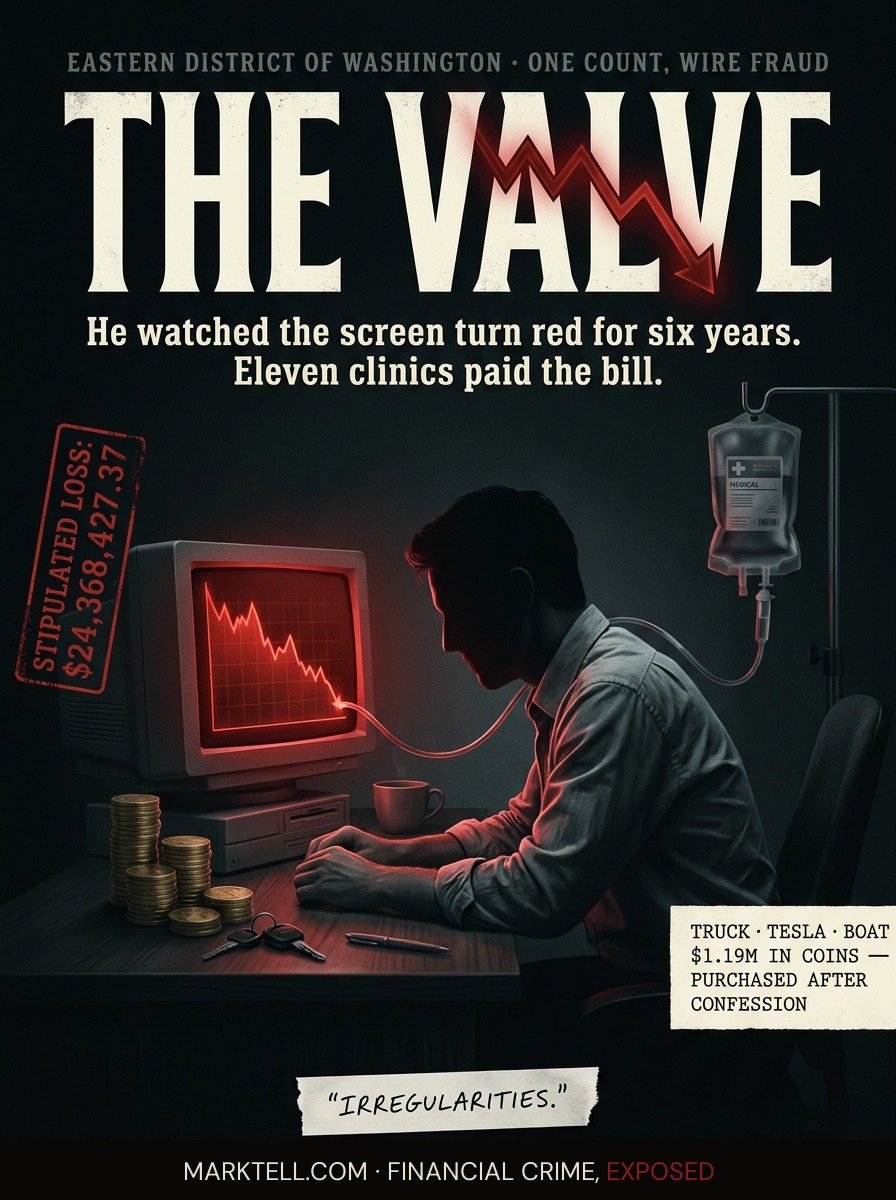
The federal release says he moved approximately $30 million out of CCN's accounts over six years. He returned approximately $7 million. The net loss to CCN is stipulated in the plea at $24,368,427.37.
Read that number slowly.
$24,368,427.37.
The cents are there because the plea document is a ledger and ledgers carry cents.
In 2019, according to the government's recitation of facts, Bucknum met with an attorney. The losses by then were what the release calls insurmountable. He had a window. He could have walked into the boardroom and said the thing out loud. He chose not to.
He kept the valve open.
III.
Marisol did not know the valve existed. Nobody at her clinic did. The front desk does not see the wire transfers. The front desk sees the schedule and the co-pays and the woman in the waiting room with the toddler who has an ear infection.
What the front desk sees is the inside of the room. What Bucknum was doing was outside the room, in a different room, at a different desk, watching a different screen.
The screen was red most days. That is what chasing losses looks like. Red, then a small green, then red again. Refresh. Refresh.
In March 2023, the government says, he made one last attempt. He transferred an additional $5 million from CCN into his investment account. He was going to win it back.
He did not win it back.
IV.
The money that was not invested went into the things people buy when they have stopped pretending.
A pickup truck for $100,000.
A Tesla for $77,000.
A boat for $33,000.
And in August 2024, after he had already resigned, after he had already told the board, after the federal investigators were already in the building, $1,199,000 in gold, silver, and platinum coins.
Read that sequence again. The coins came after the resignation. The coins came after the admission. The plea agreement requires him to forfeit them.
The forfeiture list reads like an estate sale of a man who knew time was short.
V.
He resigned in October 2023. He told CCN's board he had embezzled from the company. The FBI took the case. The U.S. Attorney's Office for the Eastern District of Washington filed it. First Assistant United States Attorney Pete Serrano announced the plea on June 25, 2026.
One count of wire fraud. Sentencing is set for September 23, 2026.
The plea is part of what the DOJ is calling the 2026 National Health Care Fraud Takedown. Four hundred and fifty-five defendants. Forty-five states and territories. Over $6.5 billion in alleged schemes. Bucknum is one name on a long list. The list includes a $1 billion wound allograft scheme and a $110 million telemedicine fraud. His $24 million is, in that company, midsize.
That part may be the saddest. The number that would have funded a clinic for a year is, in the federal accounting of healthcare fraud, midsize.
VI.
Picture Marisol on the day the news ran. She was at her kitchen table. Her granddaughter was at the other end of it, coloring. She read the press release on her phone. She did not read it twice. She did not need to.
She thought about the patient last March who had asked if the clinic would still be open in a year. She had told him yes. She had meant it. The clinic was still open. The clinic is still open. The money to keep the clinic open had been, for six years, partially on loan to a man watching a screen turn red.
She put the phone down. She did not say anything to her granddaughter.
VII.
The machine in this case is small and old and almost boring. One man. One signature authority. One brokerage account. No co-signer. No second set of eyes. No quarterly comparison of operating-account outflows to the vendor ledger that would have shown a delta the size of a small clinic's annual budget.
This is not a sophisticated fraud. This is what happens when you give one person the valve and you do not watch the valve.
The DOJ release does not tell us why nobody watched. The board, somewhere, has its own story to tell about that. They have not told it publicly yet.
Some of them may not know yet that they have one to tell.
VIII.
Bucknum told the attorney in 2019. He kept going for four more years.
That is the part of the file that does not soften with time. By 2019 he knew the math would not come back. He could have stopped. He could have walked into the room and named the number. Instead he made the trades smaller and the lies bigger. He bought the boat. He bought the Tesla. He bought the truck. He bought the coins after he had already confessed.
He was not chasing losses by then. He was furnishing a life he knew he was about to lose.
That is the renaming. It was not chasing. It was packing.
The valve was open the whole time. The valve was open because he was the one watching it.
He pleaded guilty on a Wednesday. The clinic was open on Thursday. Marisol checked in the 11:30 the way she always did.
She did not yet know what the word irregularities meant. She knows now.
- U.S. Department of Justice, U.S. Attorney's Office, Eastern District of Washington | June 25, 2026 | Press release announcing guilty plea of Patrick Alan Bucknum
- Plea Agreement, United States v. Bucknum | June 24, 2026 | Filed Eastern District of Washington
- DOJ National Health Care Fraud Takedown 2026 | June 2026 | DOJ announcement
- Source ONE News | June 25-26, 2026 | "Former Wenatchee Health Care Executive Pleads Guilty To $24 Million Wire Fraud Scheme"
- Washington Attorney General's Office | December 2025 | Confluence Health refund agreement (background context only)
- Fitch Ratings | May 2026 | Confluence Health rating affirmation (background context only)
Editorial Notice
MarkTell is a true crime publication about financial fraud. Some scenes, dialogue, and sequential details are reconstructed from court filings, enforcement actions, news reports, and public records. Where the public record does not provide exact details, editorial reconstruction is used to convey the documented pattern of events. Names of private individuals may be changed to protect identity. All factual claims are sourced to public documents cited in the Evidence Trail above. MarkTell does not provide investment, legal, or financial advice. Nothing published here constitutes a recommendation to buy, sell, or avoid any investment. Allegations described in active cases have not been adjudicated and defendants are presumed innocent until proven guilty. Readers should conduct their own due diligence before making financial decisions.