The cash, the burner phones, and the brokerage office in December
A former Daishin Securities department head, an influencer's husband, and a man who reportedly compared himself to the lead of a Korean heist film were indicted this week in Seoul. The prosecution says the scheme used cash in a bag, burner phones, and dozens of borrowed-name accounts to move a single KOSDAQ stock.
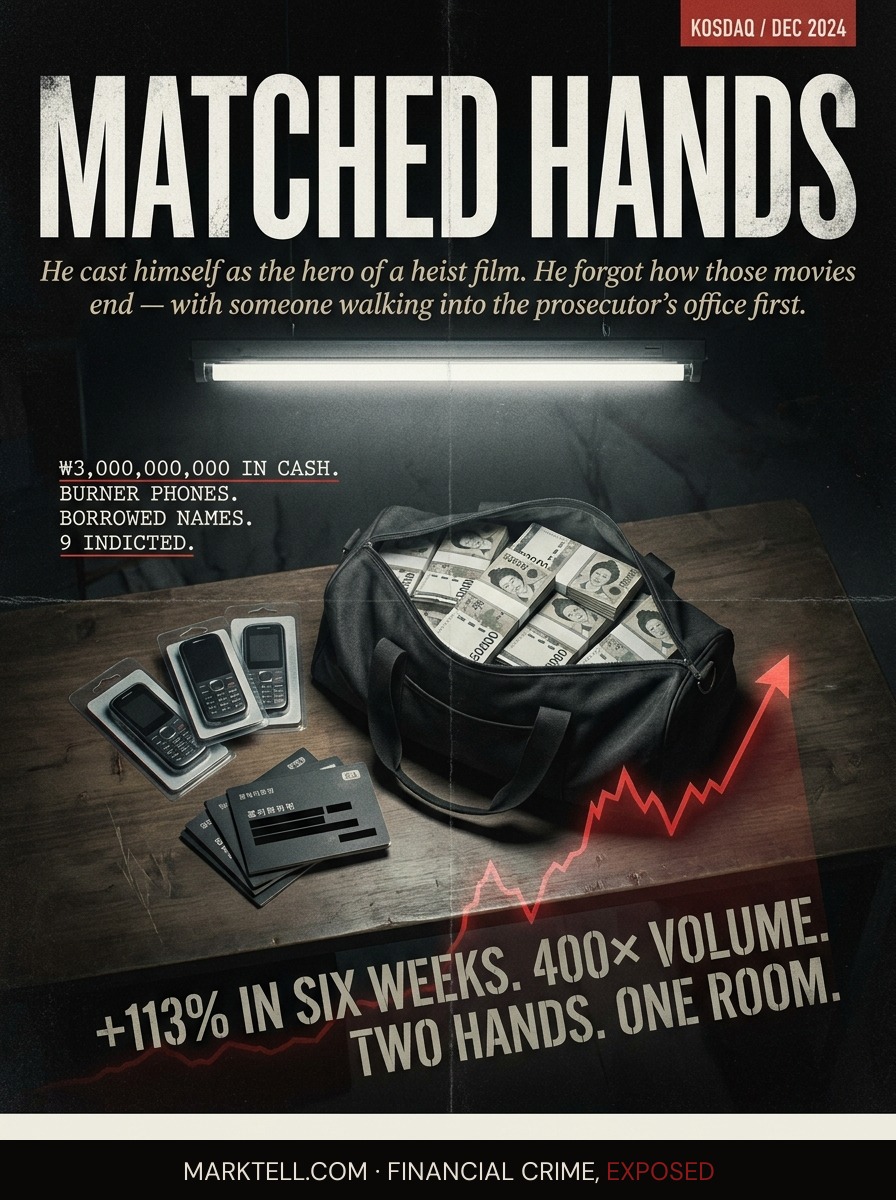
The bag arrived at a Daishin Securities office in December 2024. Inside, according to the prosecution, was three billion won in cash, about $2.2M USD at the time, along with a stack of bank accounts opened in other people's names and a set of burner phones. That is what the Seoul Southern District Prosecutors' Office says was delivered, in person, into the building of a licensed brokerage, three weeks before the manipulation began.
Picture that for a moment.
Not a wire. Not a transfer with a memo line. A bag. Phones still in their boxes. Account books that belonged to people whose only role in this story was that they let someone else use their name.
The man who allegedly carried the operation, the prosecution calls him Kim, reportedly told people he was the protagonist of a 2009 Korean heist film called The Scam. That detail is not from a wiretap. It is from how the prosecution has described him in briefings to Korean media this week. A man who allegedly cast himself as the movie version of his own crime.
I.
The company at the center of this case has not been named. Korean filings refer to it only as Company A. It traded on the KOSDAQ, the smaller of South Korea's two main exchanges, the one where the smaller and newer companies live. On January 14, 2025, Company A's shares closed at 1,926 won, roughly $1.40 USD. Six weeks later, on February 24, they closed at 4,105 won, about $2.95. That is a price increase of roughly 113 percent. During the same window, daily trading volume in the stock rose, at peak, to four hundred times its prior level.
A four-hundred-fold spike in volume is not interest. It is not discovery. It is, the prosecution alleges, two hands clapping inside the same room and calling it applause.
The mechanism is one of the oldest in any equity market. It has a Korean name, 통정매매, and an English one: matched orders, or prearranged trades. You open a buy order at 10:14 a.m. for a specific price. Someone you are coordinating with opens a sell order at 10:14 a.m. for the same specific price. The trade prints. The tape shows volume. To anyone reading the screen, it looks like the market just spoke. It did not. Two accounts that answered to the same person spoke to each other.
To do this convincingly, you need accounts that do not look like they belong to the same person. That is what a borrowed-name account is. In Korea it is called a 차명계좌. Someone else's name on the paperwork. Someone else's resident registration number. Your hand on the keyboard.
The prosecution alleges that the nine indicted defendants moved roughly 28.9 billion won in Company A's stock through accounts like these. About $21M USD in trading volume. Around 8.44 million shares. From that activity, they allegedly extracted at least 1.4 billion won (about $1M USD) in profit.
That is the headline number. The number nobody has put on paper yet is the loss carried by the retail buyers who saw the volume on their phones, saw the green, and bought into the climb.
II.
The indicted are nine people. The investigation identified ten. Three are in custody. Six were indicted without detention or through summary proceedings. The roles, as Korean prosecutors have described them:
Kim, the alleged overall organizer. The one who reportedly liked the comparison to the heist film.
Jeon, a former department head at Daishin Securities. The prosecution calls him the key player in the actual trading. The hand on the order book. He is the one whose former job title gives this case its weight, because the matched orders did not have to be guessed at by an outsider trying to learn how a Korean brokerage's order routing works. They were placed by a man who had spent his career inside one.
Lee, described in Korean reporting as a businessman and the husband of a social media influencer. The prosecution alleges that Lee's role was sourcing the funds and the borrowed-name accounts, and using his network to spread favorable stories about Company A while the price was moving. Lee is also separately accused of bribing a former team leader at the Gangnam Police Station's investigation division, a man identified as Inspector Song, and a superintendent at the National Police Agency. The bribes, the prosecution alleges, were intended to suppress two unrelated criminal matters: a fraud case involving Lee's wife, and a case involving one of his alleged accomplices in the stock manipulation itself.
Among the others indicted is a professional soccer player. Korean media has not yet named him.
Read that lineup again. A former brokerage executive. A man with a public-facing spouse. An athlete. An organizer who saw himself as a film character. This is the cast of a pump that needed credibility on the outside and operational skill on the inside. The brokerage veteran knew how to move the stock without tripping the surveillance. The husband-of-an-influencer knew how to move the story. The athlete and the rest gave the cap table the human variety it needed to look like a real shareholder base instead of one man's puppet show.
III.
The case is also a milestone for a reason that has nothing to do with Company A.
The investigation, prosecutors have said, was opened on the basis of a leniency application filed under Korea's voluntary-reporter penalty reduction program at the Supreme Prosecutors' Office. It is the first time that program has produced a stock manipulation case.
In plain English: someone inside the operation walked into the prosecution's office and offered to tell the story in exchange for a lighter sentence. The Korean securities enforcement world does not yet have the long American tradition of cooperators. This is the first one in this lane.
The implication for everyone running a similar machine right now is simple. The person sitting next to you at the meeting in December 2024 may already have been to the Supreme Prosecutors' Office. You will not know which one. That is how the program is designed.
IV.
The week this indictment landed was not a quiet week for Korean financial enforcement.
On May 6, 2026, the National Tax Service announced a probe of 31 companies, including 15 listed on the KOSDAQ, for unfair trading practices including price manipulation, related-party tunneling, and unauthorized investment advisories. The estimated tax-evasion exposure across those companies, by the NTS's own number, is two trillion won (about $1.37B USD).
The Korea Exchange has spent the last six months tightening the bolts on its own surveillance. In January 2026, the minimum market capitalization required to remain listed on the KOSDAQ was raised from 4 billion won to 15 billion won (from roughly $2.9M USD to about $11M USD). That change matters to the Company A pattern because the most reliable victims of a matched-order pump are companies floating just above a delisting threshold, where a price move looks like a survival rally rather than a manipulation. Raise the threshold and the universe of pump candidates does not shrink. It simply moves.
The pattern has not stopped. It is only moving.
V.
Nobody has named the retail buyers of Company A. They are not party to this indictment. They are present in the math.
If 8.44 million shares moved through the manipulation, and the price doubled and then partly held while it did, then a meaningful fraction of those shares ended their journey not in the manipulators' accounts but in the accounts of people who saw the chart on a Tuesday morning, decided this was the one, and clicked buy. Some of them, on the day this indictment was announced, are still holding. Some of them, when they read the news this week, learned for the first time what the volume on their screen had actually been.
That part may be the saddest. The volume looked like a market. It was two people with the same hand on both sides of the trade.
VI.
The prosecution has said publicly that it intends to seek confiscation not only of the 1.4 billion won in alleged illicit gains, but of the principal funds used to run the operation. That is an unusually aggressive posture in a Korean securities case. It is the prosecution saying, in the only language a manipulation crew responds to, that the cost of running this machine should not be the profit. The cost should be the float.
Whether the court agrees is the next chapter.
What is already in the record is the bag of cash, the borrowed names, the burner phones, and a price chart that climbed 113 percent in six weeks because two hands inside one room kept clapping at each other.
He thought he was the protagonist of a heist film.
In a heist film, somebody walks into a prosecutor's office first.
- Chosun Ilbo | May 7, 2026 | "Prosecution Indicts Nine in KOSDAQ Stock Manipulation Scheme"
- Seoul Southern District Prosecutors' Office, Financial and Securities Crime Joint Investigation Unit | May 2026 | indictment briefing as reported in Korean media
- Korea National Tax Service | May 6, 2026 | announcement of probe into 31 companies for unfair trading practices
- Korea Exchange | January 2026 | revised KOSDAQ market capitalization delisting standard (4B KRW raised to 15B KRW)
- Supreme Prosecutors' Office of Korea | leniency program for voluntary reporters in financial crime cases (program description, first application of the program to stock manipulation as cited by SSDPO)
Editorial Notice
MarkTell is a true crime publication about financial fraud. Some scenes, dialogue, and sequential details are reconstructed from court filings, enforcement actions, news reports, and public records. Where the public record does not provide exact details, editorial reconstruction is used to convey the documented pattern of events. Names of private individuals may be changed to protect identity. All factual claims are sourced to public documents cited in the Evidence Trail above. MarkTell does not provide investment, legal, or financial advice. Nothing published here constitutes a recommendation to buy, sell, or avoid any investment. Allegations described in active cases have not been adjudicated and defendants are presumed innocent until proven guilty. Readers should conduct their own due diligence before making financial decisions.