The car in Dunwoody was the last document Christopher Burns ever filed
Christopher W. Burns disappeared on September 25, 2020, the day before he was supposed to hand documents to the SEC. Six years later, the FBI raised the reward to $150,000 and put him on a brand new list.
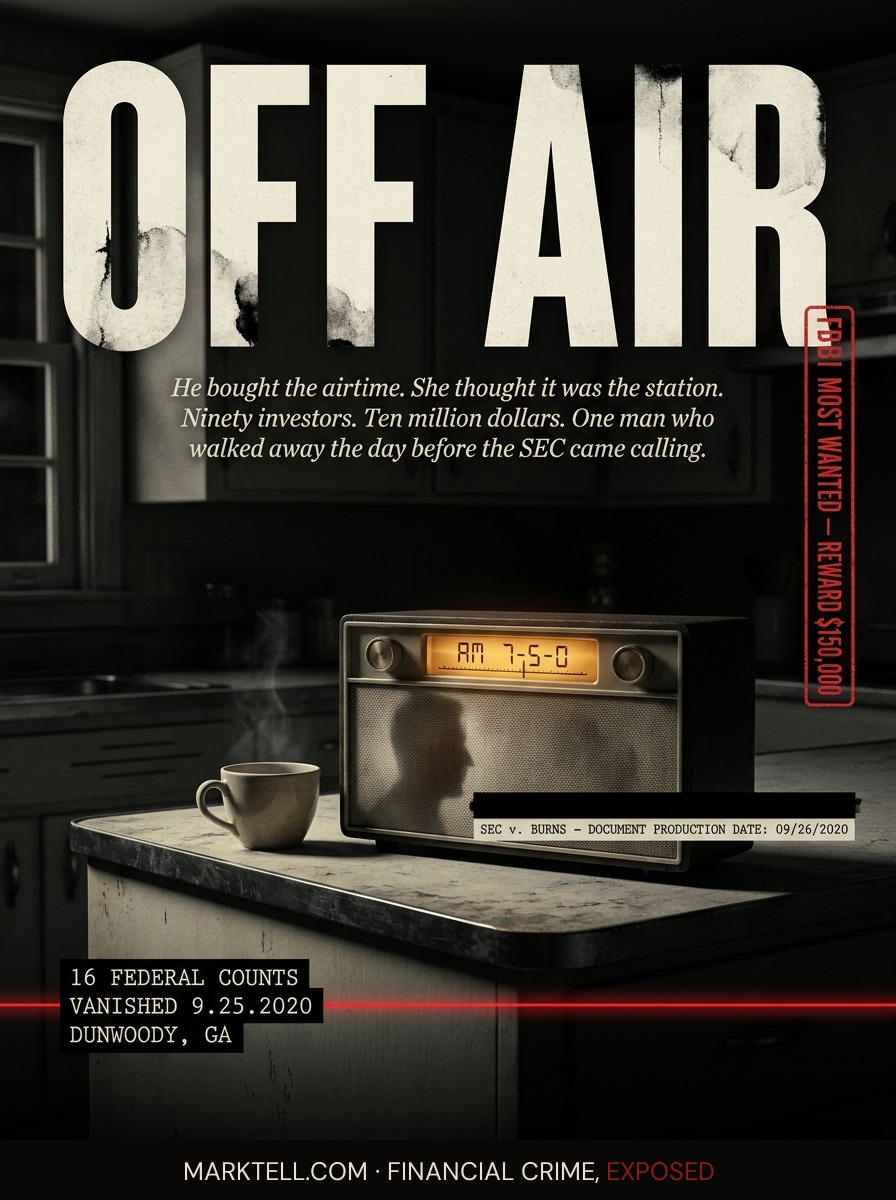
Marlene heard him on the radio first. That part matters.
She was sixty-eight the year she signed. Retired from thirty-one years in the front office of a public elementary school west of Atlanta. She drove a 2014 Camry and kept her late husband's reading glasses in the console because she had not yet decided what to do with them. On weekday mornings she made coffee and turned the kitchen radio to WSB, and that is where Christopher Burns lived for her, in the small speaker above the toaster, talking about money the way a neighbor would.
He was on WSB. He was not of WSB. He bought the airtime. That distinction is the entire opening of this story, and almost no listener in Atlanta knew it.
Marlene did not know it. What she heard was a voice that had a show on the same station that did the weather and the traffic and the Braves. That station felt like a vouch. She is not stupid. The reader needs to hear that clearly. The voice was placed inside a frame that had spent decades earning trust, and the voice paid to stand inside that frame.
She met him in a small office. She signed a promissory note. A promissory note is the simplest financial instrument in the world. It is a piece of paper that says I owe you money, and here is when I will pay it back, and here is the interest. She had signed one once for a car. This one was for a "peer-to-peer lending program." Her money, the pitch said, would be loaned out to small businesses, with collateral behind it. There was a rate. There was a maturity date. There was the voice from the radio across the desk, saying the word safe more than once.
The SEC complaint and the 2023 federal indictment allege that the collateral either did not exist or was significantly misrepresented. The indictment charges ten counts of wire fraud, two counts of mail fraud, and four counts of money laundering. None of it has been tried, because Christopher Burns has not been in a courtroom since.
He vanished on September 25, 2020.
He was scheduled, the next day, to turn documents over to the Securities and Exchange Commission. The IRS was also investigating. His vehicle was found abandoned in Dunwoody. The man who weighed about 240 pounds and stood six feet two, with brown hair and brown eyes and three interlaced black triangles inked on his left forearm, walked out of his life one day before the regulator's calendar caught him.
I.
The radio is the machine.
Not the promissory note. The note is just paper. The peer-to-peer language is just decoration. The machine, the one that fed the pipeline for years, was the paid airtime that let a private financial advisor sound like a public institution.
This is how it works. A broadcaster sells blocks of time to people who want to host programs. The host pays for the time. The host owns the content. The station owns the signal. To a listener in a kitchen with a coffee cup, the difference between an employee of the station and a man who rented the slot is invisible. The voice arrives through the same speaker. The call letters are the same. The trust transfers without anyone authorizing the transfer.
Burns, according to the public record, bought airtime on WSB Radio. He was not an employee. He had a show. The show was, in the language of broadcasting, brokered programming. In the language of fraud, it was a credentialing engine.
Picture it from Marlene's chair. The toaster clicks. The coffee is too hot to drink yet. The voice on the radio is explaining how a person on a fixed income can earn a better rate than the bank without taking on stock market risk. He uses the word secured. He uses the word collateral. He gives a phone number. The number rings into a small office. The office has a desk and a printer and a man who sounds exactly like the radio.
That is the machine. The pipe from speaker to signature.
II.
What the filings say.
The Securities and Exchange Commission alleges that Burns operated a Ponzi scheme through these notes. A Ponzi scheme is the oldest mechanism in private finance. It is not complicated. New investor money pays old investor returns. The "yield" is not a yield. It is the next person's principal arriving in time to cover the last person's interest check. The structure works until the inflow stops. When the inflow stops, the structure does not slow down. It ends.
According to the SEC and the 2023 federal indictment, the alleged loss is at least $10M across more than 90 investors in Georgia, Florida, and North Carolina. Court documents charge sixteen federal counts in total. Burns has not answered any of them.
Read the count list slowly. Ten wire fraud. Two mail fraud. Four money laundering. Each count is a separate alleged act. Each act is a separate alleged moment when a check moved or a wire cleared or a statement went into an envelope. Sixteen moments. At least.
III.
The day before.
The chronology is what makes this case sit in the chest the way it does.
September 25, 2020. Burns is scheduled to produce documents to the SEC the following day. He leaves. His vehicle is recovered in Dunwoody. He has not been seen since.
The SEC document date does not arrive at random. It is the end of a process that began months earlier with a subpoena and a calendar. A regulator does not show up unannounced. The target is told. The target has time to gather records. The target also has time to gather other things.
A document production date is a deadline that runs in two directions. Toward compliance. Toward flight.
Marlene did not know any of this on the morning of September 26. What she knew was that her advisor's phone went to voicemail. She left a message. She left another. The voicemail box filled. She drove past the small office once, the next week, and the lights were off.
That part may be the worst of it. Not the discovery. The interval between the call that did not connect and the eventual letter from a lawyer. The slow understanding, accumulated across days of unanswered phones, that the absence was not temporary.
IV.
What the FBI did this week.
On Thursday, June 4, 2026, the Federal Bureau of Investigation launched a new Most Wanted Fraudsters List. Christopher W. Burns is on it. The reward for information leading to his arrest and conviction is now up to $150,000.
The bureau's poster gives the physical description. Six feet two inches. About 240 pounds. Brown hair, brown eyes. The tattoo on the left forearm: three interlaced black triangles. It is the kind of detail that lives in the body, not the paperwork. A man can change his name. He cannot easily change the ink under his skin without leaving a different mark in its place.
The launch of the list is the news. The case underneath the list is six years old.
V.
What Marlene held.
She kept the note. People do. They keep the documents that hurt them, in a folder, in a drawer, in a box on a shelf in a hall closet. She kept the original promissory note, the subscription paperwork, two statements that arrived in the mail in 2019, and a printout of the WSB program schedule from a week she could no longer remember why she had printed it.
She kept these because they were proof that she had not imagined the room. The room had been real. The voice had been real. The signature on the note was hers and it was real. The man across the desk had been a person who existed in the world, on the radio, in Atlanta, and the documents were the only evidence that the encounter had happened at all.
The court will, someday, possibly, decide what those documents mean.
Right now they are just paper in a drawer in a kitchen in a house outside Atlanta.
VI.
The pattern.
If you are reading this because someone you love signed a note like Marlene's, here is what the machine looks like the next time it runs under a different name.
A familiar-sounding voice on a familiar-sounding platform. Radio. Podcast. Local television segment. YouTube. The platform did not vet the voice. The voice paid for the slot.
A private promissory note. Not a stock. Not a fund. A piece of paper between you and one person or one small company. There is no public market for it. There is no daily price. There is no broker statement from a custodian you have heard of. The note pays a rate that is meaningfully better than what your bank offers, and the explanation for the rate involves a word like collateral or secured or peer-to-peer.
A small office. An advisor who returns your calls quickly. Statements that arrive on time and look correct.
And then a regulator's date on a calendar somewhere, that you do not know about, that the advisor does.
The day before that date is the day the machine becomes visible. Sometimes the advisor stays and answers the questions. Sometimes the advisor's car is found in a parking area in Dunwoople and the phone goes to voicemail and stays there.
VII.
What is unresolved.
Burns has not been tried. The indictment is an allegation. The SEC complaint is a civil pleading. He has not had the chance to answer in court because he is not in court. Where he is, the FBI does not know. Whether he is alive, the FBI does not say.
The $10M figure is the floor, not the ceiling. Investigations of this kind tend to grow as more victims come forward. The 90 number is the number of investors the government has identified. It is not necessarily the number of investors who exist.
Marlene is still in the house outside Atlanta. The kitchen radio still works. She does not turn it on in the mornings anymore. She turns it on in the late afternoon, after the financial programs are over, when the station is doing the weather and the traffic and the Braves.
The voice she trusted left on a Friday in September of 2020.
The station is still there.
That was always the problem.
- WSB-TV | June 2026 | "FBI offering $150,000 reward for missing Georgia financial advisor accused of stealing millions"
- FBI | June 4, 2026 | Launch of Most Wanted Fraudsters List, Christopher W. Burns wanted poster and reward notice
- U.S. Department of Justice / Northern District of Georgia | 2023 | Federal grand jury indictment of Christopher W. Burns (10 counts wire fraud, 2 counts mail fraud, 4 counts money laundering)
- U.S. Securities and Exchange Commission | 2020 | Civil action and investigation materials concerning Christopher W. Burns and alleged peer-to-peer promissory note program
- Public reporting on Burns disappearance | September 2020 | Vehicle recovery in Dunwoody, GA; scheduled SEC document production date
- General industry data on financial advisor misconduct rates | Egan, Matvos & Seru research, "The Market for Financial Adviser Misconduct"
Editorial Notice
MarkTell is a true crime publication about financial fraud. Some scenes, dialogue, and sequential details are reconstructed from court filings, enforcement actions, news reports, and public records. Where the public record does not provide exact details, editorial reconstruction is used to convey the documented pattern of events. Names of private individuals may be changed to protect identity. All factual claims are sourced to public documents cited in the Evidence Trail above. MarkTell does not provide investment, legal, or financial advice. Nothing published here constitutes a recommendation to buy, sell, or avoid any investment. Allegations described in active cases have not been adjudicated and defendants are presumed innocent until proven guilty. Readers should conduct their own due diligence before making financial decisions.