The call came from Nagoya. The boy on the line was not her grandson.
A 39-year-old Japanese national identified only as Mr. Sasaki was arrested in Bangkok's Thonglor district on June 6 after running what Japanese prosecutors allege was a billion-yen call center empire out of Poipet, Cambodia. The voices on the phone were trafficked. The grandmothers on the other end were not.
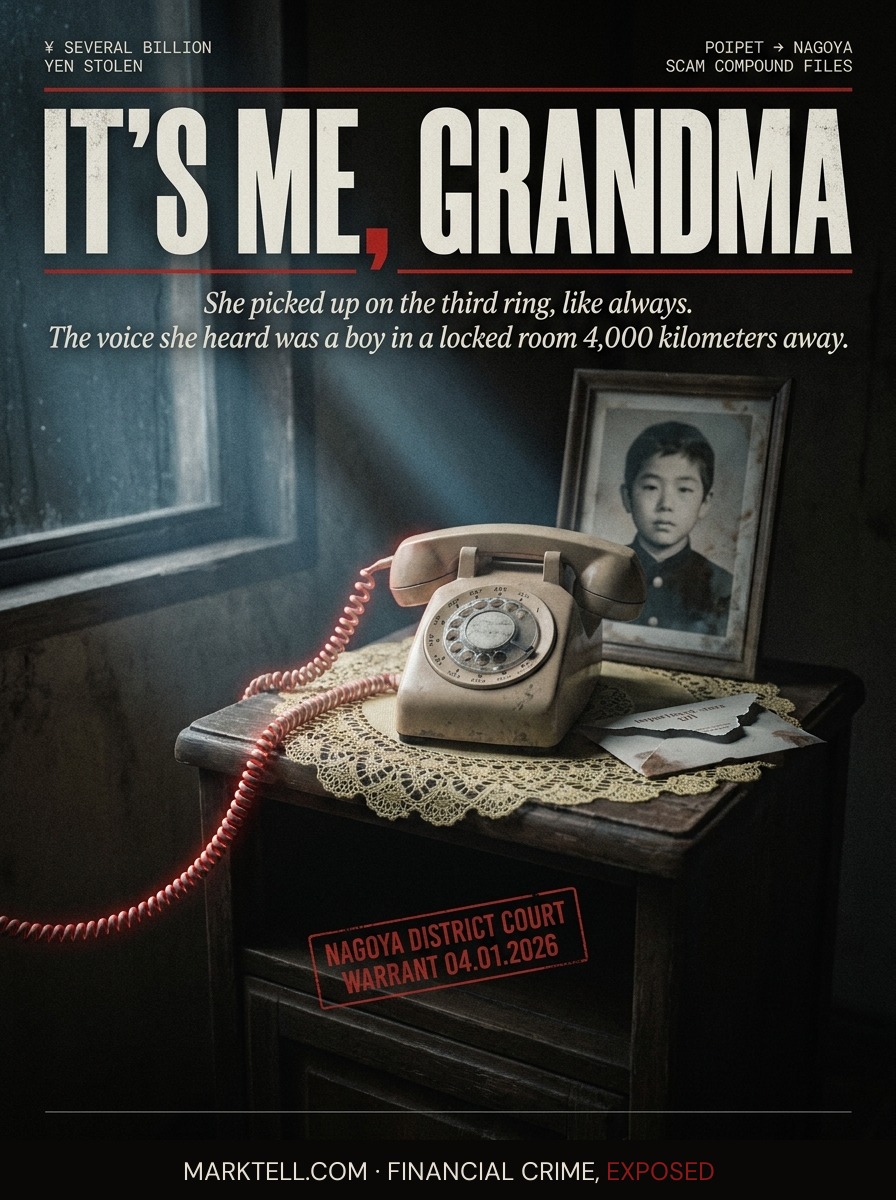
The phone rang at 2:40 on a Tuesday afternoon in Nagoya.
Yuriko was seventy-four. She had taught fourth grade for thirty-one years and had been a widow for eight. She lived alone in the house she and her husband bought in 1981, with the lace doily on the telephone stand and the bookshelf behind it where her grandson's school photos went up one a year, kindergarten through high school.
She picked up on the third ring because she always picked up on the third ring. The voice on the other end was a young man's, breathing hard.
"Grandma. It's me. I'm in trouble."
She did not hear Poipet. She did not hear the fluorescent hum of a room with sixty desks and scripts taped to the monitors. She did not hear the man behind the boy whose voice it was, the man who would, on a bad day, hit him for stumbling on a line. She heard her grandson. She heard a boy she had bought New Year's gifts for since the year he was born.
She said his name.
The voice said yes.
That is where the machine begins. Not with a wire. With a name.
I.
This past Saturday, June 6, 2026, Thai police walked into a condominium in Bangkok's Thonglor district and arrested a 39-year-old Japanese national the Thai Examiner identified only as Mr. Sasaki. The Royal Thai Police's Anti-Human Trafficking Centre coordinated the arrest with Japanese counterparts. The warrant had been issued by the Nagoya District Court on April 1, 2026. The charge is fraud. The allegation, according to Japanese and Thai authorities, is that Sasaki was a senior commander of a transnational call-center fraud operation based in Poipet, Cambodia, that targeted Japanese citizens and produced losses Japanese authorities have described as several billion yen, which is to say several tens of millions of U.S. dollars at minimum, and likely more.
Poipet is a Cambodian border town across from Thailand. It used to be casinos. After Cambodia banned online gambling in 2019, and after COVID broke the tourist economy, the buildings stayed but the business changed. The casinos became compounds. The compounds became what the United States Treasury, in its April 2026 sanctions action, called the scam-compound industry.
A scam compound is a building, sometimes a complex of buildings, behind a wall. Inside the wall are dormitories, a cafeteria, and floors of desks with computers and phones. The workers at the desks are usually not from Cambodia. They are from China, Vietnam, Thailand, Malaysia, India, the Philippines, Japan, sometimes Africa, sometimes Europe. Many of them answered job ads for customer service work in Bangkok or Singapore. They flew in. Their passports were taken at the airport pickup. They were driven across a border they did not know they were crossing. By the time they understood where they were, the door locked from the outside.
The U.S. State Department, the United Nations, and multiple NGOs have documented this. Cambodia's scam-center economy is estimated to generate around $12.5 billion a year, which researchers have suggested may account for as much as 35 percent of the country's formal GDP. Between 100,000 and 150,000 people are estimated to be inside the compounds against their will.
That is the room the boy's voice came from.
II.
The Japanese have a name for what happened to Yuriko. They have had a name for it for more than twenty years. Ore ore sagi. It means, roughly, "it's me, it's me" fraud. The script is always the same. The grandson, the nephew, the son. He is in trouble. A car accident. A pregnant girlfriend. A lost company envelope full of cash. He needs money today. A lawyer will call. A colleague will come pick it up.
The Japanese National Police Agency has been publishing warnings about this since the early 2000s. The warnings are on posters in post offices. The warnings are on the back of bank receipts. Yuriko had seen them. She would have told you, before that Tuesday, that of course she knew about ore ore sagi. Of course she would never fall for it.
The machine knows that. The machine is built for people who know.
The reason the machine works is not that the mark is stupid. The mark is never stupid. The mark is a grandmother who has not heard her grandson's voice in three months because he is busy at university and does not call as often as he used to, and the voice on the phone is panicked, and panic compresses the ear. Her brain fills in the missing frequencies with the boy she remembers. The script is designed to give her brain just enough to fill in.
The "lawyer" who called Yuriko twenty minutes later spoke in the calm, slightly bored tone of a man handling an unfortunate but routine matter. He used legal-sounding words. He gave a fake bar registration number. He told her a courier would meet her at the west exit of Nagoya Station at 5:15 to collect the cash for the settlement, because the bank transfer would take too long and her grandson needed the matter resolved today.
She withdrew the money. She put it in a department-store gift envelope because she did not have anything else. She walked to the station. She handed the envelope to a young man in a black hoodie who did not look her in the eye. He bowed quickly and walked away.
The courier was a mule. The mule passed the cash to another mule. The cash was deposited in pieces under transaction-reporting thresholds, converted, and moved out of Japan. Where exactly it went, Japanese prosecutors will spend the next year trying to trace. What is alleged is that the top of that chain, or near the top, was Sasaki.
III.
Here is what is documented about how Sasaki allegedly ran the operation, based on Thai police statements and Japanese press reporting.
He moved. He traveled to China, Malaysia, and Vietnam. He used Bangkok as a base because Bangkok has the airports, the condos, the anonymity of a city of eleven million people, and a border two hours away. The Thonglor district where he was arrested is full of glass towers with doormen and elevators that ask you for a key card. It is where you live in Bangkok if you do not want to be found and you have the money not to be.
The compound in Poipet was, according to Japanese authorities, a fraud factory specializing in the Japanese market. The workers were Japanese speakers, recruited or coerced. The targets were Japanese elderly. The product was the voice of a grandson. The raw material was the script.
On May 12 of this year, less than a month before Sasaki was arrested, Cambodian authorities raided a scam operation in Phnom Penh and rescued a Japanese national who was later identified as a trafficking victim. Sixteen people, Chinese and Vietnamese, were detained. That raid was not, as far as the public record shows, directly connected to Sasaki's operation. But it was the same machine in a different building.
Read that slowly. The same machine in a different building.
That is the thing about a machine. One arrest does not stop it. One compound raid does not stop it. The Cambodian parliament passed a law in March 2026 that on paper carries life sentences for running a scam compound. The U.S. Treasury, in April, sanctioned 29 targets in Cambodia including a sitting senator, Kok An, accused of providing infrastructure to the industry. The U.S. Department of Justice charged two Chinese nationals who had managed a Myanmar compound and were trying to relocate operations to Cambodia when Thai police picked them up.
This is what an offensive against an industry looks like. Sasaki is one arrest inside it.
IV.
Yuriko found out two days later, when she called her grandson to ask if everything had been resolved.
He answered on the second ring. He was at the library. He sounded confused. He had not been in a car accident. He had not called her. He had not asked her for money.
She did not say anything for a long time. He had to ask her twice if she was still there.
She told him the story slowly, because she was trying to understand it as she said it. The voice. The lawyer. The envelope. The station. The boy in the hoodie. She used the phrase "your voice" three times. She kept correcting it. The voice that sounded like your voice. The voice I thought was your voice.
He took the train down from Tokyo that night. They went to the police the next morning. The officer who took the report did not look surprised. He had taken three reports like it that week.
The amount Yuriko handed over was the amount she had been keeping for the renovation she and her husband had talked about doing to the kitchen before he got sick. She had not done the renovation. She had been saving it because doing it felt like admitting he was not coming back.
That part may be the saddest.
V.
What was lost is not only the money. The money is recoverable in theory, in the sense that the legal system has a theory of recovery. What is not recoverable is the phone.
Yuriko still has the beige landline on the lace doily. It still rings. When it rings, her hand stops before it reaches the receiver. She picks up now on the fifth ring, not the third, because she wants to hear the silence before the voice, the way a person who has been bitten once stands a little farther from the dog.
When her actual grandson calls, she asks him a question only he would know the answer to. She does it as a joke. He plays along. They both know it is not a joke.
The compound in Poipet, as of this writing, has not been raided. The room with the desks and the scripts and the door that locks from outside, if the allegations are accurate, is still running. The boy whose voice spoke to Yuriko, if he existed and was who Japanese authorities believe he was, is still inside it, or he has been moved, or he has been replaced.
Sasaki is in custody. The Nagoya District Court will receive him on extradition. Whatever the charges become at trial, those are charges, not findings. Allegation is not adjudication.
But the machine he is alleged to have run is not in custody. It is an industry. It has lawyers. It has senators. It has $12.5 billion a year in revenue and the protection that revenue buys. It has, by the most credible estimates, more than 100,000 people locked inside its compounds reading scripts to grandmothers in a dozen languages.
The grandson she heard on the phone was somebody. He was just not hers.
That is the chapter. The voice she trusted was real. It just belonged to a boy on the other end of a script, in a building she could not picture, working for a man she had never heard of, who was, that same week, sitting in a glass tower in Bangkok, waiting for the elevator.
- Thai Examiner | June 2026 | "Japanese scam kingpin at the heart of a Cambodian scam centre empire arrested while hiding in Bangkok"
- Royal Thai Police, Anti-Human Trafficking Centre | June 6, 2026 | arrest announcement, Thonglor district
- Nagoya District Court | April 1, 2026 | arrest warrant for fraud charges
- U.S. Department of the Treasury, OFAC | April 2026 | sanctions announcement on 29 Cambodia-linked targets including Senator Kok An
- U.S. Department of Justice | April 23-24, 2026 | Scam Center Strike Force announcement; charges against Huang Xingshan and Jiang Wen Jie
- U.S. Department of State | 2024-2025 | Trafficking in Persons Reports on Cambodia
- United States Institute of Peace | 2024 | reporting on Southeast Asia scam compound economy and estimated $12.5B annual revenue
- United Nations Office on Drugs and Crime | 2023-2024 | reports on Mekong region forced criminality and trafficking
- Japanese National Police Agency | ongoing | public warnings on ore ore sagi (it's me, it's me fraud)
- Cambodian National Assembly | March 2026 | online scam operations law
- Reuters, Kyodo, AP | May 12, 2026 | reporting on Phnom Penh raid and Japanese trafficking victim rescue
Editorial Notice
MarkTell is a true crime publication about financial fraud. Some scenes, dialogue, and sequential details are reconstructed from court filings, enforcement actions, news reports, and public records. Where the public record does not provide exact details, editorial reconstruction is used to convey the documented pattern of events. Names of private individuals may be changed to protect identity. All factual claims are sourced to public documents cited in the Evidence Trail above. MarkTell does not provide investment, legal, or financial advice. Nothing published here constitutes a recommendation to buy, sell, or avoid any investment. Allegations described in active cases have not been adjudicated and defendants are presumed innocent until proven guilty. Readers should conduct their own due diligence before making financial decisions.