The brand ambassador smiled. The OFW signed. The franchise never opened.
The Philippine SEC ordered Easy Franchise and its celebrity-backed founders to stop selling what regulators call unregistered securities dressed up as franchise ownership. The marks were overseas workers who wanted their money to work while they slept.
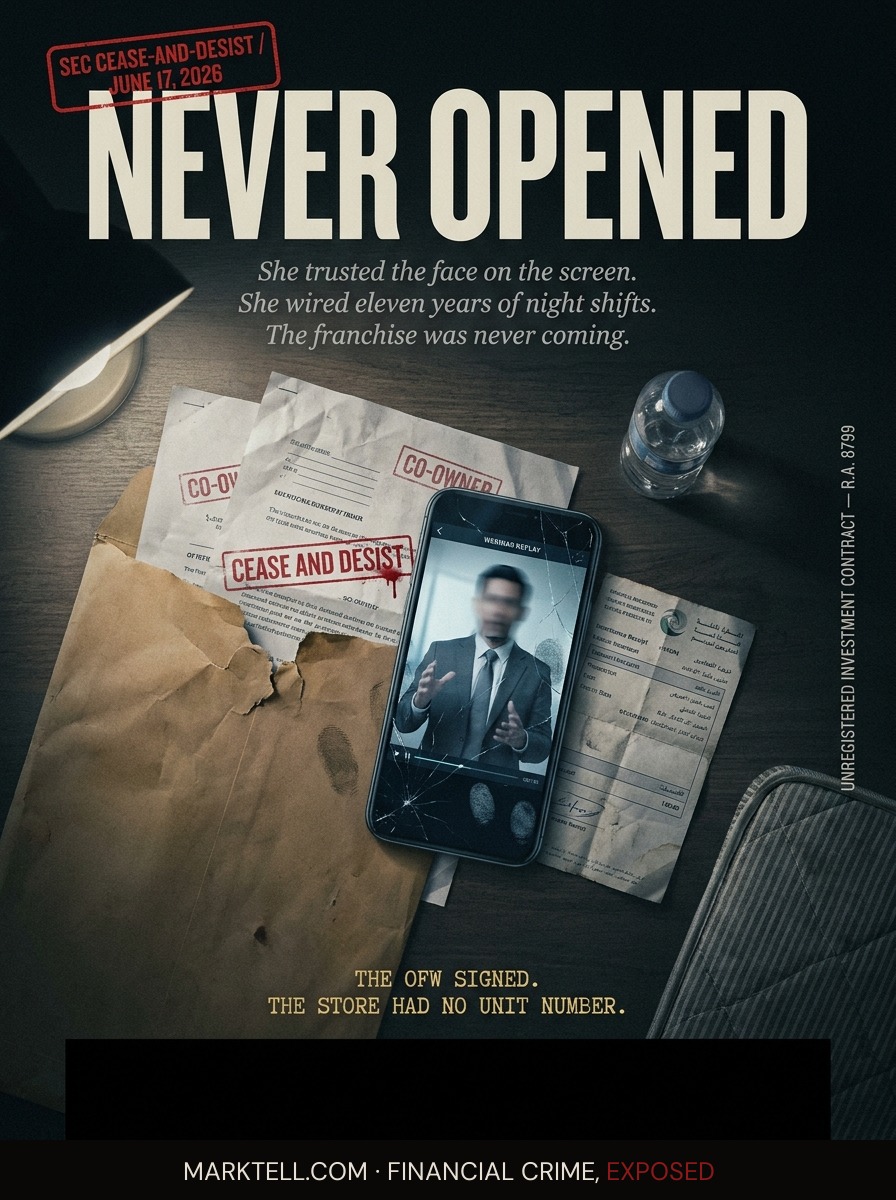
Marites was forty-seven and finishing a twelve-hour shift in a private home in Riyadh when she watched the webinar replay for the third time. The phone was propped against a water bottle on the small table next to her cot. The volume was low. The other caregiver in the room was asleep. The man on the screen was familiar. She had seen him on television in the Philippines years ago, before she left, back when she still watched television.
He was talking about franchises. He was talking about how a person like her, working abroad, could own a piece of a real business at home. He used the word passive. He used the word starter. He used the word OFW like he knew her.
She had been sending money home for eleven years. Most of it went to her mother in Cavite, who was raising her two children. Some of it sat in a bank account she rarely touched. She had been told, by friends and by her own arithmetic, that money in a bank does not grow. Money in a bank waits.
The webinar told her the money did not have to wait.
She filled out the form before her shift the next morning.
I.
The SEC's order came down on June 17, 2026. It named EF Easy Franchise Technological Ventures Inc. and an affiliated company, Sunspark Holdings Inc. It named the co-founders, including Rene "RJ" A. Ledesma Jr., the television host, and Jose "JoMag" Magsaysay Jr., the co-founder and CEO of Potato Corner. It named Charmaine Isabel Lim, the general manager. It named Jose Anton Ojeda, Gianpaolo Acosta, Karla dela Cruz, Angelica Carlos, Emerson Tan, and Angela Kirsten Villaluz. It told all of them to stop.
Stop offering. Stop selling. Stop soliciting. Stop moving money in the depository banks without written authorization.
The Enforcement and Investor Protection Department of the Philippine Securities and Exchange Commission found, according to the order, that Easy Franchise was engaged in unauthorized investment-taking. The vehicle was a product line called Investment Starter and a franchise management program. The pitch, the SEC alleges, was passive income, guaranteed returns, profit-sharing, and high returns on investment. The market, the SEC alleges, was the public, with particular targeting of overseas Filipino workers.
A franchise, in normal use, is a business you run. You sign a contract with a brand. You pay a fee. You open a store. You work it, or you hire someone to work it, and you are responsible for what happens inside the four walls.
That is not what was being sold here. The SEC describes a different shape. Investors were allegedly made to appear as incorporators, shareholders, or co-owners of franchise entities. They put up money. They got a name on a document. The operational control stayed with the respondents.
That is the renaming move. Call it a franchise. Treat it like a fund.
In Philippine law, when you put money into a common enterprise expecting profit, and the profit depends on the efforts of someone else, you are buying a security. Specifically, an investment contract. And securities sold to the public have to be registered with the SEC before they are offered. The Securities Regulation Code, Republic Act No. 8799, has said so since 2000.
Easy Franchise was registered as a corporation. That is not the same thing. A Certificate of Incorporation lets you exist. A secondary license lets you sell. The SEC says Easy Franchise had the first and not the second.
II.
Marites did not know any of this on the morning she filled out the form. She knew what the man on the screen had said. She knew she had been working eleven years of night shifts for a future she could not quite picture. She knew her mother was getting older and her children were getting older and the bank account was the same.
She wired the money through a remittance service she had used for a decade. The receipt printed in Arabic and English. She kept the paper folded in her wallet.
A few weeks later, a manila envelope arrived at her mother's house in Cavite. Inside were documents she did not entirely understand. Her name appeared on them. She was, according to the paper, a co-owner. Of what, exactly, was harder to say.
She sent photos of the documents to a group chat with two friends who also worked abroad. One of them said congratulations. The other one did not respond for a week, then sent a single line: "Did they tell you where the store is?"
Marites scrolled back through her messages with the Easy Franchise representative. She found a reference to a mall. She found a projected opening date. She did not find a unit number.
She told herself this was normal. She told herself the man on the television would not put his face on something that was not real.
III.
Here is what the record says about the men whose faces were on it.
RJ Ledesma is a television host. He is the founder of Mercato Centrale, the night market. He is a co-founder of EnterPH. After the SEC order, he made a public statement. He said he serves only as a brand ambassador for Easy Franchise. He said he is not involved in day-to-day operations. He said he will fully cooperate with the SEC.
JoMag Magsaysay is the co-founder and CEO of Potato Corner, one of the most recognizable franchise success stories in the country. He teaches at the Asian Institute of Management.
These are not anonymous men. These are men whose names mean something in the Philippine business world. That is, in the structure of an alleged investment solicitation, the asset. The face is the asset. The face is what makes a caregiver in Riyadh believe the form on her phone is not the same as every other form on every other phone.
The SEC's order, on its face, covers influencers, enablers, and all persons acting on behalf of the respondents. The brand-ambassador defense is a defense. It is not a dismissal. Whether it holds will depend on what the record shows about who knew what and when. That part is not yet adjudicated. Allegation is not adjudication.
What is on the record now is the order. The order says stop.
IV.
The Philippine franchise industry is real. As of April 2025, there were roughly 120,000 to 130,000 franchise outlets operating in the country. Industry promoters cite a 90 percent success rate compared with traditional startups. The numbers are good. The model works.
That is what makes the wrapper effective.
A pump-and-dump in a small-cap stock has to invent a future. A franchise pitch does not have to invent anything. It can point at a Potato Corner in a mall. It can point at a Mercato Centrale stall. It can say: this works. And then it can sell you something that is not quite that.
The Investment Starter, as the SEC describes it, did not give the investor a store to run. It gave the investor a position on a piece of paper and a promise about money that would arrive later. Some of that money, according to complaints cited by the SEC, did not arrive. Some of the outlets, according to complaints, did not open. Some closed.
Read that slowly. The thing being sold was the appearance of the thing that works. The thing actually delivered, in the cases the SEC has surfaced, was something else.
V.
Marites learned the order existed from a Facebook post a cousin sent her. The cousin worked in a call center in Cebu and forwarded news stories about scams when he saw them. He did not know Marites had invested. She had not told anyone except the group chat.
She read the article on her break. She read the names. She read the dates. She read about the cease-and-desist and the five days to file a verified motion to lift and the language about influencers and enablers and all persons acting on their behalf.
She did not call her mother that day. She finished her shift. She walked back to the dorm. She sat on her cot and looked at the photo on her phone of the paperwork in the manila envelope.
The paper still said she was a co-owner. The paper had not changed.
What had changed was that the Securities and Exchange Commission of the Philippines had said, on the record, that the entity that issued the paper did not have the license to do so. That the offering was unregistered. That the structure had the characteristics of an investment contract sold to the public without authority.
Marites was not stupid. Marites was a woman who had spent eleven years of nights in other people's houses sending money to a country she could not afford to live in. She had done the only thing the pitch was designed to make her do. She had trusted a face.
VI.
The machine, if the SEC's allegations hold, works like this.
Take a regulated, legitimate business form. Franchising. Something the public already understands and respects. Wrap an investment contract inside it. Use words from the legitimate form. Co-owner. Incorporator. Shareholder. Use words from the investment form. Passive income. Guaranteed returns. Profit-sharing.
Do not get the secondary license. The license is what would force you to register the offering, disclose the risks, and answer to the regulator before the money comes in. Skip it. Rely on the Certificate of Incorporation. Let the public confuse the two.
Put a familiar face on the marketing. Television. Conference stage. A successful franchise everyone has eaten at. The face does not have to be involved in operations. The face just has to be visible.
Target the people most likely to want passive income because they cannot be present to run anything actively. OFWs. Their savings are sitting in banks. Their time is consumed by work in another country. They cannot fly home to manage a store. The pitch is built for them: we will run it for you.
Collect the money. Issue the paperwork. Open some outlets. Do not open others. Pay some returns. Do not pay others.
When the regulator arrives, say the offering was a franchise, not a security. Say the prominent name was an ambassador, not an operator. Say you will cooperate.
The SEC's order is the moment the wrapper came off. Whether what is underneath is what the order alleges will be settled in the proceedings that follow. The administrative case is open. The civil and criminal proceedings, the SEC has said, will follow.
VII.
Marites has not decided yet what she will do. There is a process. The SEC has a complaint mechanism. There are advisories on its website explaining how to report a fake SEC registration. There are lawyers in Manila who will take her call.
There is also the math she does not want to do. Eleven years of remittances. The amount she put into the Investment Starter. The amount her mother needs next month. The amount her oldest child needs for school. The amount that is now sitting somewhere she cannot see, under the control of people whose bank accounts the SEC has just frozen pending written authorization.
She put the phone down on the cot. The webinar replay was still in her watch history. She did not delete it.
The man's face was still familiar. He was still on television. The order had not changed that either.
What the order had changed was the tense.
She had thought she was an owner. The SEC said she was something else. She was a member of the public to whom an unregistered security had allegedly been offered. She was, in the language of the law she had never read, a person the law was supposed to protect before the money left her hands, not after.
The money had already left her hands.
That is the part the order cannot undo. That part is what the proceedings are for. That part is the rest of the story.
She is still waiting on a store that may not open in a mall that may not have a unit for it. She is still working nights. She is still the asset the pitch was built to find.
- Bilyonaryo Business News | June 23, 2026 | "SEC orders Easy Franchise, RJ Ledesma, JoMag Magsaysay to halt investment solicitations"
- Philippine SEC Enforcement and Investor Protection Department | June 17, 2026 | Cease-and-Desist Order against EF Easy Franchise Technological Ventures Inc. et al.
- Republic Act No. 8799 | 2000 | Securities Regulation Code of the Philippines
- Philippine SEC | June 20, 2026 | Advisory on reporting fake SEC registration investment scams
- Public statement of RJ Ledesma | June 2026 | Response to SEC cease-and-desist order
- Philippine Franchise Association industry data | April 2025 | Franchise outlet count and success rate figures
Editorial Notice
MarkTell is a true crime publication about financial fraud. Some scenes, dialogue, and sequential details are reconstructed from court filings, enforcement actions, news reports, and public records. Where the public record does not provide exact details, editorial reconstruction is used to convey the documented pattern of events. Names of private individuals may be changed to protect identity. All factual claims are sourced to public documents cited in the Evidence Trail above. MarkTell does not provide investment, legal, or financial advice. Nothing published here constitutes a recommendation to buy, sell, or avoid any investment. Allegations described in active cases have not been adjudicated and defendants are presumed innocent until proven guilty. Readers should conduct their own due diligence before making financial decisions.