The box in the car park was the job. Ihor thought it was a favor.
Ihor Samotos needed work. What he found was a box of cash in a Dublin car park, a two-step verification, and a criminal network that reached from Santry to a bank in Kyrgyzstan.
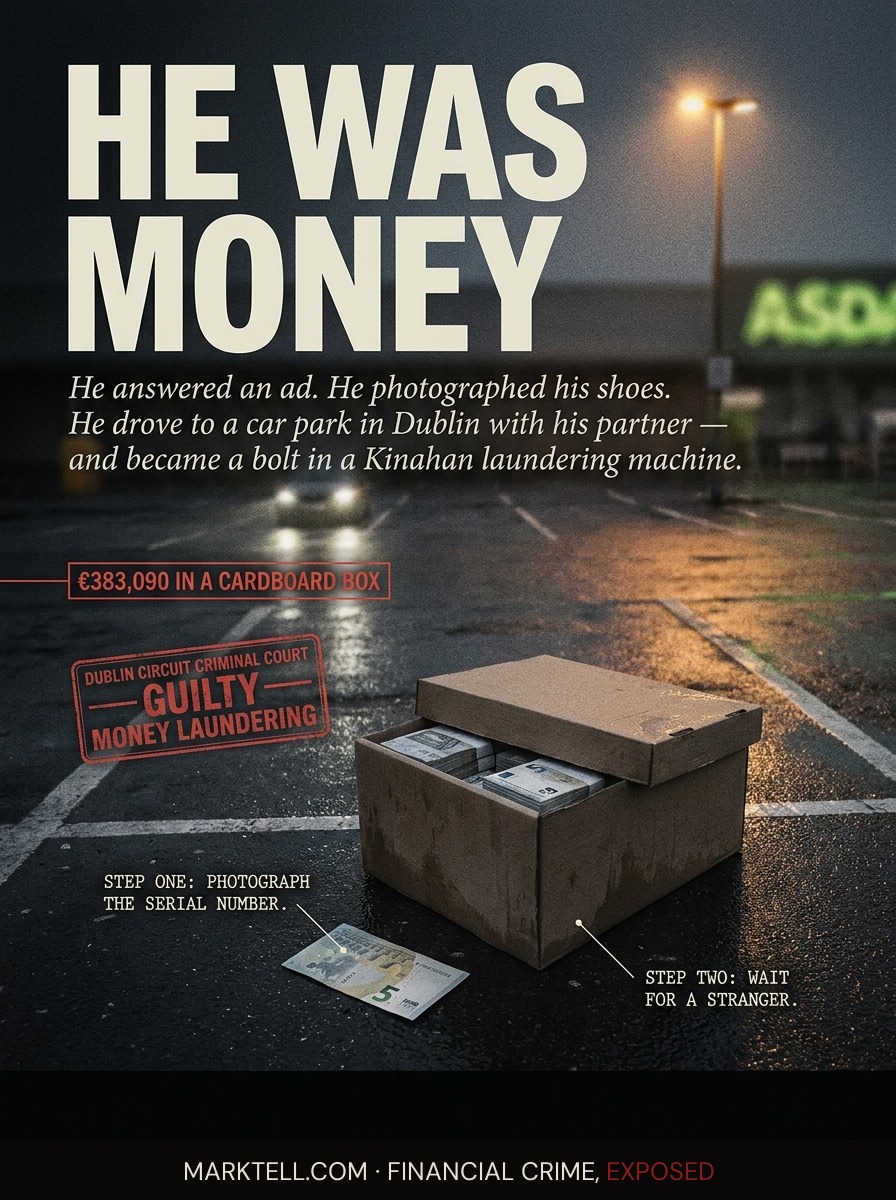
Take a photograph of your trousers. Take a photograph of your shoes. Take a €5 note out of your wallet, hold it so the serial number is legible, and photograph that too. Send all three to a number you were told to save. Then drive to a retail park in Santry and wait for a stranger to hand you a box.
That was the job.
Ihor Samotos was thirty-two years old and living in County Leitrim when he did this on the fourteenth of October, 2025. His partner, Sabina Kolukhonova, thirty-four, was in the passenger seat. They had arrived in Ireland separately, after the war, and neither had ever been arrested in Ukraine or in Ireland. What they had was a car, a phone, and a set of instructions that, at first, must have looked like the strangest job interview either of them had ever been through.
The box contained €383,090 in cash. About $415K USD at the rate that week. That is the number the Gardaí counted after they moved in.
Read that protocol again slowly. The photograph of the trousers. The photograph of the shoes. The €5 note with a serial number the other side could match against a message on their own phone. This is not the fumbling of amateurs. This is what an operation looks like when it has been run enough times to build a checklist. Two-step verification, the same phrase your bank uses when it wants to keep your savings safe. Here it was keeping a cash handoff safe. Same lock. Different door.
II. THE RECRUIT
Ihor's defense counsel, Fiona Murphy, described a "precarious situation." Limited work. A war behind him. A partner to keep. He looked online for ways to earn, and something online found him back. That is how the machine finds people now. Not on a floor with a hundred phones. Not in a hotel ballroom. On a screen, in a language you can read, offering something that sounds like piecework and pays like piecework, until the piecework turns out to be a felony.
He could not, his lawyer told the court, withdraw once he was in.
I have heard that sentence before, in different rooms, in different accents. The pitch has to feel like a favor at the start. Then it has to feel like an obligation. Then it has to feel like a threat. That is not three stages. That is one stage, repeated with the volume turned up each time.
III. THE MACHINE HE WAS FEEDING
The couple did not know, and may still not know, the full architecture of the thing they served. But British law enforcement has a name for it. Operation Destabilise. The UK's National Crime Agency has publicly described a Russian-speaking network that launders cash for drug traffickers, including the Kinahan Organised Crime Group, and that has been used to move value in ways that evade Russian sanctions. Public reporting on the operation has described the network purchasing a bank in Kyrgyzstan to keep the pipes running.
That is the machine. A Kinahan cash pickup in a Dublin retail park and a bank in Bishkek are on the same conveyor belt. Ihor was one bolt in it. Sabina was another.
He did not build the bank. He did not know the traffickers. He photographed his shoes and drove to Santry.
IV. THE COURTROOM
At Dublin Circuit Criminal Court, Judge Martin Nolan heard the case. Detective Garda Ciaran O'Neill gave the state's account. Prosecuting counsel Sarah Connolly walked the court through the protocol, the handoff, the recovery of the money. Both defendants pleaded guilty to one count of money laundering. Both were jailed. A third individual, the person who handed over the box, remains before the courts.
Neither of them had ever been in trouble before. That is the sentence in the record that sits heaviest. Two people, in their thirties, no criminal history in the country they fled or the country they fled to, standing in a Dublin courtroom because they answered the wrong ad.
V. WHY THIS ONE MATTERS
Ireland is not the Ireland of the money-laundering statistics from a decade ago. In 2017, the Gardaí handled roughly fifty money-laundering cases a year. In 2024 it was 996. In 2025 it was nearly 2,800. Arrests hit 741 last year and are on track to pass a thousand this year. A Central Bank study this April found that thirty-five percent of Irish adults had experienced fraud or a scam. Reported payment fraud in the country hit €160M (about $174M USD) in 2024. Investment fraud reports rose more than twenty percent in 2025.
The reason the numbers are moving is that the machines are hiring. Not employees. Recruits. People whose names the operators do not need to remember, because the operator never meets them. The recruit meets a phone. The phone meets a photograph of a shoe. The shoe meets a box in a car park.
On June 8 of this year, a man in Ireland was jailed for seven years for opening eighteen bank accounts and moving more than €431,000 (about $470K USD) through them. Different technique. Same machine. Different bolt. Same conveyor belt.
VI. THE BOX
Picture it. A Tuesday in October. The car park at Gulliver's Retail Park, a place ordinary people go for ordinary things. Sabina in the passenger seat. Ihor's phone lighting up with a confirmation from a stranger who has just matched the serial number on a €5 note to a picture on a screen. The box changes hands. The car door closes. The Gardaí close in.
He was not a mastermind. She was not a mastermind. The prosecution never suggested they were. What they were, in the language of the trade, was a delivery. A verified, protocol-compliant, two-step-authenticated delivery. The sophistication was not theirs. It was the network's, using them.
That is what money laundering looks like at ground level in 2026. Not a suitcase in a private jet. A retail park. A young couple. A photograph of shoes.
VII. WHAT HAPPENS NEXT
Ihor and Sabina are inside. The third courier is in the system. The network is not. The bank in Kyrgyzstan, if the UK's public reporting is right, is still there. The recruitment posts are still online. The next Ihor is already reading them.
He thought he was earning money.
He was money.
- Shannonside.ie | July 2026 | "Leitrim-based Ukrainian couple jailed for money laundering over €380,000"
- Dublin Circuit Criminal Court proceedings | 2026 | State v. Samotos and Kolukhonova, sentencing before Judge Martin Nolan
- UK National Crime Agency | December 2024 public statements | Operation Destabilise disclosures on Russian-speaking money laundering networks and Kinahan OCG links
- An Garda Síochána | 2025-2026 | Money laundering case volume statistics
- Central Bank of Ireland | April 28, 2026 | Consumer fraud and scam prevalence study
- Irish court reporting | June 8, 2026 | Seven-year sentence for €431,000 laundering via eighteen bank accounts
Editorial Notice
MarkTell is a true crime publication about financial fraud. Some scenes, dialogue, and sequential details are reconstructed from court filings, enforcement actions, news reports, and public records. Where the public record does not provide exact details, editorial reconstruction is used to convey the documented pattern of events. Names of private individuals may be changed to protect identity. All factual claims are sourced to public documents cited in the Evidence Trail above. MarkTell does not provide investment, legal, or financial advice. Nothing published here constitutes a recommendation to buy, sell, or avoid any investment. Allegations described in active cases have not been adjudicated and defendants are presumed innocent until proven guilty. Readers should conduct their own due diligence before making financial decisions.