The bedroom in Devon, the wholly unrealistic return, and the 81 percent that never traded
Daniel Pugh sold a trader's life on Facebook from a bedroom in Devon. The FCA has now secured £452,286.80 in compensation. The math of what he actually traded is the part that should stop you.
Marie was fifty-eight, an administrator at a primary school outside Plymouth, and the Facebook ad came in between two work emails on a Tuesday evening in 2021. She remembers it being a Tuesday because Tuesday was the night her husband worked late and she ate dinner at the counter with her phone propped against the kettle.
The ad showed a young man. Clean shirt. A chart behind him that went up the way charts do in ads. He called himself a fund manager. He said he traded across markets. The returns he showed were the kind of returns Marie had stopped believing in after 2008, but the man in the ad was so calm about them, so matter-of-fact, that her disbelief began to feel like the problem.
She messaged him. He messaged back.
She is not real. The school is not real. The kettle is not real. But the Tuesday is real, and the ad is real, and the man in the ad is real, and last week a court in London finished doing the arithmetic on what happened to the people who messaged back.
His name is Daniel Pugh. He is thirty-six. He ran his fund from his bedroom in Devon.
I.
The Financial Conduct Authority, which is the UK regulator that oversees investment marketing, says Pugh raised £1.3 million (about $1.65M USD) from investors who found him through Facebook ads. He promised, in the regulator's words, "wholly unrealistic returns" from trading across various markets.
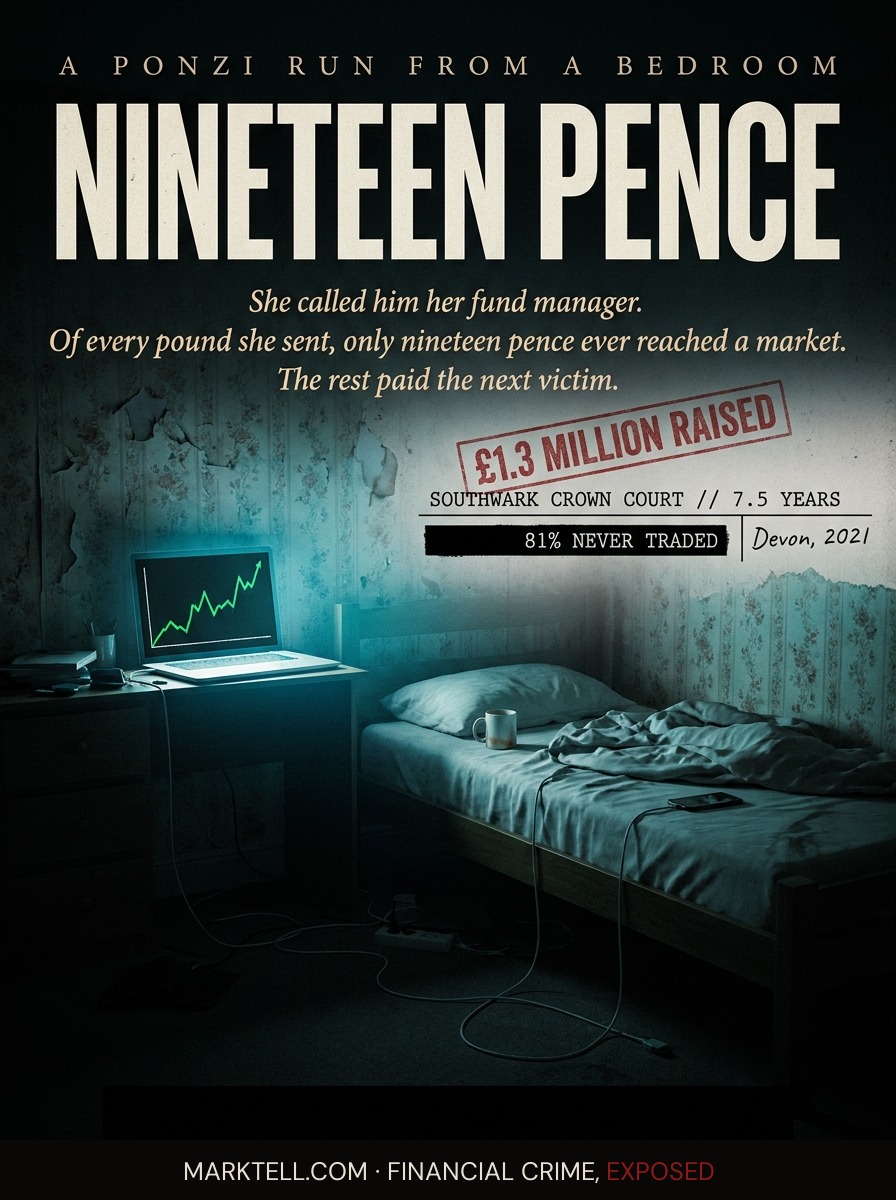
Of every pound that came in, nineteen pence reached a market.
Read that again. Nineteen pence of every pound.
The other eighty-one pence did what the other eighty-one pence always does in a Ponzi. It paid earlier investors their "returns." It paid the operator's life. It became the illusion that funded the next ad that funded the next Marie.
A Ponzi scheme is a structure named after Charles Ponzi, who ran one in Boston in 1920. The structure has not changed in a hundred and six years. New money pays old money. There is no investment behind the returns. The math only works while new money keeps arriving, and the math stops working the moment it stops arriving. Every Ponzi ends the same way. The only variable is who is still in the room when the music stops.
In Pugh's room, the music stopped sometime before June 5, 2026, when Southwark Crown Court ordered him to pay £452,286.80 (about $570K USD) in compensation to his victims. He is already serving a seven-and-a-half-year sentence for the underlying fraud. The court gave him three months to pay the confiscation order. If he does not, he serves an additional four years and nine months.
That is the adjudicated part. That is the part where a judge has done the work.
II.
The bedroom is the part to sit with.
Not an office on Canary Wharf. Not a Mayfair address with a brass plate. A bedroom in Devon, which is to say a room with a bed in it, in a county on the south coast of England known for cream teas and cliff walks. From this room, Pugh ran the Facebook ad spend. From this room, he answered the messages. From this room, the money came in and the money went out and the customer statements were sent, and somewhere in this room there was a screen showing a trading account that held about nineteen percent of what the customer statements said it should.
The FCA has not described the room. Nobody outside the investigation has been inside it. But the FCA has been inside the bank records, and the bank records describe the room well enough. A laptop. A phone. A Facebook Ads Manager account. A trading platform that received the small slice. Recipient bank accounts that received the rest.
That is a fund. That is what a fund looks like when you strip away the brass plate and the receptionist and the compliance officer and the auditor and the prospectus and the licence and the supervision. A laptop in a bedroom and a Facebook ad budget.
Marie did not know any of this. Marie believed she was investing with a fund manager. She used the word "fund" in conversations with her sister. She said, "my fund manager," the way someone with money says it. The word made her feel like a person who had arrived somewhere.
The word was doing work the word was not licensed to do.
III.
Steve Smart, the FCA's Executive Director of Enforcement and Market Oversight, said when the confiscation order came down: "Fighting financial crime is a key priority for the FCA. We'll do everything in our power to seize the profits from their crimes."
That is the line for the press release.
The line for the bedroom is this. The FCA has spent the last several months in what it called a "week of action" against illegal investment promotions on social media. Working with seventeen international regulators in April, it made 120 takedown requests to platforms. It identified 1,267 illegal financial adverts. Those adverts reached at least 2.3 million UK accounts. Two-thirds were linked to entities already on the FCA's Warning List, which is the list of names the regulator has already flagged as suspicious and which the platforms continue to host anyway.
Picture the size of that. 2.3 million accounts. Adverts the regulator had already warned about. A platform infrastructure that kept serving them.
Pugh's ad was one of those ads, in an earlier season of the same problem. He is the version that got caught and convicted. The 1,267 is the version still running.
IV.
The day Marie understood was not dramatic. There was no phone call. There was a story online, and a name she recognised, and a search that took her to the FCA's website, and a page that explained what a confiscation order was and how to register as a victim.
She read the date. June 30, 2026. The FCA's final call for victims to come forward.
She marked the date on the calendar on her fridge. The calendar she had bought at a school fundraiser. The calendar with photos of the children's artwork on each month.
She did not cry in the kitchen. She put the pen back in the drawer. She made tea. She did not open her banking app at lunch the next day, which was something she had done for years, and she did not open it at lunch the day after, either. She had been the person in her family who knew about money. That was the part she was sitting with. Not the amount. The job description.
V.
Look at the numbers in order.
£1.3 million collected.
19 percent traded.
£452,286.80 ordered as compensation.
Three months to pay.
Four years and nine months in default.
June 30, 2026, deadline for victims.
That is the case file. That is what is recoverable.
What is not recoverable is the year Marie spent thinking she was a person with a fund manager. The Tuesday evenings she spent watching the ad's chart and feeling she had finally understood something the rest of her family did not. The conversation with her sister where she used the word "fund." The slow movement, over months, of trust into a bedroom she had never seen, in a county she had never been to, belonging to a man whose face she knew from a video she could no longer find.
Pugh marketed himself as a finfluencer. That word, finfluencer, did not exist when Charles Ponzi ran his scheme in 1920. The word is new. The structure is not.
A finfluencer is a person who promotes financial products on social media, often without being authorised by a regulator to give financial advice. The word is a costume. Underneath the costume is the same machine that has always been there. A promise of returns. New money paying old money. A room nobody sees. A regulator arriving after the room has done its work.
Marie's room had a kettle and a calendar.
Pugh's room had a laptop and a Facebook Ads Manager account.
One room funded the other. That was the entire fund.
If you have sent money to someone you found in a sponsored post, and you live in the UK, and the name was Daniel Pugh, the FCA's deadline is June 30, 2026. Mark it on whatever calendar you have. The one with the children's artwork. The one on your phone. Whichever one you will see.
The machine has been switched off in this bedroom. There are 1,267 other adverts the regulator has already counted.
Marie does not know about those yet. She is still looking at the one she clicked on.
- Financial Conduct Authority press statement | June 5, 2026 | Confiscation order against Daniel Pugh, Southwark Crown Court
- This is Money | June 2026 | "Finfluencer 'fund manager' ordered to pay £450,000 compensation to victims of his 'ponzi scheme'"
- FCA "Week of Action" announcement | April 2026 | Coordinated regulatory action with 17 international regulators on illegal investment promotions
- Steve Smart, FCA Executive Director of Enforcement and Market Oversight | June 2026 | Public statement on Pugh confiscation
- Proceeds of Crime Act 2002 | UK statute under which the confiscation order was secured
Editorial Notice
MarkTell is a true crime publication about financial fraud. Some scenes, dialogue, and sequential details are reconstructed from court filings, enforcement actions, news reports, and public records. Where the public record does not provide exact details, editorial reconstruction is used to convey the documented pattern of events. Names of private individuals may be changed to protect identity. All factual claims are sourced to public documents cited in the Evidence Trail above. MarkTell does not provide investment, legal, or financial advice. Nothing published here constitutes a recommendation to buy, sell, or avoid any investment. Allegations described in active cases have not been adjudicated and defendants are presumed innocent until proven guilty. Readers should conduct their own due diligence before making financial decisions.