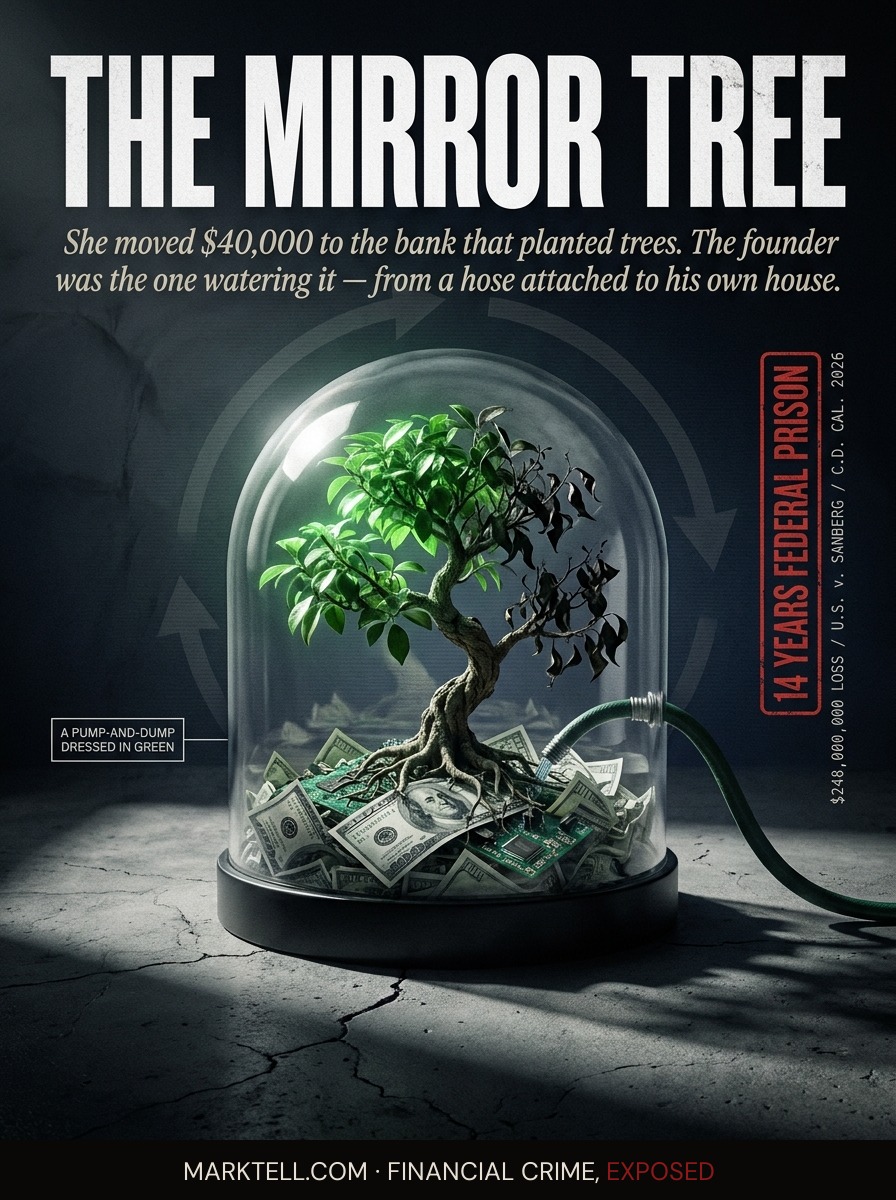
The bank that planted trees was watering itself.
Joseph Sanberg built a "socially conscious" bank that celebrities trusted with hundreds of millions. On June 1, a federal judge in Los Angeles sentenced him to fourteen years for running the carbon-credit version of a kite.
Marla was 58 and three years into retirement when she opened the Aspiration app on her couch in Pasadena. She had spent thirty-one years inside a public school district, the last nine running curriculum for the middle schools. She knew how to read a budget. She did not know how to read a bank.
The welcome screen had a little animated tree on it. Every time you swiped your card, the tree grew. The app told her where her money was not going. Not to pipelines. Not to private prisons. Not to the companies she had spent her career trying to keep out of textbooks. She moved about forty thousand dollars over. It felt like the cleanest decision she had made with money in a long time.
She did not know that the man who built the tree was the one watering it from a hose attached to his own house.
I. THE COURTROOM
On Monday, June 1, 2026, in the Los Angeles courtroom of United States District Judge Stephen V. Wilson, Joseph Neal Sanberg, 46, of Orange, California, was sentenced to 168 months in federal prison. Fourteen years. He had pleaded guilty in October 2025 to two counts of wire fraud. The Department of Justice put the total loss at more than $248 million.
Sanberg was the co-founder of Aspiration Partners Inc. Aspiration was the bank with the tree. It marketed itself as the place you parked your money if you wanted your money to behave. It sold carbon credits. It sold a debit card called the Aspiration Zero. It told you, on the screen, how many trees you had planted that month.
Steve Ballmer, the billionaire owner of the Los Angeles Clippers, put $60 million into Aspiration. Robert Downey Jr. invested. Orlando Bloom invested. Leonardo DiCaprio invested. In April 2026, Ballmer posted on X that he had been "duped." His lawyers wrote to Judge Wilson asking that the sentence account for the damage to his reputation.
That is what the celebrities lost. A reputation can be repaired. Marla's forty thousand was the slower wound. Hers was the belief that the thing on the screen was true.
II. THE MIRROR
Here is how the machine worked. You can call it the Mirror, because that is what it was. A company looking at itself and selling the reflection as growth.
Aspiration needed to show revenue to attract investors. Real revenue. The kind of monthly payments from real customers that make a bank look like a bank. According to the Justice Department, Sanberg solved this problem by becoming the customer.
He personally recruited companies and individuals to sign agreements with Aspiration. Those agreements committed them to pay tens of thousands of dollars a month for tree-planting services. The money flowed in. On the books, it looked like Aspiration had landed corporate clients who cared about carbon.
What investors were not told, according to the government, was that Sanberg himself was the source of those payments. He was paying the counterparties so the counterparties could pay Aspiration. The trees were a circle. The revenue was a mirror. The growth chart in the investor deck was Sanberg writing checks to himself through other people's hands.
That is what the prosecutors mean when they say he "concealed from investors that he was the source of millions of dollars in purported revenue."
In plain English: the customer was the founder. The founder was selling air. The air had a tree drawn on it.
III. THE LOAN
Then there was the second machine, the one that turned the inflated company into cash.
Between 2020 and 2021, Sanberg and a fellow Aspiration board member, Ibrahim AlHusseini, 52, of Venice, California, obtained $145 million in loans from two lenders. The collateral was Sanberg's Aspiration stock. The lenders needed to see that AlHusseini, as a guarantor, had the assets to make them whole if the stock failed.
He did not. So, according to the government, they made up the assets. AlHusseini's bank and brokerage statements were falsified. His net worth was inflated by tens of millions of dollars on paper. The lenders looked at the paper. The paper said yes. The money moved.
AlHusseini pleaded guilty to wire fraud in March 2025. He is awaiting sentencing.
Read the structure slowly. The stock used as collateral was inflated by fake revenue. The fake revenue was Sanberg paying himself. The co-signer's wealth was fake too. Every leg of the table was the same leg, painted a different color.
IV. THE CLIPPER
In any other fraud case, the tree-planting circle and the falsified brokerage statements would be the whole story. In this one, there is a stranger room.
Federal investigators have described a $28 million marketing contract that Aspiration signed with Kawhi Leonard, the Clippers star, in 2022. Prosecutors have alleged the contract functioned as a way around the NBA's salary cap. Pay the player through the sponsor. Keep the team's books clean. The Clippers deny wrongdoing. Leonard has not been charged. The NBA's investigation is ongoing.
Allegation is not adjudication. But the structure is worth seeing. The same man who was running a tree-planting carousel to fake bank revenue was, according to the government, the man holding the pen on a $28 million endorsement deal that did not behave like an endorsement deal.
A pattern is not a verdict. It is a thing the reader should be allowed to notice.
V. MARLA'S APP
Marla did not find out from the news. She found out the way most retail customers find out. The app started behaving strangely. Then the company filed for bankruptcy. Then the emails came from a claims administrator she had never heard of, asking her to fill out forms about money she could no longer see.
The little tree was still on the welcome screen the day she opened the app for the last time. The animation still worked. The branch still moved.
She had told her sister about Aspiration two Christmases earlier. She had said the word "clean." She had meant it.
That part may be the saddest. Not the money. The word.
VI. THE RENAMING
The headlines will call this a fraud at a green fintech. That is the polite name.
The real name is older. A company that books its own money as customer money is running a kite. A kite is when you write a check from one account to cover the check you wrote from another, both accounts empty, the float doing the work until the float runs out. Sanberg ran a kite with a carbon ledger on top. The ESG branding was not the crime. The ESG branding was the wrapping paper. Underneath was a circle of payments labeled as growth.
A restitution hearing is set for July 20. The lenders will line up. The celebrity investors will line up. Somewhere behind them, in a much longer line that does not make the press release, are the depositors who opened the app because of the tree.
Marla still has the welcome screen on her phone. She has not deleted the app. She says she wants to remember what it looked like to believe a thing.
The tree is still there. It is still animated. It still grows every time she taps it. It was always doing that. That was the only part that was real.
- United States Department of Justice, Central District of California | June 1, 2026 | Sentencing announcement, United States v. Joseph Neal Sanberg
- KTLA | June 2, 2026 | "Orange County man sentenced to 14 years for defrauding investors, lenders of more than $248M"
- United States District Court, Central District of California | October 2025 | Plea agreement, United States v. Joseph Neal Sanberg, two counts of wire fraud
- United States District Court, Central District of California | March 2025 | Plea agreement, United States v. Ibrahim AlHusseini, wire fraud
- Steve Ballmer | April 2026 | Public statement on X regarding Aspiration investment
- Letter from Ballmer's counsel to U.S. District Judge Stephen V. Wilson | 2026 | Sentencing submission
- Aspiration Partners Inc. | bankruptcy filings | public docket
Editorial Notice
MarkTell is a true crime publication about financial fraud. Some scenes, dialogue, and sequential details are reconstructed from court filings, enforcement actions, news reports, and public records. Where the public record does not provide exact details, editorial reconstruction is used to convey the documented pattern of events. Names of private individuals may be changed to protect identity. All factual claims are sourced to public documents cited in the Evidence Trail above. MarkTell does not provide investment, legal, or financial advice. Nothing published here constitutes a recommendation to buy, sell, or avoid any investment. Allegations described in active cases have not been adjudicated and defendants are presumed innocent until proven guilty. Readers should conduct their own due diligence before making financial decisions.