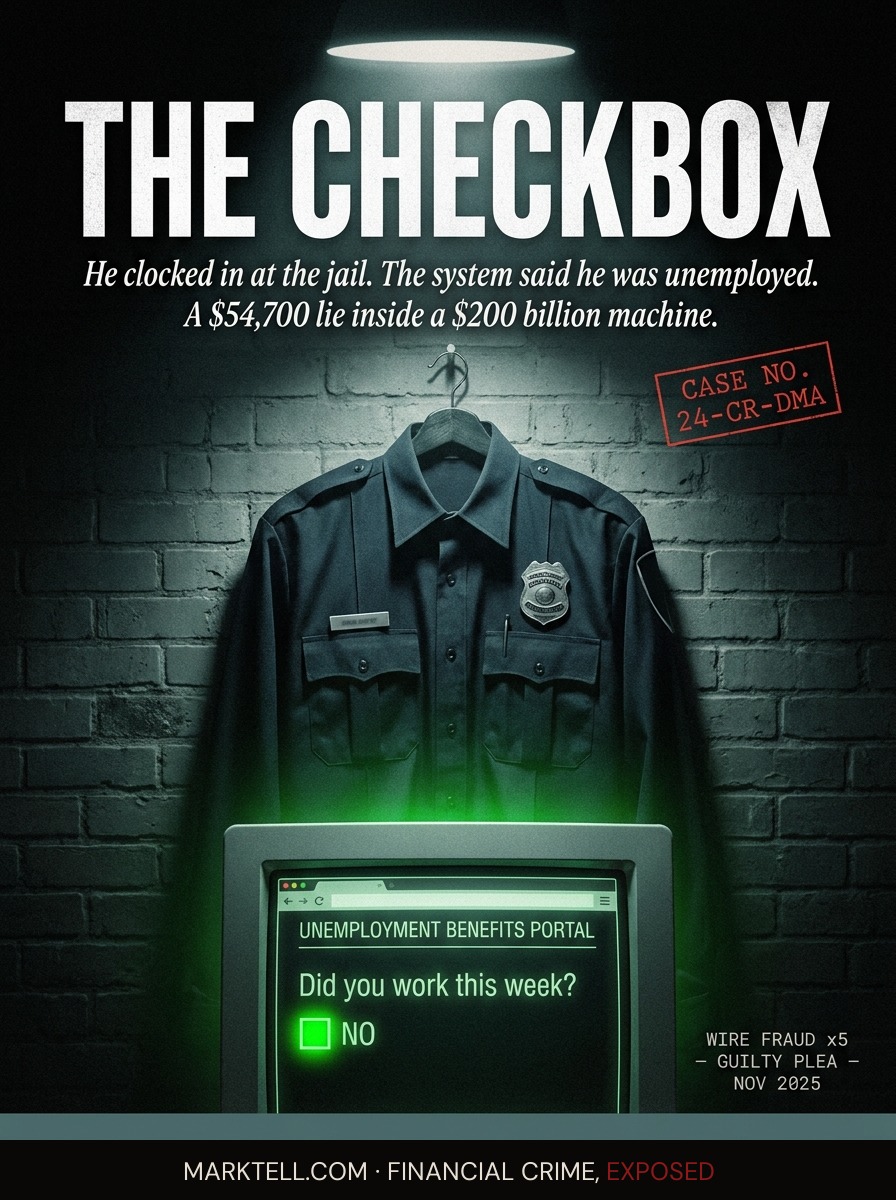
The badge clocked in at the jail. The benefits app said he was unemployed.
Christnel Orisca wore a Suffolk County corrections officer uniform from late 2021 through December 2024. The pandemic relief system, on paper, thought he had no job at all. The gap between those two stories is what a federal judge settled this week.
Marisol was up at 5:30 in the morning the way she always was, because the first patient on her route in Mattapan needed her by seven. She was 47. She had been a home health aide for fourteen years. The kitchen light was the only light on in the apartment. She was waiting for the coffee and she was waiting for the portal.
The portal was the Massachusetts Department of Unemployment Assistance website. She had been refreshing it for eleven weeks. The patients she usually saw had been told not to open their doors. The agency she worked for had cut her hours to almost nothing. She had filed for Pandemic Unemployment Assistance in April 2020, the way the state told her to, and she was waiting.
The status bar spun. The status bar always spun.
She did not know it then, but somewhere else in the same system, the certification was working perfectly. Somewhere else, a man was clicking through the same weekly questions she had to answer, and the answers were going through on the first try.
Did you work this week.
No.
Did you receive any income this week.
No.
The federal complaint and the U.S. Attorney's announcement put a name on that other claimant. Christnel Orisca. 26 years old. Boston. From late 2021 forward, he wore the uniform of a Suffolk County Sheriff's Department corrections officer. He punched in. He punched out. The county paid him. And the benefits system, on paper, thought he had no job at all.
This is a story about a checkbox.
I.
The machine that ran the CARES Act was a certification machine. That is the polite name for it. The real name is the honor machine. Congress built it in a hurry in March of 2020 because people were dying and people were also losing their jobs, and there was no time to verify each claim through the old process. So the government did what the government does when it needs to move money fast. It pushed the verification down to the applicant. Check the box. Sign the form. Tell us under penalty of perjury that you are who you say you are and that you do not have what you say you do not have.
The Small Business Administration's Office of Inspector General has since estimated that more than $200 billion in potentially fraudulent EIDL and PPP loans went out the door. That is roughly 17 percent of the total. The Department of Labor's OIG has flagged over $1.3 billion in suspect unemployment and EIDL payments going to the same likely fraudsters. Those are not numbers from a partisan think tank. Those are numbers from the agencies that were supposed to be guarding the door.
The honor machine was the door. It worked exactly the way it was designed to work. That is the problem.
II.
According to the U.S. Attorney's Office for the District of Massachusetts, Orisca filed for Pandemic Unemployment Assistance in 2020. He filed for traditional Unemployment Insurance. And he applied for Paycheck Protection Program loans through SBA-approved lenders, the kind of loans that were supposed to keep small business payrolls intact when storefronts went dark.
PUA was the program built for gig workers and the self-employed, people who did not have a regular W-2 employer to lay them off. To get a weekly check, you had to certify each week that you were not working and had not earned income. The complaint alleges Orisca did this while drawing a county paycheck.
PPP was the program for small businesses. To get a loan, you had to tell the lender what your business made and what your payroll cost. The complaint alleges Orisca submitted those numbers about businesses whose actual revenue and payroll did not match what he reported. Later, when it came time to ask for the loans to be forgiven, he certified the loans had been used for permitted purposes.
In total, federal prosecutors say he obtained approximately $54,700.
That is the number on the restitution order. That is also the number on the forfeiture order. The math is clean because the government is taking back exactly what it sent. The accounting is symmetrical. The harm is not.
III.
Picture the booking desk at the jail. Picture the uniform. Picture the timecard. Picture the supervisor's signature.
Now picture the laptop at the kitchen table. The DUA portal open in one tab. The weekly certification screen. The checkbox.
Did you work this week.
He worked that week. He worked every week from late 2021 through December 2024, according to the Sheriff's Department employment record cited in the case. The county was paying him to guard people who had been accused of breaking the law.
The checkbox said no.
The reader is supposed to feel something at that gap. I will not name the feeling. The gap is the feeling.
IV.
The case did not break because someone in the office noticed. The case broke the way these cases break now, after five years of cleanup. The Department of Labor's Office of Inspector General and the Department of Homeland Security's Office of Inspector General run cross-matches. State payroll rolls against federal benefit rolls. Names. Social Security numbers. Dates of employment. Dates of certification. The computer does the work that the checkbox refused to do up front.
Orisca was indicted in December 2024. The Sheriff's Department employment record stops the same month. He pleaded guilty in November 2025 to five counts of wire fraud and one count of making a false statement to a financial institution. Wire fraud is the charge prosecutors use when the lie traveled over the internet, which all of these lies did, because the portal is the internet. The false statement count covers what he told the bank.
On May 28, 2026, U.S. District Court Judge Julia E. Kobick sentenced him. One year of supervised release. $54,700 in restitution and forfeiture. No prison time on the public docket.
Assistant U.S. Attorney Dustin Chao prosecuted the case. U.S. Attorney Leah B. Foley's office announced the sentence.
His co-defendant, Jasmine Murphy, also a former Suffolk County corrections officer, pleaded guilty on April 3, 2026, to seven counts of wire fraud and one false-statement count. The DOJ release puts her take at approximately $44,346. She is scheduled to be sentenced on July 9, 2026.
V.
Marisol got her first PUA check in July of 2020. By then the rent was three months behind and her mother in Hyde Park had stopped asking if she needed help, because asking made it worse. The check covered some of it. Not all of it. The portal kept spinning for other people she knew. One of them, a woman who cleaned offices downtown, gave up and went back to work in a building where two of her coworkers had been hospitalized.
That is the part that does not show up in the restitution order. The money Orisca took came from the same pot Marisol was drawing from. Every fraudulent claim slowed the legitimate ones down. Every checkbox lie added a layer of verification that the next legitimate claimant had to clear. The honor machine got tighter after the fraud, not before it, because tightening it before would have cost lives.
That is the saddest part. The system was built loose on purpose, for her, and it got robbed because it was loose, and now the next emergency will have a system that does not trust her on the first try.
VI.
You will read more of these in the coming months. The five-year statute of limitations on 2020 conduct runs through this year and into next. The SBA recently sent 562,000 suspected fraudulent loans, totaling roughly $22 billion, to Treasury for collections. The federal task force is still running.
The cases will look similar because the machine was the same. A nurse who kept billing the agency while collecting PUA. A delivery driver who filed for unemployment in three states. A teacher with a side business that did not exist until the loan application asked if she had one. A corrections officer who answered no to a question he was answering yes to on his timecard.
The mechanism is not exotic. The mechanism is a checkbox.
That is what the chapter is about. Not Orisca. Orisca is small. The chapter is about what happens when a government, under pressure, decides to trust the answer on the form because there is no time to check. The pandemic was the pressure. The next pressure will be different. The form will be the same.
Marisol still has the email confirming her first PUA payment. She kept it because she keeps everything from that year. She does not know Christnel Orisca's name. She does not need to. The man she is angry at is not a man. It is the spinning status bar. It is the eleven weeks. It is the feeling that the system did not believe her when she told the truth.
The system did believe somebody. That was the problem.
He just was not the one waiting.
- U.S. Attorney's Office, District of Massachusetts | May 28, 2026 | Press release on sentencing of Christnel Orisca
- U.S. Attorney's Office, District of Massachusetts | December 2024 | Indictment announcement, Orisca and Murphy
- U.S. Attorney's Office, District of Massachusetts | April 3, 2026 | Press release on guilty plea of Jasmine Murphy
- The Boston Globe | May 2026 | "Former Suffolk County corrections officer to pay $55,000 for pandemic loan, unemployment fraud"
- Small Business Administration, Office of Inspector General | 2023 report | Estimate of $200B in potentially fraudulent EIDL and PPP loans
- U.S. Department of Labor, Office of Inspector General | Pandemic Response Oversight reports | $1.3B in suspect UI and EIDL payments
- COVID-19 Fraud Enforcement Task Force | Established May 17, 2021 by U.S. Attorney General
- Small Business Administration | 2025 disclosure | 562,000 suspect loans, $22B referred to Treasury
Editorial Notice
MarkTell is a true crime publication about financial fraud. Some scenes, dialogue, and sequential details are reconstructed from court filings, enforcement actions, news reports, and public records. Where the public record does not provide exact details, editorial reconstruction is used to convey the documented pattern of events. Names of private individuals may be changed to protect identity. All factual claims are sourced to public documents cited in the Evidence Trail above. MarkTell does not provide investment, legal, or financial advice. Nothing published here constitutes a recommendation to buy, sell, or avoid any investment. Allegations described in active cases have not been adjudicated and defendants are presumed innocent until proven guilty. Readers should conduct their own due diligence before making financial decisions.