The applications were the business. The business was the applications.
Nikenson Jean Mathurin sat at a keyboard in Sparta, New Jersey, and built fifteen businesses that did not exist. A federal jury in Newark needed four days to see what he had actually built.
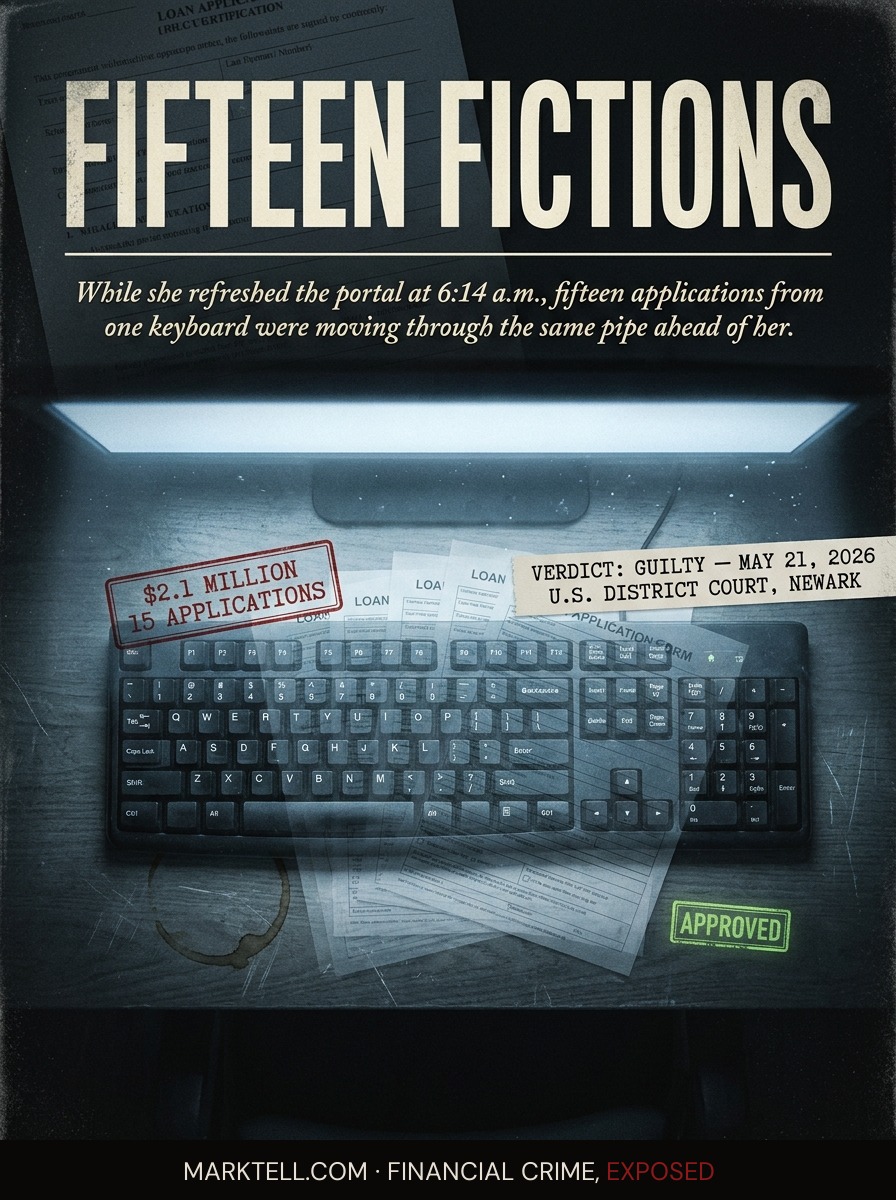
Marisol was thirty-eight and she ran payroll for a cleaning company in Paterson that almost did not make it through April 2020. Eleven employees. Mostly women. Mostly the only paycheck in the house.
She woke up at 6:14 on a Tuesday morning to refresh the SBA portal on a laptop her boss had bought her on Craigslist. The kitchen was still dark. The coffee was still brewing. She watched a spinning circle on a federal website and prayed it would stop spinning.
This is a story about that spinning circle.
It is also a story about a man who, somewhere about an hour up Route 80 in Sparta, New Jersey, was sitting at his own keyboard, filling out his own applications. His were not for a real company. According to a federal jury that returned a verdict on May 21, 2026, after four days of trial in Newark, his applications were for businesses that did not exist.
His name is Nikenson Jean Mathurin. He is forty-six. He went by Nik. He lived in Sparta, a town of lakes and good schools in Sussex County. And between April 2020 and the day the IRS came knocking, he submitted fifteen fraudulent applications to the Paycheck Protection Program and the Economic Injury Disaster Loan program and walked away with more than $2.1 million.
That is what the jury found. That is what the U.S. Attorney's Office for the District of New Jersey said in its announcement. The conviction is three counts of wire fraud and one count of money laundering. Sentencing is set for October 6, 2026, in front of U.S. District Judge Michael A. Shipp.
I want to slow down on the number for a second. Two point one million dollars. Fifteen applications. Do the math. That is an average of about $140,000 per application, sometimes more, sometimes less, depending on how big a fake business he claimed to run. Each one of those applications was a small fiction. A payroll that did not exist. A tax document that was made up. A headcount of employees who were nobody.
Each one of those fifteen fictions sat in a queue with Marisol's real one.
I
The Paycheck Protection Program was a wire stretched across a national emergency. The Economic Injury Disaster Loan program was another wire stretched alongside it. Congress passed the CARES Act in late March 2020 and the money was supposed to start moving within days. The Small Business Administration, which had never moved money this fast, was suddenly the plumber of the entire small business economy.
The pipe was wide. The pipe was fast. The pipe trusted what it read.
That is not a complaint about the policy. The policy had to be fast. People were going to lose their houses if the policy was not fast. But fast and trusting is also the exact specification of a vulnerable system. The Pandemic Response Accountability Committee later identified $5.4 billion in potential identity fraud just in EIDL and PPP applications tied to questionable Social Security Numbers. The Department of Justice has charged more than 3,096 people with pandemic relief fraud, with more than 2,500 convictions, as of late 2024.
The pipe was the machine. The applications were the fuel.
II
Picture the keyboard in Sparta.
It is an ordinary keyboard, in an ordinary house, in an ordinary suburb. There is no boiler room. There is no bank of phones. There is no script taped to a desk. There is one man at a screen, filling out a form, then filling out another one, then filling out another one. According to the government, Mathurin claimed ownership of businesses he did not own, attached payroll records that were not real, included tax documents that had been fabricated, and listed employees and revenue numbers that were not accurate.
Fifteen times.
The first one is the hard one. The first one is where you find out if the pipe pushes back. After the first one clears, the rest are typing exercises.
This is the part of every fraud that surprises civilians. They imagine sophistication. They imagine a vast scheme with confederates and shell companies and offshore structures. Sometimes it is that. Often it is a guy at a keyboard who learned that the form does not push back, and decided to fill it out again.
III
Back to Marisol.
Her boss's PPP application was rejected the first time around because the bank she banked with was not processing for non-customers. By the time the second wave opened, she had moved everything to a credit union that would. She got the money in late May. It was enough to keep the eleven women on payroll for two months. Two of them still left. One went back to El Salvador. One found a job in a warehouse where she did not have to ride a bus.
That part may be the saddest. The program worked the way it was supposed to work for Marisol's boss. And it still was not enough.
Now imagine what it is supposed to feel like to find out, six years later, that while you were refreshing a portal at 6:14 in the morning, fifteen applications from one keyboard in Sparta were moving through the same pipe in front of you.
This is what fraud against a public program actually steals. Not just dollars. Position in line.
IV
The investigation was run by IRS Criminal Investigation out of the Newark Field Office. Special Agent in Charge Jenifer L. Piovesan oversaw it. U.S. Attorney Robert Frazer announced the conviction. Frazer said the pandemic relief programs were not, in his words, "a personal payday for fraudsters."
The trial took four days. The jury came back guilty on all four counts.
The maximums are large. Twenty years on each wire fraud count. Ten years on the money laundering count. Fines up to $250,000 per count or twice the gross gain or loss, whichever is greater. Federal sentences are not maximums in practice. They are negotiated against guidelines that look at the loss amount, the role, the history. The loss amount here is $2.1 million. That is a guideline range that puts a person in federal custody for a meaningful number of years, even before the judge adds or subtracts.
Sentencing is October 6, 2026. We will know then.
V
The same week Mathurin was convicted, a federal jury in South Carolina convicted two other people, Devlon Porter and Amber Baldwin, of running a scheme that generated more than $9.1 million in fraudulent PPP loans. A woman in Kanawha County, West Virginia, pleaded guilty to a separate $83,332 COVID fraud. A few days earlier, in Minnesota, Aimee Bock was sentenced to 500 months, more than 41 years, for leading a $250 million scheme that exploited a federal child nutrition program during the pandemic.
That is one week. That is what the cleanup of the pipe looks like.
The pipe is closed now. The new SBA has citizenship verification, age verification, automatic fraud alerts, enhanced oversight. The next emergency program, whatever it is, will be built with these lessons in mind. Or it will not, because the next emergency will also be fast, and fast and trusting is the specification the country keeps writing when the country is scared.
VI
I worked phone rooms in the 1980s where the script was taped to the desk. I sold things over the phone that I did not understand. I sold timeshare contracts at hour five of a five-hour presentation, when nobody reads. I know what it looks like when a system is built to be filled out without resistance, and I know what it feels like to be on the side of the desk that is doing the filling.
The keyboard in Sparta is the same desk. It is just that the customer on the other end of the line was the United States Treasury, and the script was the loan application, and the trial close was the click that submitted the form.
Fifteen times.
Marisol is still in Paterson. The cleaning company is still open. Nine of the original eleven women still work there. Her boss has a framed copy of the original PPP approval letter on the wall behind the desk, the way some people frame their first dollar.
A few miles north and west, in a federal courthouse in Newark, a jury sat for four days and looked at fifteen fictions, and called each one of them what it was.
The applications were the business.
The business was the applications.
- U.S. Attorney's Office, District of New Jersey | May 21, 2026 | Press release announcing conviction of Nikenson Jean Mathurin
- TAPinto Sparta | May 29, 2026 | "Sparta Man Convicted of $2.1 Million in COVID-19 Relief Funding Fraud"
- IRS Criminal Investigation, Newark Field Office | statement by SAC Jenifer L. Piovesan
- Pandemic Response Accountability Committee (PRAC) | report identifying $5.4B in potential identity fraud in EIDL/PPP
- Department of Justice COVID-19 Fraud Enforcement Task Force | charging statistics through December 2024
- DOJ press releases | May 22, 2026 (Aimee Bock sentencing); May 27, 2026 (Porter/Baldwin convictions); May 28, 2026 (Kanawha County plea)
- Small Business Administration | CARES Act program rules and post-2020 reform documentation
Editorial Notice
MarkTell is a true crime publication about financial fraud. Some scenes, dialogue, and sequential details are reconstructed from court filings, enforcement actions, news reports, and public records. Where the public record does not provide exact details, editorial reconstruction is used to convey the documented pattern of events. Names of private individuals may be changed to protect identity. All factual claims are sourced to public documents cited in the Evidence Trail above. MarkTell does not provide investment, legal, or financial advice. Nothing published here constitutes a recommendation to buy, sell, or avoid any investment. Allegations described in active cases have not been adjudicated and defendants are presumed innocent until proven guilty. Readers should conduct their own due diligence before making financial decisions.