The application took six minutes. The prison sentence took forty-one months.
Currin Caridine ran a kickback assembly line through the PPP program, recruiting Mainers and New Hampshire residents into fake applications for businesses that did not exist. The Small Business Administration paid out roughly $475,000 before the machine got names.
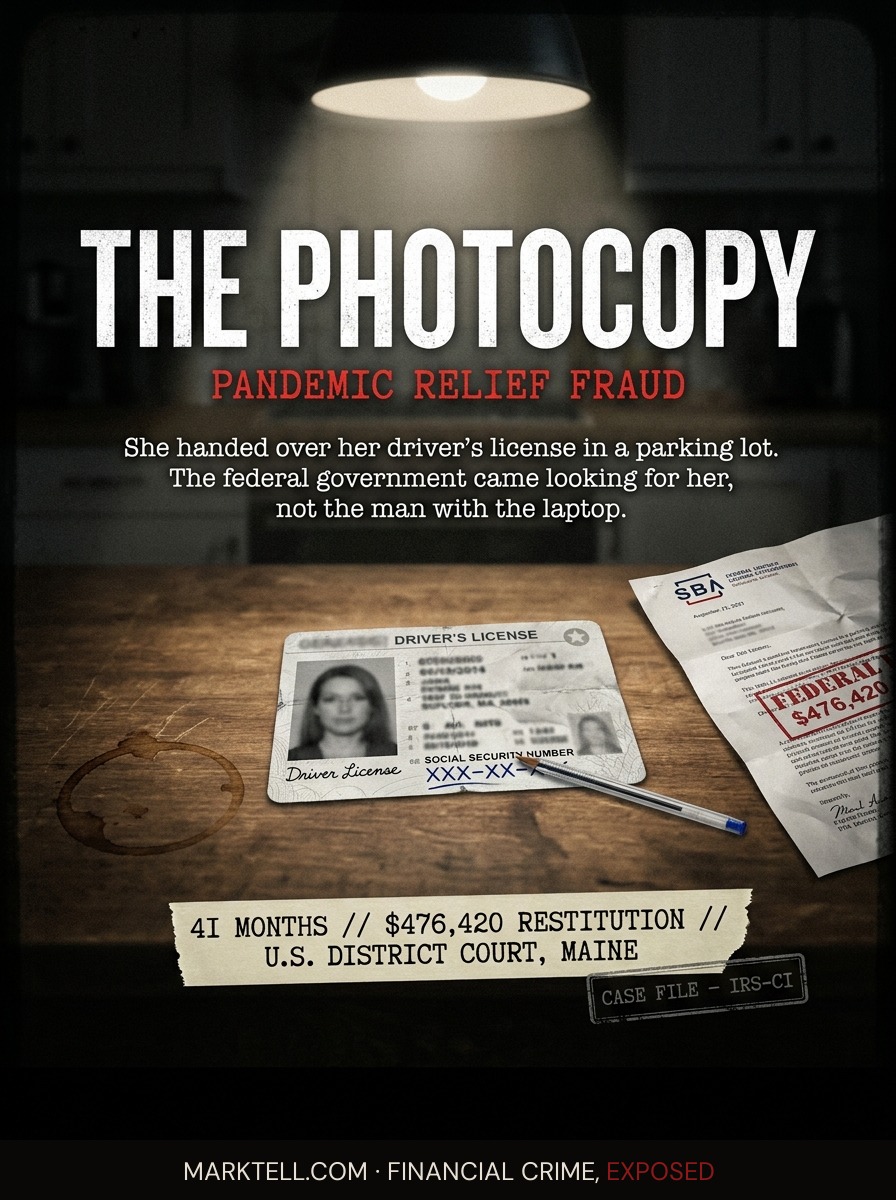
Dawn kept the photocopy on the kitchen table for almost a year before she understood what it was.
A folded piece of paper. Her driver's license on one side. Her social security number written underneath in blue pen, in her own handwriting, because the man in the parking lot had asked her to copy it out neatly so the application would go through faster. She remembered the parking lot. A strip mall off a state route in central Maine. October 2020. She was fifty-two, working twelve-hour shifts as a home health aide, and the woman who introduced her to the man had said he was helping people get the COVID money the government was supposed to be sending anyway.
The money never came to Dawn. A few hundred dollars cash, weeks later, from the woman. A thank-you. For what, exactly, Dawn could not have said at the time.
She kept the photocopy because she did not know what else to do with it.
She is a composite. The case she sits inside is not.
I. The assembly line
On June 12, 2026, in U.S. District Court in Portland, Maine, Chief U.S. District Judge Lance E. Walker sentenced a man named Currin Caridine to forty-one months in federal prison. Caridine is thirty-nine, lives in Katy, Texas, and lived in Illinois during the period in question. He pleaded guilty to wire fraud and conspiracy to commit wire fraud. The court ordered him to pay $476,420 in restitution to the U.S. Small Business Administration, which is the federal agency that ran the Paycheck Protection Program and the Economic Injury Disaster Loan program during the pandemic.
Those two programs, PPP and EIDL, were the emergency relief pipes Congress built into the CARES Act in 2020. The idea was that the money had to move fast. Small businesses were dying in weeks. So the government turned the vetting valves down and the disbursement valves up. The Department of Justice now estimates that somewhere between $80 billion and $200 billion of the roughly $1.2 trillion in pandemic relief went out the wrong door.
Caridine ran one of the smaller doors. According to court filings, from June 2020 through September 2021, he filed four fraudulent PPP applications in his own name, claiming to be the sole proprietor of management consulting and entertainment businesses that did not exist. He attached false tax returns. He collected over $80,000.
That was the easy part. The harder part, and the part that drew the federal sentence, was the assembly line.
II. The recruit, the filer, the wire
Caridine worked with a man named Tyree Jones, a New Hampshire resident, who had already been sentenced to two years in prison for his role. Jones was the recruiter. He found people. He collected their personal information. He passed it to Caridine. Caridine filed the applications, invented the businesses, fabricated the Schedule Cs, and submitted everything to the SBA's funding partners.
When the money hit, the split happened. The recruit got a piece. Jones got a piece. Caridine kept the rest.
The total take from the recruited applications, on top of Caridine's own four loans, came to approximately $475,000 in EIDL and PPP funds.
Read that number slowly. Not because it is the largest pandemic fraud number in the country. It is not. The largest cases run into the tens of millions. Read it slowly because it is the small one. Because it represents the scale at which thousands of these schemes ran in 2020 and 2021. Because it is the size of a fraud that did not need a boiler room or a yacht. It needed a Maine parking lot, a folded photocopy, and a man with a laptop in Illinois.
III. What Dawn signed
Dawn did not sign anything in the parking lot. That part may be the saddest. She handed over the photocopy and the woman she trusted said she would take it from there. The application went in under Dawn's name. The IRS-CI investigators would later find a Schedule C for a consulting business Dawn had never heard of, with revenue figures Dawn had never earned, attached to a tax return Dawn had never filed.
Picture it. A federal application, signed electronically, in her name, claiming she ran a company she did not run, earning money she did not earn, signed with a signature she did not type. The wire went out from the SBA. It did not go to her bank. It went to an account controlled by someone she had met once.
This is what the pandemic relief assembly line looked like at the recruit level. The kickback paid in cash. The promise that it was forgivable. The reassurance that everyone was doing it. The detail nobody mentioned was that the application was a federal document and the signature was a federal signature and the loan was a federal loan, and when the federal government got around to looking, the name on the document was the name they would look for.
I sold a lot of things in a lot of rooms before I started writing about this. I sold metals to dentists. I sold timeshare contracts at hour five. I sold magazine subscriptions and small-cap shares in a blimp company that did not make blimps. I know what it sounds like when the person across the table says it is easy and everyone is doing it. That sentence is the oldest one in the room.
IV. How the machine became visible
IRS Criminal Investigation worked this case. The U.S. Attorney's Office for the District of Maine prosecuted it. The mechanism of discovery, in cases like this, is almost always the tax return.
The fabricated Schedule Cs are the fingerprints. A recruiter can collect a hundred names and pass them up the line, and the filer can invent a hundred consulting businesses, but the consulting businesses do not exist in the IRS's own records. They do not have real returns from prior years. They do not have real bank histories. When investigators pull the file, the business that was supposed to have earned $80,000 in 2019 has no record of having existed in 2019. The lie sits in front of them like a body that does not match the name on the door.
That is how the case against Caridine came together. Not through one dramatic informant. Through the slow alignment of fake returns against real ones, fake businesses against the absence of any business at all.
V. The cost downstream
Dawn does not appear in the court docket by name. The Maine and New Hampshire residents whose information was used are described in the filings as recipients of fraudulent applications filed on their behalf. Some of them took small cuts. Some of them, like the composite I have built from this case profile, may not have understood what they were signing up for. Some of them may have understood perfectly.
The federal government does not always sort that distinction kindly. The statute of limitations on PPP fraud has been extended to ten years, which means investigations and prosecutions can run until 2030 or 2031 for loans issued in 2020 and 2021. The letters are still going out. The recruits are still being interviewed.
For Dawn, the letter came on a Tuesday afternoon. She was sitting at the kitchen table where the photocopy had lived all year. The letter was from the SBA. It referenced a loan number she did not recognize and an amount she had never received. She read it twice. She set it down on top of the photocopy. The two pieces of paper, one she had made and one that had been made about her, finally sat in the same place.
She called her daughter before she called anyone else.
VI. The machine under a new name
Caridine got forty-one months. Jones got twenty-four. The restitution order was $476,420, which means the SBA may recover a portion of it over time and may not.
What does not get recovered is the architecture. The recruiter, the filer, the wire, the split. Five years on from the CARES Act, federal investigators are still working through the backlog. The June 2026 enforcement calendar alone shows a Marina Del Rey man sentenced for $3.15 million in fraudulent PPP applications, and seven men indicted across three states for $205,639 in COVID relief fraud, and Caridine's own sentencing in Portland. Three cases. Three states. Same machine.
The pandemic pipe is closed. The architecture is not. The next emergency program, whatever it is called, will move fast for a real reason and the recruiters will already know the script. They will find the home health aide working twelve-hour shifts. They will find the parking lot. They will ask for the photocopy.
Dawn keeps hers in a drawer now. She does not look at it. She knows what it is.
That is the part the sentence does not fix.
- The Maine Wire | June 2026 | "Texas Man Sentenced to 41 Months in Prison Following PPP Loan Fraud on Behalf of Mainers"
- U.S. Attorney's Office, District of Maine | June 12, 2026 | Sentencing announcement, U.S. v. Caridine
- U.S. Department of Justice | COVID-19 Fraud Enforcement Task Force materials, est. May 2021
- SBA Office of Inspector General | PPP and EIDL fraud estimates (range cited: $80B to $200B+)
- IRS Criminal Investigation | COVID fraud sentencing statistics, average sentence data through late 2024
- U.S. Attorney's Office, Central District of California | June 15, 2026 | Mark Shehata sentencing
- DOJ press materials | June 12, 2026 | Three-state PPP/EIDL indictment, seven defendants, $205,639
Editorial Notice
MarkTell is a true crime publication about financial fraud. Some scenes, dialogue, and sequential details are reconstructed from court filings, enforcement actions, news reports, and public records. Where the public record does not provide exact details, editorial reconstruction is used to convey the documented pattern of events. Names of private individuals may be changed to protect identity. All factual claims are sourced to public documents cited in the Evidence Trail above. MarkTell does not provide investment, legal, or financial advice. Nothing published here constitutes a recommendation to buy, sell, or avoid any investment. Allegations described in active cases have not been adjudicated and defendants are presumed innocent until proven guilty. Readers should conduct their own due diligence before making financial decisions.