She thought she was helping him through customs. She was paying the room he worked in.
Four men were arrested in India last week over a romance scam police say drained one victim of roughly $81,500. The pitch was love. The closer was a customs officer who did not exist.
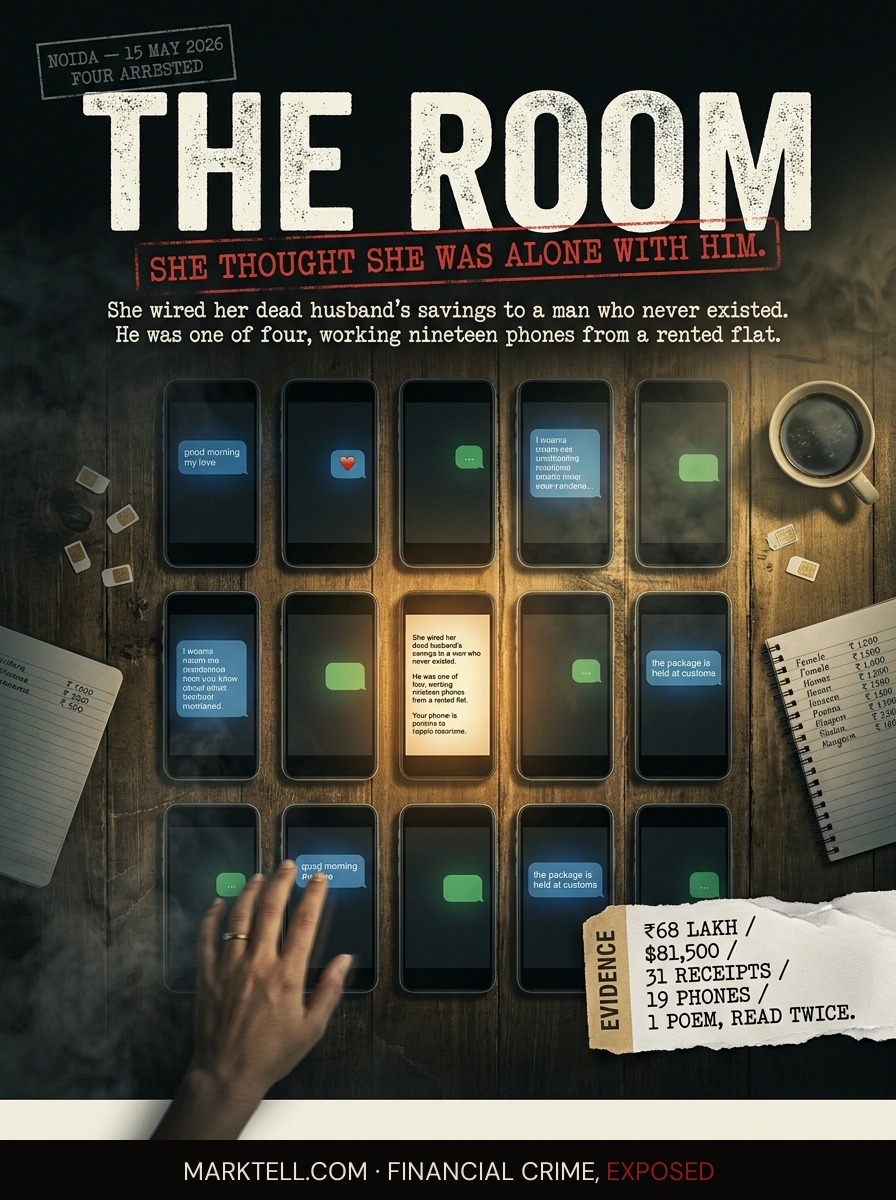
Meera kept the phone face-down on the kitchen table because she did not want her daughter to see it light up. She was fifty-four. Her husband had been dead two years. The man on the other end of the messages had a British accent in his voice notes and said he was an engineer in Dubai. He sent her a poem on a Tuesday. She read it twice.
That part may be the saddest. She read it twice.
By the time the police in Noida walked into a rented flat last Friday night and put nineteen phones into evidence bags, Meera had already wired roughly Rs 68 lakh, about $81,500 USD, to a series of Indian bank accounts she believed belonged to a customs officer at Mumbai airport. The customs officer had called her three times. He had a different voice than the engineer. She found this reassuring. Two different men, two different jobs, two different stories that lined up.
They were the same room.
I. The room
Gurugram Police arrested three men in Noida late on the night of May 15, 2026. The Uttar Pradesh Special Task Force picked up a fourth the next day. Indian press, reporting from the police statements, named them as Chinedu, Sunday, Jules, and Uchenwa, the last of them forty-nine years old. The Guardian Nigeria carried the story under the headline that four Nigerians had been arrested over a multi-million naira romance scam.
What the police took out of the flat tells you what the flat was.
Nineteen mobile phones. One laptop. Eighteen SIM cards, Indian and international.
That is not a household. That is a switchboard.
Picture it. A table. Phones face-up in rows. Each phone is a woman. Each woman is somewhere in India, or the UK, or the US, sitting at her own kitchen table, reading a good-morning message from a man she has never met. The man behind the phones is one of four. He runs three or four conversations at once. He copies and pastes the poems. He keeps a spreadsheet of which woman believes which story.
When the conversation is ready to close, a different man picks up a different phone and calls her as the customs officer. That is the trial close. The takeaway comes next, when the package gets "held" and the duties go up.
I have sat in rooms like that. Different product. Same furniture.
II. Meera
She did not start on Facebook looking for a man. She started looking for old classmates. The algorithm did the rest. A friend request from a profile picture of a grey-haired white man in a hard hat, standing in front of what looked like a refinery. The bio said widowed. The bio said engineer. The bio said faith and family.
She accepted because it felt rude not to.
The first month was talking. The second month was voice notes. The third month was a photograph of a wrapped package on what he said was a courier belt, addressed to her. Perfume. A watch. Cash, he said, in pounds, for her to keep safe until he could fly to her.
Then the phone call from the man who said he worked for Indian customs.
The duty was Rs 50,000 (about $600 USD). She paid it. The next call said the package had been flagged for foreign currency and needed a clearance fee. She paid that too. Then a tax. Then a fine for the tax being late. Then a final release fee that was not final.
By the fourth payment she was using her late husband's savings. By the seventh she had stopped sleeping. By the time her daughter saw the WhatsApp thread, the folder of receipts in the kitchen drawer was thick enough to stand on its edge.
The daughter did one thing. She typed the WhatsApp number into Google.
III. The mechanism
This is the part where I would normally walk you through the financial product. There is no financial product. The product is the man. The product is the engineer who is not an engineer, the customs officer who is not a customs officer, the package that does not exist sitting on a conveyor that does not exist in an airport where no one is waiting.
That is the renaming.
This is not a romance scam. This is a customer service operation, run from a rented flat, where the customer is the victim and the service is loneliness, delivered in installments, paid for in clearance fees.
The numbers we have are partial. One complaint, filed April 25, 2025, reported a loss of Rs 69,900 (about $838 USD) on a single "registration fee" for a fake cheque exchange at Mumbai airport. Another, attributed to the Uchenwa investigation, reported the Rs 68 lakh loss. The press release talks about the four men. The press release does not talk about the women on the other end of the nineteen phones.
The press release gets the photograph of the evidence table. The women get the silence.
India now accounts for roughly 12% of reported romance scam cases globally, second only to Nigeria at 14%, according to figures circulated by NDTV Profit in February 2025. Global losses to romance fraud crossed $1.3 billion in 2024, per FTC data. The UK's Financial Conduct Authority reported a 9% increase in romance fraud in its 2024/2025 financial year, with losses above £106 million (about $134M USD), and noted that banks were failing to catch the small early payments that scammers use to build the rails before the large transfers come.
The small payments are the tell. They are not the first crime. They are the audition.
IV. How the men got there
Sunday allegedly entered India through Bangladesh in 2022, without papers. Chinedu came on a student visa in 2018. Jules came on a student visa in 2017. Uchenwa, the oldest, came in 2010 to run a garment business, told investigators it failed, and said he moved into cyber fraud after the losses.
I am not going to pretend I do not recognize that arc. A man arrives somewhere to do honest work. The honest work does not pay. Somebody he knows is making money on the phones. He sits down at a phone. He tells himself it is temporary. Then it is sixteen years later and the police are at the door.
That is not a defense. It is a description.
The men in the flat were running a machine. The machine was older than they were. It was running in Chicago metals rooms in the 1980s, in timeshare lobbies in the 1990s, in boiler rooms selling penny stocks in the 2000s. The script changes. The closing mechanics do not.
Urgency. Scarcity. Authority. A second voice that confirms the first voice. A document that looks official. A deadline that keeps moving.
V. The drawer
Meera's daughter took the folder of receipts out of the kitchen drawer and laid them on the table next to the phone. There were thirty-one of them. The earliest one was for Rs 12,000 (about $145 USD). The last one was for Rs 4,80,000 (about $5,750 USD). The bank accounts on the receipts were not all the same. Some were in Delhi. Some were in Hyderabad. One was in the name of a woman.
Meera looked at the phone. She did not pick it up.
That is the moment in every one of these stories. The moment after. The phone is still there. The man is still on the other end, somewhere, typing good morning to someone else. The money is gone. The shame is not. The shame stays in the room for a long time.
She has not been back on Facebook.
VI. What the arrests do not solve
Four men were arrested. Nineteen phones were taken off the table. The table is still there. Another four men will sit at it next month, in another flat, in another suburb, with new SIM cards and the same script.
That is not pessimism. That is the math.
Romance fraud reports are rising in every jurisdiction that measures them. The technology to spin up a synthetic engineer with a voice and a face is now sitting on the phone in your pocket. The banks miss the small early transfers because the small early transfers do not look like fraud. They look like a woman sending a friend Rs 12,000.
If you are reading this because you are worried about someone you love, the ugly question is not whether they are smart enough to spot a scam. They are. The ugly question is whether they are lonely enough to want the scam to be real.
Meera was. That is not weakness. That is the human condition the machine was built to feed.
She read the poem twice because nobody had written her one in a long time.
- The Guardian Nigeria | May 18-19, 2026 | "Four Nigerians arrested in India over multi-million naira romance scam"
- Gurugram Police statements (reported via Indian press) | May 15-16, 2026 | Arrest announcements
- Uttar Pradesh Special Task Force statements | May 17, 2026 | Arrest of Uchenwa
- NDTV Profit | February 14, 2025 | Global romance scam statistics, India share
- UK Financial Conduct Authority | October 17, 2025 | Romance fraud annual report, 2024/2025
- US FTC | 2024 data | Global romance fraud loss figures
- Moody's analytics commentary | 2025 | Bank exposure to romance fraud risk
Editorial Notice
MarkTell is a true crime publication about financial fraud. Some scenes, dialogue, and sequential details are reconstructed from court filings, enforcement actions, news reports, and public records. Where the public record does not provide exact details, editorial reconstruction is used to convey the documented pattern of events. Names of private individuals may be changed to protect identity. All factual claims are sourced to public documents cited in the Evidence Trail above. MarkTell does not provide investment, legal, or financial advice. Nothing published here constitutes a recommendation to buy, sell, or avoid any investment. Allegations described in active cases have not been adjudicated and defendants are presumed innocent until proven guilty. Readers should conduct their own due diligence before making financial decisions.