She thought she was funding a wedding. She was funding a wire route through Esenyurt.
A Hong Kong dentist spent two years wiring her savings to a man she believed was an American businessman in Istanbul. Turkish police now say the man was Nigerian, the romance was a script, and the bank accounts were a relay system.
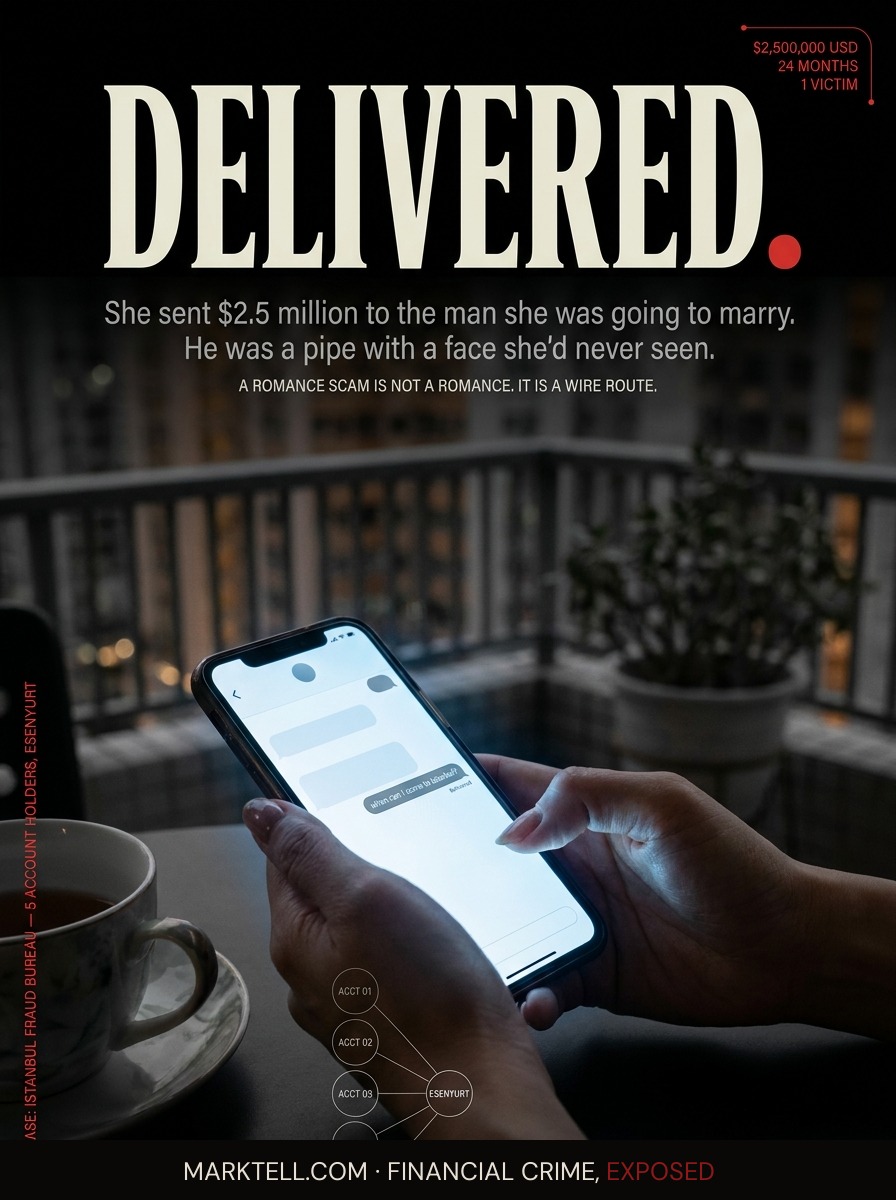
Mei was forty-seven and she lived above her dental clinic in Kowloon. The clinic had her name on the door in two languages. The flat upstairs had nothing on the door at all. That was how she liked it. She had built a quiet life. Two chairs in the waiting room, a receptionist who had been with her for nine years, a balcony with a single plant she remembered to water about half the time.
The message came on a Tuesday night in 2020. She was on the balcony with a cup of tea that had gone cold while she finished a patient file. The app was something a friend had told her to try. She had not told her mother. She had not told anyone. She had answered three messages in six months and deleted two of them.
The third one said his name was Richard.
He said he was American. He said he was in Istanbul on business. He said he had seen her photo and wanted to know what she did for work, because the smile in the photo looked like someone who took care of people. That was the first sentence. Read it again. That is the opening line of the pitch.
For two years, Mei talked to Richard every night.
He was an investor, he said. He was building something in Turkey. He sent photos of construction sites and photos of his hotel room and photos of his hand holding a coffee with the Bosphorus behind it. He spoke about marriage by month four. He spoke about flying her out by month six. He spoke about the wedding by month nine. By month twelve, he needed help.
The help was an investment project. The investment project needed capital. The capital was time-sensitive. The bank in Istanbul was slow. The partner in Istanbul was difficult. The opportunity in Istanbul would close. Could she send a little. Could she send a little more. Could she send the rest by Friday.
Mei sent $2.5 million across two years, in installments, to a series of bank accounts in Turkey. That is the figure Turkish authorities have put on the case. That is the figure that lands in the police statement. Two and a half million United States dollars. From a single woman. To a man she had never met. Across twenty-four months. In a steady drip.
Picture it. Each transfer on her banking app. Each confirmation screen. Each time she tapped through, she was building the marriage. That is what the machine sells. Not greed. Not even love, exactly. The story of a future life. Each wire was a brick in the house in Istanbul where they were going to live.
Now look at where the money actually went.
This is the part Turkish police have walked backward. Istanbul's Fraud Bureau, working from a complaint filed through a Turkish lawyer the victim eventually retained, traced the receiving accounts. Five account holders. All of them in Esenyurt, a dense district on the European side of Istanbul. Each one received a portion of the wires. Each one withdrew cash. Each one, according to the police account, handed the cash up the line to a man they knew as Richard.
Richard, the police say, was not American. Richard was Kingsley O., a Nigerian national living in Esenyurt. He was arrested last week alongside four others. He has denied the allegations. One of the account holders has reportedly admitted to passing the money along.
That is the machine.
The front of the machine is the persona. American businessman. Construction project. Coffee on the Bosphorus. The voice on the messages, the photos that were not his, the wedding that did not exist.
The middle of the machine is the account farm. Five people in flats in Esenyurt, each one renting their name and their bank credentials to receive a portion of the wires. Smaller pieces are slower to flag. Smaller pieces clear.
The back of the machine is the principal. Allegedly. Collecting the cash from the runners, never touching the wire system directly, never letting the receiving account match the persona. The persona was American. The accounts were Turkish. The man was Nigerian. None of the three were in the same room as the money for very long.
This is what is meant by a romance scam, in the operational sense. The romance is the front of a wire-routing operation. The love is the closing technique. The wedding is the urgency. The investment is the pretext. Strip those out and what you have is a pipe. Money goes in one end in Hong Kong. Money comes out the other end in Esenyurt, broken into pieces, in cash.
Mei did not see the pipe. She saw a man.
The night the messages stopped, she was on the balcony again. Same chair. Same plant. The last wire had cleared a few days earlier. She had asked when she could come to Istanbul. He had said soon. Then he had said tomorrow. Then he had said nothing.
She tapped his name. The message bubble said delivered. Then it said nothing.
She tapped it the next night. And the next.
Hong Kong police took the complaint. The trail went cold on the receiving side. It was the Turkish lawyer she eventually hired who walked the file into the Istanbul Chief Public Prosecutor's Office and asked for the accounts to be traced. That is the request that produced the chart. Five names. Five accounts. One alleged principal in a flat in Esenyurt.
The arrest happened last week. Kingsley O., a Nigerian national, denies the allegations. He is one node in a network that law enforcement agencies have been chasing in coordinated operations for years. Interpol's Operation Contender 3.0, run last summer, arrested 260 people across fourteen African countries for romance and sextortion scams tied to roughly $2.8M USD in losses. The FBI, in a February warning, put 2024 U.S. romance-scam losses above $1.3B USD. Median loss per victim, by FTC data, is around $2,000. Mei lost more than a thousand times that.
Older victims lose the most. Single victims lose more than married ones. Professional women, in their forties and fifties, with savings and discretion and no one in the next room to ask about the wires, are a specific target. The script is built for them.
The script knows what Mei wanted. It is not money. It is a man who notices the smile in the photo and asks what she does for a living. That is the bait. The rest is plumbing.
Here is the part that may be the saddest.
For two years, the most consistent presence in Mei's life was a man who did not exist. She talked to him more than she talked to her receptionist. She told him about her patients and her mother and the plant she kept forgetting to water. She built a record of herself inside the conversation. When the conversation ended, that record did not go away. It went to whoever sat behind the keyboard. It went into the file the next persona would use on the next woman who answered a message on a Tuesday night.
Mei still works at the clinic. The chair in the waiting room is the same chair. The plant is still alive. The balcony is still there.
The wedding never was.
He just was not the man she thought she was marrying. He was the front of the pipe.
- MSN / Google News aggregation | June 2026 | "Nigerian arrested in Turkey over $2.5m romance scam"
- Istanbul Police Department, Fraud Bureau | June 2026 | Public statement on Esenyurt arrests
- Interpol | August 2025 | Operation Contender 3.0 press release
- FBI | February 2026 | Public advisory on romance scams, 2024 loss totals
- U.S. Federal Trade Commission | 2024 data release | Romance scam median loss figures
- TSB (UK) | February 2026 | Romance fraud trend analysis
Editorial Notice
MarkTell is a true crime publication about financial fraud. Some scenes, dialogue, and sequential details are reconstructed from court filings, enforcement actions, news reports, and public records. Where the public record does not provide exact details, editorial reconstruction is used to convey the documented pattern of events. Names of private individuals may be changed to protect identity. All factual claims are sourced to public documents cited in the Evidence Trail above. MarkTell does not provide investment, legal, or financial advice. Nothing published here constitutes a recommendation to buy, sell, or avoid any investment. Allegations described in active cases have not been adjudicated and defendants are presumed innocent until proven guilty. Readers should conduct their own due diligence before making financial decisions.