She signed the return. She trusted the math. The math was wrong on purpose.
A Belleville tax preparer admitted in federal court this week to filing hundreds of false returns, hiding six figures of her own income while inflating her clients' deductions. The clients who trusted her with their most private numbers may now owe the government money they were told they had already handled.
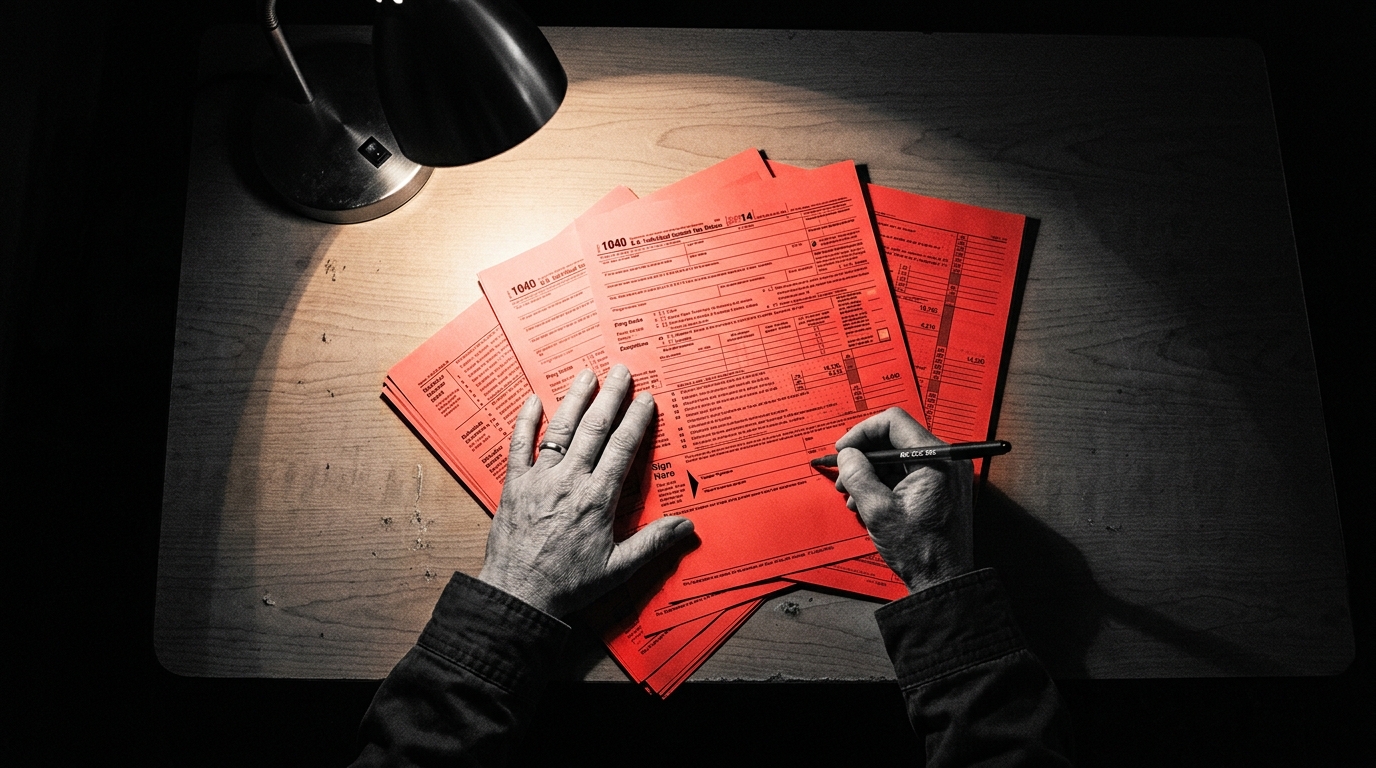
I. The Transaction
The form came back looking right.
That is the thing about a tax return. Most people cannot read one, not really. They know their name at the top and their refund amount at the bottom, and the space in between is someone else's territory. That is why they paid a professional. That is why they drove to the office, took a number, sat down, slid the W-2 across the table.
A woman we will call Renata, composite of the clients whose names do not appear in the public record but whose situation the record describes, did exactly that. She was fifty-one, worked in accounts receivable for a construction company out of East St. Louis, kept her tax documents in a manila folder she renewed every January. She had used the same preparer for three years. The refunds had always come. That felt like evidence of something.
The office had a name on the window. It had a desk and a printer and a woman behind the desk who typed quickly and asked the right questions. Renata watched the numbers go in. She signed at the bottom. She took the copy home in an envelope and put it in the drawer.
She did not know what the business expense line said. She had no particular reason to check.
That is not a failure of intelligence. That is what trust looks like, and the machine was built to run on it.
II. The Ledger Itself
Dormeshia A. Haire, 38, of St. Charles, Missouri, owned and operated several tax preparation businesses in Belleville, Illinois: Dormeshia Taxes, Dormeshia Haire Taxes, Dormeshia Haire Tax Services, and One Tax Guru Financial Services Inc.
Read those names. Each one is a ledger with a different cover.
According to the guilty plea she entered on April 29, 2026, in federal court in the Southern District of Illinois, Haire admitted to filing hundreds of false returns. The mechanism was simple in both directions. For her clients, she inflated business expense deductions. That made the taxable income look smaller and the refund look larger. The client left happy. The ledger said something that was not true.
For herself, she ran the same logic in reverse. She did not report what she earned.
In 2019, she left more than $43,000 in gross receipts off her own return entirely.
In 2020, she reported $23,834. The government estimates her actual gross receipts were $192,200.
In 2021, she reported $50,323. The government estimates her actual gross receipts were $323,396.
Do the math on that last year. She reported about fifteen cents of every dollar she made.
The gap between what the ledger said and what the ledger should have said produced a federal tax obligation of over $600,000. The State of Illinois is owed an additional $48,000.
The machine had two sides. The clients saw one. Nobody saw the other until the IRS did.
III. The Shape of the Trust
Here is what the IRS will tell you, in language it puts on its own website: the taxpayer is responsible for the accuracy of their return. Not the preparer. The taxpayer. The person who cannot read the form, who sat in the chair, who signed at the bottom.
That is the legal exposure Renata and clients like her are sitting with right now. If the IRS audits a return Haire filed, and finds the inflated deductions, the client owes the tax. Plus interest. Plus potentially penalties. The fact that a professional made the entry does not erase the liability that flows from it.
The manila folder in Renata's drawer has her signature on it.
The woman who typed the numbers already pleaded guilty.
That is not turbulence. That is the shape of the machine.
IV. The Visible Record
The first indictment came in April 2024. That is already two years of Haire's clients living with returns in their files whose accuracy is now a federal question.
A nine-count superseding indictment was filed on March 17, 2026.
On April 6, 2026, her bond was revoked due to bond violations. The court took her into custody.
On April 29, 2026, she pleaded guilty: one count of making false statements on a tax return, one count of wire fraud, three counts of aiding and abetting the filing of false and fraudulent returns.
Wire fraud carries a maximum sentence of twenty years. Each of the other counts carries up to three years. Sentencing is scheduled for August 5, 2026, at the federal courthouse in Benton.
U.S. Attorney Steven D. Weinhoeft described the conduct as a "toxic 'free-money mentality.'" The IRS Criminal Investigation office, through Special Agent in Charge Thomas F. Murdock and Assistant Special Agent in Charge Melissa McFadden, investigated the case. Assistant U.S. Attorney Kathleen Howard is prosecuting.
The investigation found what the ledger had been hiding. What it has not yet resolved is what becomes of the people who handed their numbers to the woman holding the pen.
V. What the Ledger Leaves Behind
There is no entry in the public record for Renata's name, because Renata is the shape of a client, not a named client. The record does not tell us what she earned in 2021, or what deduction appeared on her return under business expenses, or whether that number was real.
What the record tells us is that Haire filed hundreds of returns. That the deductions were inflated. That the clients did not write those deductions. That the IRS is now owed more than six hundred thousand dollars that no one is claiming to dispute.
The refunds those clients received may have been paid out of obligations that were quietly shifted forward. The returns they signed were documents they could not fully audit. The professional they trusted was in the process, those years, of not reporting most of her own income to the same government she was preparing their returns for.
Picture the envelope in Renata's drawer. Picture the copy of the return inside it. Picture what it says on the business expense line, and picture that she has no particular way of knowing whether that line is correct.
The copy still says what it said when she signed it.
The ledger keeps that version. It does not note the correction.
That is the thing about a document that says the wrong thing quietly. It keeps saying it until someone opens the drawer.
- U.S. Department of Justice, Southern District of Illinois | April 29, 2026 | Press release: "St. Clair County Tax Preparer Pleads Guilty to Wire Fraud, Filing False Returns"
- Belleville News-Democrat | April 29-30, 2026 | News report on Haire guilty plea
- U.S. District Court, Southern District of Illinois | March 17, 2026 | Nine-count superseding indictment, USA v. Dormeshia A. Haire
- U.S. District Court, Southern District of Illinois | April 6, 2026 | Bond revocation order, USA v. Dormeshia A. Haire
- IRS Criminal Investigation, St. Louis Field Office | via DOJ press release | Investigative attribution, Special Agent in Charge Thomas F. Murdock and ASAC Melissa McFadden
- IRS.gov | ongoing | Taxpayer responsibility for return accuracy; guidance on selecting a tax preparer
Editorial Notice
MarkTell is a true crime publication about financial fraud. Some scenes, dialogue, and sequential details are reconstructed from court filings, enforcement actions, news reports, and public records. Where the public record does not provide exact details, editorial reconstruction is used to convey the documented pattern of events. Names of private individuals may be changed to protect identity. All factual claims are sourced to public documents cited in the Evidence Trail above. MarkTell does not provide investment, legal, or financial advice. Nothing published here constitutes a recommendation to buy, sell, or avoid any investment. Allegations described in active cases have not been adjudicated and defendants are presumed innocent until proven guilty. Readers should conduct their own due diligence before making financial decisions.