Seven Alaskans never knew their names tried to fly north without them
Adepoju Salako never set foot in Alaska. He tried to collect seven Permanent Fund Dividends anyway, using stolen names and a VPN that failed him once. On Tuesday a federal judge added eighteen months to the six and a half years he is already serving.
Marjorie was seventy-one and had lived in Wasilla long enough to remember when the dividend came as a paper check. She filed her PFD application every January the way other people changed the batteries in their smoke detectors. Routine. Civic. A small piece of being from here.
In late January 2022 she sat down at the kitchen laptop to log into myAlaska, the state's online portal, and the password did not work. She tried it twice. She tried the reset link. The reset email did not arrive in her inbox because the email on the account was no longer hers. It belonged to someone in Philadelphia she had never met and would never meet, a man who had created a new address in her name the week before and pointed her account at it.
She did not know any of that yet. She knew only that the screen would not let her in.
This is a story about a wrapper. Not a Ponzi, not a pump, not a token. A wrapper. A thin layer of someone else's identity slipped over a government form so that the money inside the form would walk out the door wearing the wrong name. The Alaska Permanent Fund Dividend is the annual cash payout funded by the state's oil-royalty sovereign wealth fund. In 2022, the dividend was $3,284 per eligible Alaskan. To collect it you have to be from here. The wrapper makes you look like you are.
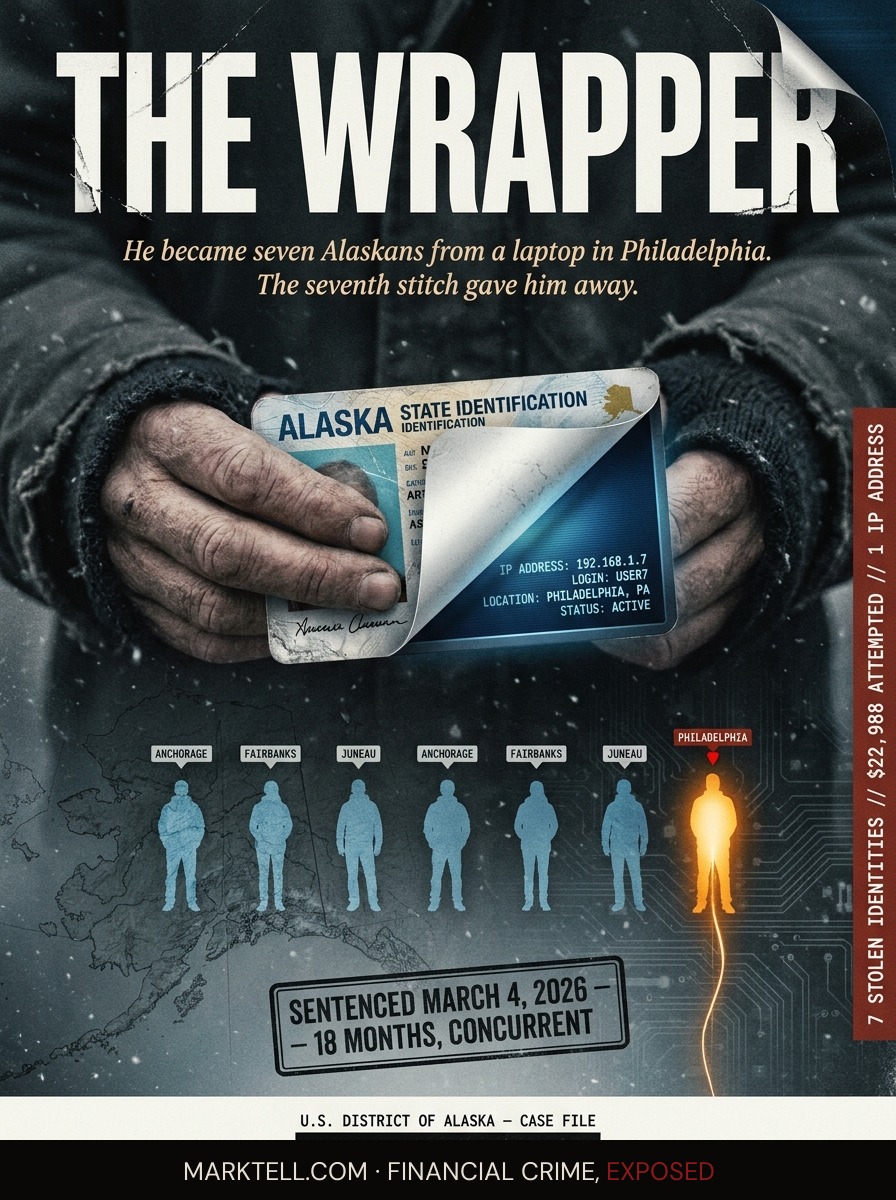
The man inside the wrapper was Adepoju Babatunde Salako, thirty-three, of Philadelphia. According to the U.S. Attorney's Office for the District of Alaska, between January and February 2022 Salako submitted seven applications to the Alaska Department of Revenue's PFD program using the stolen personal identifying information of seven legitimate Alaska residents. He had never lived in Alaska. He had, the filings indicate, never been to Alaska.
He built the wrapper carefully. For each victim he created a fresh email account he controlled. He took over their myAlaska accounts. He changed the contact information so that confirmations would route to him, not to them. He changed the bank account on file so that any approved dividend would land in an account he controlled. Then he applied.
To make the applications look like they were coming from inside Alaska, he used a virtual private network. A VPN is a piece of software that hides the real location of a computer by routing its traffic through a server somewhere else. Six of the seven applications appeared, on the state's logs, to originate from an Alaska IP address. They looked, on the wire, like they were filed from Anchorage or Fairbanks or Juneau.
The seventh did not.
The seventh application came through bare. It carried a Philadelphia IP. Read that slowly. Six clean, one dirty. One application out of seven, filed by a man who had presumably done this enough times to know better, leaked its real origin.
That is how a wrapper fails. Not because the inside is wrong. Because one stitch on the outside catches the light.
The State of Alaska's PFD program has been running fraud analytics since 2016. The Department of Revenue's Criminal Investigations Unit, working with vendors that cross-check applicant data against risk factors, flags applications before payment, not after. All seven of Salako's applications were denied. No dividend left the state. The attempted theft, by the math, was seven times $3,284, which is $22,988.
That number matters less than the method. The method is the machine.
Marjorie did eventually get back into her account. She called the PFD office. She answered the questions only she could answer. She reset her email. She reset her password. She changed her bank login because she did not know what else the man in Philadelphia had touched. She wrote her Social Security number on a piece of paper and then shredded the piece of paper because writing it down had started to feel dangerous.
The dividend, that year, came through. The state's system had worked.
What the system could not do was give her back the week she spent on the phone, or the small new habit of checking her credit report every Sunday, or the feeling, which did not go away, that some stranger in another city now knew her middle name and her mother's maiden name and the year she graduated high school.
Salako was already in federal custody for other work. On March 4, 2026, he was sentenced in Colorado to more than six years in federal prison and ordered to pay over $2.5M in restitution for wire fraud and money laundering tied to COVID-19 relief loan fraud and romance scams that touched victims across thirty states. The Alaska case was, in the language of federal sentencing, a concurrent matter. It added eighteen months. It did not extend his release date by a day.
That part may be the saddest part. Not because the punishment was light. Because the Alaska piece, the part where he reached across the country and tried to take seven small civic payments from seven people who had earned them by living somewhere cold for long enough, was small enough to fold inside a larger sentence without changing it.
U.S. Attorney Michael J. Heyman said the case should send a clear message that stealing an identity to exploit the Permanent Fund Dividend will not be tolerated. Scott Stair, of the state's Criminal Investigations Unit, said the department was committed to protecting Alaskans from financial fraud. Matthew Schlegel, the FBI's Special Agent in Charge in Anchorage, said the PFD program is intended to benefit eligible Alaskans, not criminals like Salako.
All of that is true and all of that is the language of a press release. The language of the case is different. The language of the case is the seventh IP address. The language of the case is Marjorie staring at a login screen that has decided she is not herself.
The wrapper will be tried again. It is being tried right now, against other government benefits, in other states, by other people. The PFD is a clean target because the dividend is predictable, the amount is published, the application window is known, and the deposit is electronic. The only friction is residency. Residency, in the era of stolen PII and rented VPNs, is a field on a form.
Picture it from his side for a moment. A laptop in Philadelphia. Seven browser tabs. Seven email accounts he made yesterday. Seven myAlaska logins he took over the week before. A VPN client humming in the background. The 2022 dividend was $3,284. Multiply by seven. Hit submit.
Now picture it from hers. The kitchen laptop. The password that no longer works. The polite hold music of a state office. The slow, private work of being un-stolen.
Salako tried to be seven Alaskans at once. He could not maintain the wrapper for the seventh. The state caught him on the stitch. He will serve eighteen months for it, inside a sentence he was already serving for something larger.
The machine that built the wrapper is still running. It does not require him.
- U.S. Attorney's Office, District of Alaska | May 20, 2026 | Press release on sentencing of Adepoju Babatunde Salako for PFD wire fraud
- U.S. Department of Justice / District of Colorado | March 4, 2026 | Sentencing of Salako on COVID-19 relief fraud and romance scam charges, restitution order exceeding $2.5M
- Alaska Department of Revenue, Permanent Fund Dividend Division | 2022 | Published 2022 dividend amount ($3,284) and program eligibility requirements
- Alaska Department of Revenue, Criminal Investigations Unit | program materials | Use of data analytics and LexisNexis risk-factor screening since 2016
- FBI Anchorage Field Office | May 20, 2026 | Statement from SAC Matthew Schlegel accompanying sentencing
- Your Alaska Link | May 21, 2026 | "Pennsylvania man sentenced in Alaska PFD fraud scheme"
Editorial Notice
MarkTell is a true crime publication about financial fraud. Some scenes, dialogue, and sequential details are reconstructed from court filings, enforcement actions, news reports, and public records. Where the public record does not provide exact details, editorial reconstruction is used to convey the documented pattern of events. Names of private individuals may be changed to protect identity. All factual claims are sourced to public documents cited in the Evidence Trail above. MarkTell does not provide investment, legal, or financial advice. Nothing published here constitutes a recommendation to buy, sell, or avoid any investment. Allegations described in active cases have not been adjudicated and defendants are presumed innocent until proven guilty. Readers should conduct their own due diligence before making financial decisions.