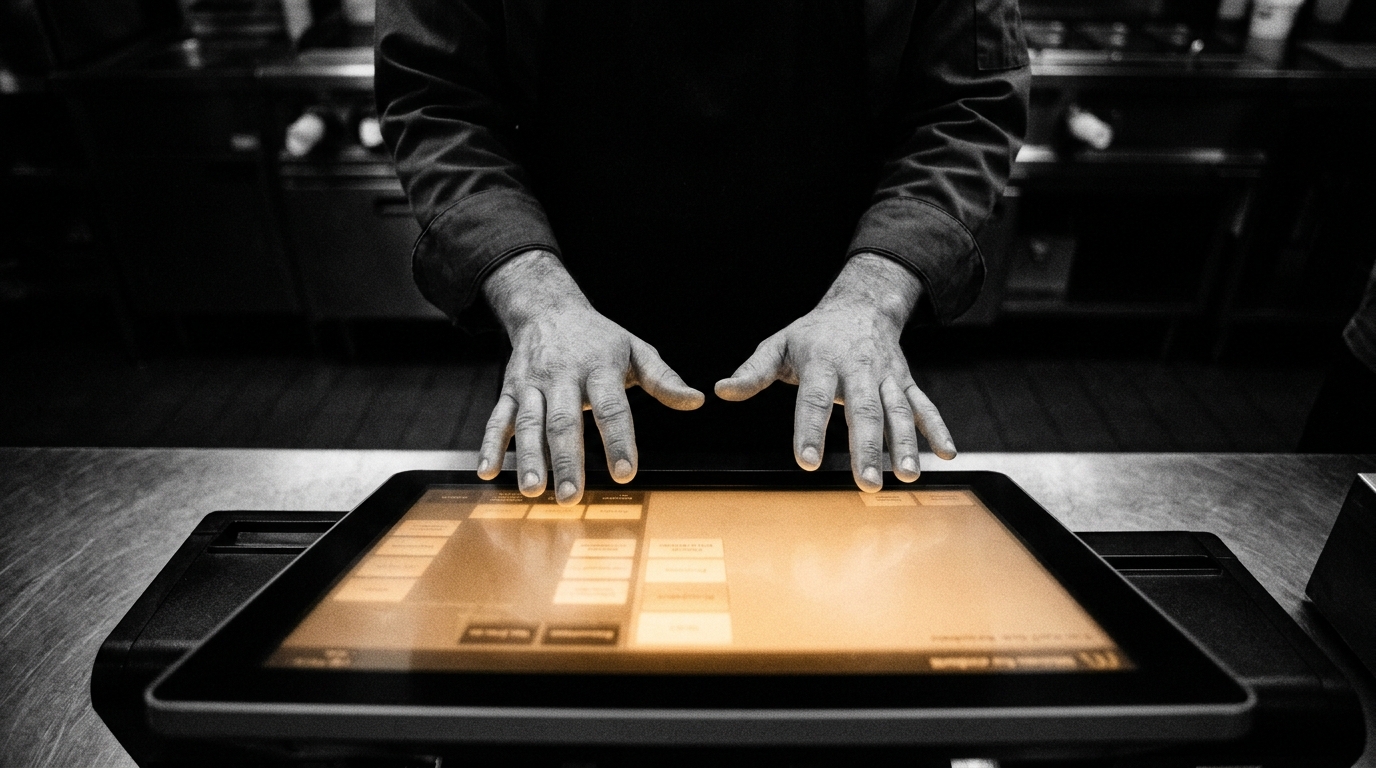
He was fired in October. In November, the register still knew his hands.
A former Chick-fil-A employee in Grapevine, Texas allegedly walked back behind the counter after his termination and ran 800 fake mac and cheese orders through the register, refunding each one to his own credit cards. The machine that let him do it was not a hack. It was a door that nobody thought to close.
I. The Tray That Was Never Made
Sometime in November 2025, the owner of a Chick-fil-A franchise in Grapevine, Texas sat down with a stack of POS reports. POS stands for point-of-sale. That is the system that records every transaction at a register: what was ordered, what was charged, what was voided, what was refunded. Every fast-food location generates thousands of these lines every week. Most owners never read them all the way down.
This one did.
What he found, according to the police investigation that followed, was a pattern that did not match any normal night of business. Mac and cheese orders, one after another, rung up and immediately refunded. Not refunded to a customer. Refunded to a credit card. The same credit cards, over and over. No product made. No customer served. Just a transaction that existed long enough to generate a refund, and then disappeared into a card that did not belong to the restaurant.
He called Grapevine police in November 2025.
The number the investigation eventually landed on: just over $80,000. Approximately 800 transactions. The item at the center of each one: a catering tray of macaroni and cheese, the kind Chick-fil-A sells for large orders, priced at roughly $106. Do the math slowly. Eight hundred trays at $106 each is $84,800. The figure in the charging documents is just over $80,000. The math is close enough to see the shape of the machine.
The machine, in this case, was not a computer exploit. It was not a sophisticated wire transfer scheme or a shell company registered in a state nobody checks. It was a door. Specifically, it was a door that the restaurant forgot to close.
The employee attached to the alleged transactions, according to Grapevine police, was Keyshun Jones. Jones had been terminated from the Grapevine location in October 2025. That is one month before the alleged scheme began.
Picture the gap. October. Terminated. November. The register still running his hands.
II. The Door Nobody Closed
Here is what the surveillance footage allegedly showed, according to the investigation: a man who no longer worked at that restaurant walking behind the counter. Standing at the register. Entering orders.
Nobody stopped him. The footage captures it.
We do not know, from the public record, exactly how Jones allegedly re-entered the restaurant. We do not know whether a door was unlocked, a code was unchanged, a coworker looked away, or whether the layout of that particular location made it easier than it should have been to slip behind the counter during a shift. What the record tells us is that, according to the Grapevine Police Department's investigation, it happened repeatedly, enough times to run approximately 800 transactions before the owner looked at his numbers.
That is the door. Not a password. Not an exploit. A physical door, and a POS system that kept accepting input from hands that had been let go.
Refund fraud works like this. An employee with register access rings up a transaction for a real item on the menu. Then, before any product is made, before any customer collects anything, the employee processes a refund. A refund, in most POS systems, can be redirected to a payment method that was not used in the original transaction. Instead of going back to a customer's card, the refund goes to a card the employee controls. The system records a clean transaction: order placed, order refunded. The till does not come up short. The inventory count does not flag a missing tray. The money simply moves from the restaurant's account to a private card, wrapped in paperwork that looks like a customer return.
The item Jones allegedly used was not chosen at random. A catering tray of mac and cheese is not a $4 order. At approximately $106 per tray, each transaction was large enough to matter but not so unusual, on its face, that a single entry would trigger an alert. It is only at 800 transactions that the pattern becomes visible.
That is the math of concealment. Keep each individual transaction within a plausible range. Let the volume do the damage.
By the time the volume became visible, the number was over $80,000.
III. Five Months
The owner reported the theft in November 2025. Grapevine police opened an investigation. The Texas Attorney General's Fugitive Task Force eventually assisted. Fort Worth Police Department assisted. Jones reportedly evaded arrest more than once before he was taken into custody on April 17, 2026.
Five months between the report and the arrest.
The charges Jones faces: property theft, money laundering, and evading arrest. These are felonies. The case is pending. Jones has not been adjudicated. What the public record contains is an arrest and a set of allegations. What happens next is for a court to determine.
But the charges include money laundering, which is worth pausing on. Money laundering, in plain terms, is the process of making money that came from illegal activity look like it came from somewhere legitimate. In this alleged scheme, the mechanism is the refund receipt itself. A receipt that says "refund processed" looks like a legitimate transaction. It is, technically, a transaction the system recorded correctly. The illegitimacy is not in the record. It is in the intent behind the entry.
The refund is the wrapper. The wrapper is the laundering. That part may be the saddest, because the wrapper is generated automatically by the same system the restaurant uses for every legitimate return. The machine does not know the difference. It just processes.
IV. This Is Not a New Door
Keyshun Jones is not the first person to find this door.
In June 2024, a former Chick-fil-A manager named Timothy Hill pleaded guilty to wire fraud. Hill had worked at a location in the Minneapolis-St. Paul International Airport. Between September 2022 and October 2023, he embezzled approximately $144,000. The mechanism was similar in structure: register access, diverted transactions, money moving through the POS system to accounts it was not supposed to reach.
Before that, in September 2021, two former Chick-fil-A employees, Larry James Black, Jr. and Joshua Daniel Powell, pleaded guilty to a conspiracy that diverted $492,000 in customer payments to their own accounts between April 2018 and January 2018.
Three cases. Three locations. Three time periods. One open door.
The door is the POS system running without adequate exception controls. It is the access credential that outlives the employment relationship. It is the refund process that does not require a second set of eyes. It is the physical space that allows someone who used to stand behind the counter to stand there again.
This is the thing about a machine that keeps running: it does not need the same operator every time. When one operator is removed, the machine waits. The next operator finds it.
The restaurant industry, and particularly quick-service restaurants, runs on high turnover. Many employees. Many access credentials. Many transactions per shift. The combination creates a monitoring problem that the industry has documented for years: POS exception reporting, which flags unusual patterns like high-value refunds or repeated voids, is available but not universally deployed or reviewed in real time.
When it is reviewed in real time, the pattern stops.
When it is reviewed a month later, the tray count is 800.
V. What the Register Recorded
Here is what the record contains, stripped to its structure.
A man is terminated in October 2025.
In November 2025, transactions begin appearing on the register at the restaurant where he used to work. The transactions are mac and cheese trays. They are immediately refunded. The refunds go to credit cards.
The transactions continue. The surveillance camera is running.
The owner finds the numbers. He calls the police.
Five months pass.
The man is arrested. He faces felony charges. The case is pending.
The register recorded all of it. The order. The refund. The card number. The time stamp. Every transaction logged and stored, in the order it happened, with no opinion about what it meant.
That is the thing about a POS system. It keeps the record. It does not close the door. It does not ask whether the hands at the register belong there. It does not know the difference between a legitimate refund and the one being processed right now.
It just records.
The door was open. The record was kept. And somewhere in Grapevine, Texas, there is a surveillance tape of a man standing where he no longer had the right to stand, and a register that accepted everything he entered without asking whether he still worked there.
The system performed exactly as designed.
That is the open door.
It is still in every restaurant that has not checked who still has the keys.
- Grapevine Police Department | April 2026 | Arrest record and investigation, Keyshun Jones, Grapevine Texas Chick-fil-A fraud case
- WWNY / Google News | April 29, 2026 | "Chick-fil-A employee accused of ringing up 800 mac and cheese orders, refunding them to his credit cards" | https://news.google.com/rss/articles/CBMixwFBVV95cUxNTFFPV0t4MWdvNkpMMlBJX1ZqWHVuQ0hwei0yN0NIemtOT3VZeWZqci1CUm5EUHd1T1dwQ01KY0NfeTVNdnR1N0hVWTJkaVJUdXM1MFctRW5rdWZKTGRvOXo4UnJrcUxXWDMxRzlUQTJXbmNnMVNpR2E5Snhwcnd3cnB5VEdVcEFTOWxtR0lMdUtkUGx5QXF3SElPV2lFdEd3WThaUGNlb2xJWmVVMTBFbnNjS1psLXdhYWZtZ0l2bnE1ZWRtRldB
- U.S. Department of Justice | June 2024 | Timothy Hill guilty plea, wire fraud, Chick-fil-A Minneapolis-St. Paul Airport, $144,000
- U.S. Department of Justice | September 2021 | Larry James Black Jr. and Joshua Daniel Powell guilty plea, conspiracy, $492,000 in diverted customer payments
- Chick-fil-A public catering menu pricing | 2025 | Mac and cheese tray pricing, approximately $106 per large catering tray (used for contextual calculation only)
Editorial Notice
MarkTell is a true crime publication about financial fraud. Some scenes, dialogue, and sequential details are reconstructed from court filings, enforcement actions, news reports, and public records. Where the public record does not provide exact details, editorial reconstruction is used to convey the documented pattern of events. Names of private individuals may be changed to protect identity. All factual claims are sourced to public documents cited in the Evidence Trail above. MarkTell does not provide investment, legal, or financial advice. Nothing published here constitutes a recommendation to buy, sell, or avoid any investment. Allegations described in active cases have not been adjudicated and defendants are presumed innocent until proven guilty. Readers should conduct their own due diligence before making financial decisions.