He stole from the relief fund. Then he stole again to pay the court back.
Levelle Joseph Harris already owed the federal government $1.28 million for stealing pandemic relief. To pay it off, prosecutors say, he ran a second scheme. The court called it a bogus mortgage deal. The trapdoor opened twice.
I.
Marisol's monitor glowed at 3:14 on a Tuesday afternoon. She was a loan processor at a mid-sized Florida lender. Thirty-eight years old. Two kids. She had been doing this work for eleven years and she was good at it, which mostly meant she was fast and she did not miss the obvious things.
The file on her screen looked clean. Income documentation. Employment verification. A borrower applying for a mortgage on a residential property. The numbers tied. The paystubs matched the bank deposits. The employer answered the phone.
She clicked approve.
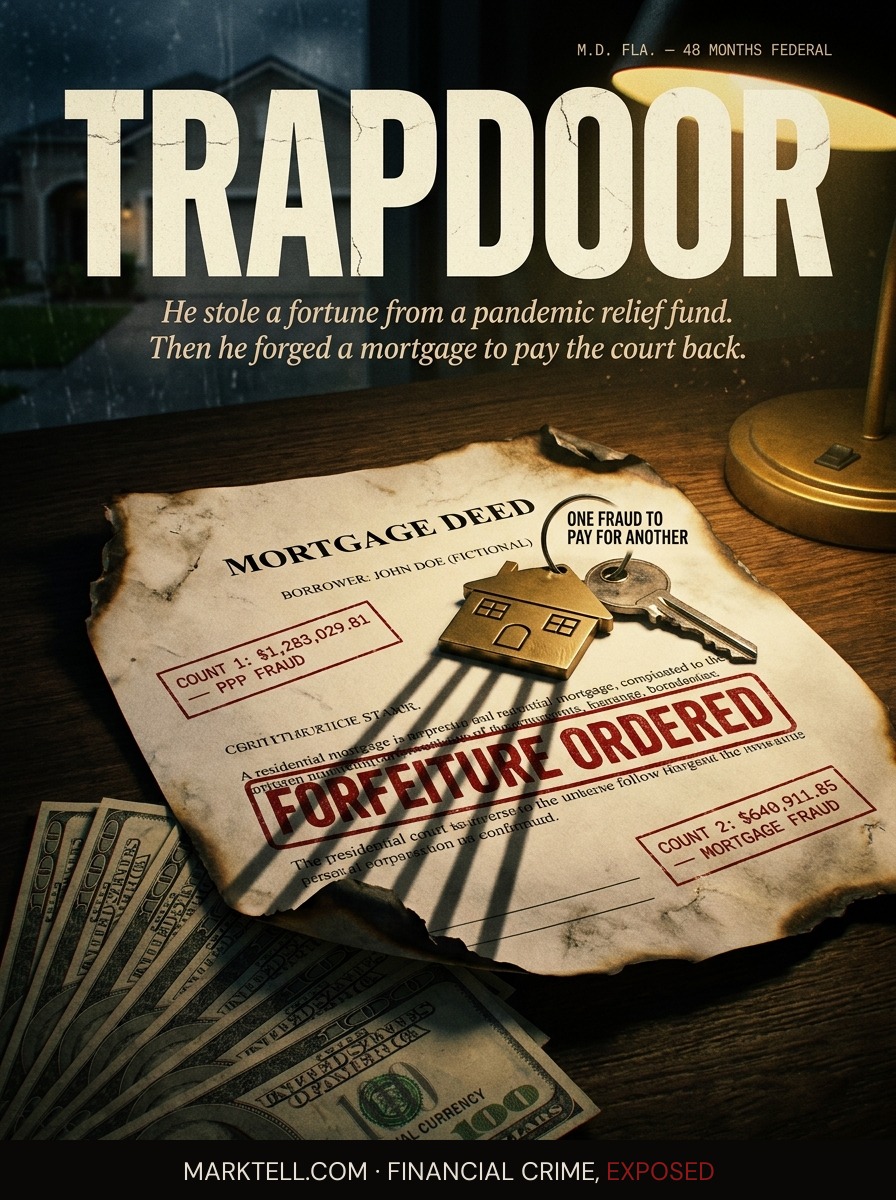
She did not know, when she clicked, that the man whose name was on the application already owed the federal government $1,283,029.81. She did not know that a federal judge had entered that number as a criminal forfeiture order. She did not know that the loan she had just helped close, all $640,911.85 of it, would be used to pay that debt.
She would not know any of that for years.
That is how a trapdoor works. The person on top of it does not feel the floor until it opens.
II.
Levelle Joseph Harris is forty years old. He lives, or lived, in Kissimmee.
In 2020, when the federal government was pushing pandemic relief money out the door as fast as it could move, Harris filed applications under the Paycheck Protection Program. PPP was a forgivable-loan program designed to keep small businesses paying their workers during the COVID shutdowns. The applications required the borrower to attest, under penalty of perjury, to payroll figures and business operations.
Harris obtained more than $1.28 million in PPP loans, according to the U.S. Attorney's Office for the Middle District of Florida. The applications were false. A federal grand jury indicted him. He was convicted on fourteen counts of wire fraud.
In January 2023, he was sentenced to 27 months in federal prison. Judge entered a criminal forfeiture order in the amount of $1,283,029.81. That number is exact because the government tracked exactly what he took.
A criminal forfeiture is the government's claim on the proceeds of the crime. The defendant does not get to keep the house, the car, the boat, or whatever else the stolen money paid for. He has to give it back, or give back the cash equivalent. Harris had used a portion of the PPP money to buy a home. The government wanted the home.
This is where most fraud stories end. The indictment. The plea. The sentence. The forfeiture. The press release.
Harris's story did not end there. According to the government, it forked.
III.
Between February 2022 and January 2023, while the PPP case was still moving through the federal courthouse in Orlando, Harris was running a second play.
The first scheme had been a fraud on the relief program. The second scheme, the government alleges and Harris later admitted, was a fraud on a mortgage lender.
He applied for a mortgage. The application contained false representations. The lender approved it. The proceeds, $640,911.85, were used to purchase a residential property and to pay off the criminal forfeiture from the PPP case.
Read that again.
He used a fraudulent mortgage to pay the court back for the previous fraud.
The U.S. Attorney's Office described it, in plain language, as an attempt to "outsmart a court-ordered forfeiture with a bogus mortgage deal." That phrase is doing a lot of work. It captures the structure. One fraud underneath another, holding it up.
The government calls this wire fraud because a mortgage application moves through wires. Underwriting software, electronic signatures, wire transfers at closing. Every step generates a federal hook.
IV.
Marisol does not exist. Or rather, a Marisol exists at every lender that closed a residential mortgage in central Florida between 2022 and 2023. The composite is the point. Every fraudulent mortgage moves through a person who is doing her job correctly based on the documents in front of her.
The fraud is not the lender's failure. The fraud is the application.
But the cost of the fraud spreads. The lender loses money. The investor who bought the loan on the secondary market loses money. The federal mortgage insurance program, if it was involved, loses money. The neighborhood absorbs an artificially priced sale that gets baked into the comps. And the next borrower in line pays a slightly higher rate because the lender prices in the risk of being lied to.
That is what a single mortgage fraud does. Multiply by the volume of the trade. The DOJ has a name for this and an entire task force structure built around it.
V.
On July 30, 2025, Harris pleaded guilty to wire fraud for the mortgage scheme.
On June 1, 2026, Senior U.S. District Judge John Antoon II sentenced him to 21 months in federal prison. The court also ordered the forfeiture of $640,911.85, representing the proceeds of the mortgage fraud.
The investigation was run by the FBI. The case was prosecuted by Assistant U.S. Attorney Hannah Nowalk Watson.
Add the numbers. 27 months for PPP. 21 months for the mortgage scheme used to pay off the PPP forfeiture. Forty-eight months of federal prison stacked on top of forfeiture orders that together claim nearly $1.93 million.
The math does not redeem the victims. PPP money went to Harris instead of a small business that needed it to make payroll. Mortgage money went to Harris instead of staying inside the lender's loan portfolio. The forfeiture orders create a paper claim on assets. Whether those assets exist, and in what form, is a separate question. The government can get a judgment for $1.28 million. Collecting it is a different conversation.
VI.
The U.S. Attorney's Office for the Middle District of Florida has federally charged 109 individuals with COVID-19 related fraud schemes since March 2020. That number, drawn from the office's own count, tells you what the field looks like. Pandemic relief was a once-in-a-generation flood of federal money distributed under emergency conditions, with controls relaxed because the controls would have starved the program of its purpose. The fraud was always going to be substantial. The prosecutions are still arriving, six years on.
Harris is one of a longer list. In April 2026, a Florida woman named Jane Batista was sentenced to 18 months for a $465,489 COVID relief scheme. In March 2026, Angel Jackson of Astatula was sentenced for a mortgage fraud conspiracy involving fictitious paystubs. The same week Harris was sentenced, a Tampa real estate investor was indicted for allegedly inflating his income on a $1.6 million mortgage application.
Different names. Different counties. The same shape underneath.
VII.
The PPP scheme was the first fraud. The mortgage scheme was the second. Both used the same machinery: a document submitted under penalty of perjury, attesting to a fact that was not true, processed by a system that takes the attestation at face value and releases the money.
The system has to take the attestation at face value, most of the time, because the alternative is that no money moves. The cost of fraud is built into the cost of credit and the cost of relief programs. The system tolerates a certain amount of leakage because the alternative is no system.
The fraudster bets on the leakage. The fraudster who bets twice, bets that the leakage will keep flowing even after the first bet has been called.
Harris bet twice. The second bet was the one where the trapdoor opened.
VIII.
Marisol is still at her desk. She is still clicking approve on files that look clean. She has to. That is the job.
Somewhere in her workflow, in a stack of files this quarter or next, another application will come through that ties out perfectly. Paystubs that match deposits. An employer who answers the phone. A borrower with a story that holds together.
She will click approve.
She will not know which file is the next one until the indictment lands.
The first fraud was the relief. The second fraud was the repayment. The next fraud is already in the queue.
- U.S. Attorney's Office, Middle District of Florida | June 1, 2026 | Sentencing announcement, U.S. v. Levelle Joseph Harris
- U.S. District Court, Middle District of Florida | January 2023 | Sentencing and criminal forfeiture order, U.S. v. Harris (PPP case)
- U.S. District Court, Middle District of Florida | July 30, 2025 | Plea agreement, U.S. v. Harris (mortgage fraud)
- Orlando-News.com | June 2026 | "Kissimmee man sentenced for using mortgage fraud to pay off previous COVID scam"
- Federal Bureau of Investigation | Investigating agency
- U.S. Department of Justice | COVID-19 Fraud Enforcement Task Force background and statistics
Editorial Notice
MarkTell is a true crime publication about financial fraud. Some scenes, dialogue, and sequential details are reconstructed from court filings, enforcement actions, news reports, and public records. Where the public record does not provide exact details, editorial reconstruction is used to convey the documented pattern of events. Names of private individuals may be changed to protect identity. All factual claims are sourced to public documents cited in the Evidence Trail above. MarkTell does not provide investment, legal, or financial advice. Nothing published here constitutes a recommendation to buy, sell, or avoid any investment. Allegations described in active cases have not been adjudicated and defendants are presumed innocent until proven guilty. Readers should conduct their own due diligence before making financial decisions.