He spun tale after tale for fifteen years. The wire transfers told a quieter one.
Franklin Ikechukwu Nwadialo got five years in federal prison this week for a romance fraud that drained $3.5 million from eight people over fifteen years. The court called it devastating. The wire chain called it a business.
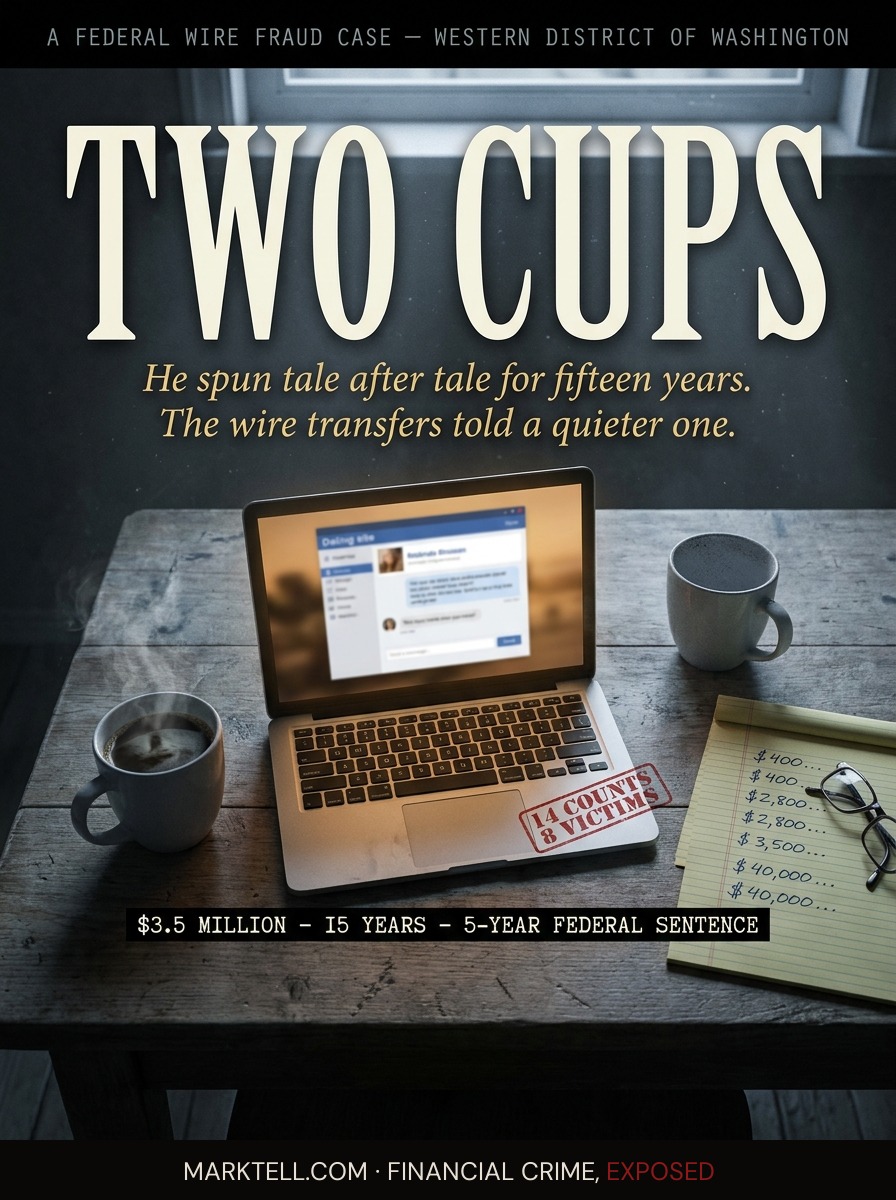
Marlene set two cups out that Sunday morning out of habit. Her husband had been gone three years. The second cup still went on the table because the table looked wrong without it.
She was sixty-eight. She had kept the books for a school district in Pierce County for thirty-one years. She knew how to read a ledger. She knew what a reconciliation looked like. She knew the difference between a debit and a credit better than most of the men she had worked for.
The message came in on the dating site around two in the afternoon. The photograph was a man in fatigues, leaning against something that looked like a Humvee. He said his name was a name. He said he was deployed. He said he had seen her profile and something about her face had stopped him.
She read it twice. Then she read it again.
This is not a story about a foolish woman. Read that slowly.
This is a story about a man named Franklin Ikechukwu Nwadialo, who is forty-two, and who was sentenced this week in a federal courtroom in Tacoma to five years in prison. The case file says fourteen counts of wire fraud. The case file says eight victims. The case file says more than $3.5 million.
The case file says it took fifteen years.
I.
A fraud that runs for fifteen years is not a crime of impulse. It is a business.
Nwadialo, a Nigerian national, ran his on dating sites. According to the U.S. Attorney's Office for the Western District of Washington, he built online identities, courted women he never met, and produced a rotating catalog of reasons they needed to send him money. A military fine he had to pay before he could come home. His father had died and the funeral could not happen without help. His son needed school fees. There was an investment, and the investment was going to make everything right.
First Assistant U.S. Attorney Charles Neil Floyd said at sentencing that Nwadialo "spun tale after tale." That is the prosecutor's language. It is also, accidentally, a description of the business model. Each tale was an invoice. Each invoice generated a wire. Each wire cleared.
Judge Tiffany M. Cartwright called the harm "devastating." She used three more words at sentencing that mattered. Shame. Depression. Isolation.
Those are not side effects. Those are the locks on the door. Shame is what keeps the victim from telling her daughter. Depression is what keeps her from calling the bank. Isolation is what keeps her sending the next wire, because by then he is the only person in her life who texts her good morning.
The fraud is the wire. The machine is what makes the next wire possible.
II.
Picture the kitchen table again.
Marlene did not send money the first week. She did not send money the second week. He did not ask. He asked about her husband. He asked what her husband had been like. He asked if she still kept his tools.
The first ask came around week six. It was small. A few hundred dollars for a phone card so they could keep talking while he was deployed. She sent it through a gift card she bought at the drug store on Pacific Avenue. She did not tell anyone. There was nothing to tell. It was a phone card.
The asks got larger. The reasons got more elaborate. By the time he mentioned the investment, she had already sent enough that walking away meant admitting the earlier money was gone. She did not want to admit that. So she sent more.
This is the part the prosecution made explicit. Nwadialo, according to the government, was running a fraudulent investment scheme inside the romance scheme. He used money from one victim to send fake "returns" to another. The second victim saw the returns and sent more. The first victim was told her money was working. Nobody was watching the whole picture except him.
A Ponzi scheme is when you pay early investors with later investors' money and call it profit. The word usually shows up in stories about hedge funds and crypto tokens. It applies here. The product was love. The accounting was the same.
One of Marlene's wires was $40,000. She walked it into her credit union and slid the form across the counter. The teller asked her if she was sure. She said she was sure. The teller asked her again. She said she was sure.
She was not lying. She was sure. The man on the other end of the messages had told her this was the one that would bring him home.
III.
The total, across eight people, was more than $3.5 million.
One victim lost over $2.4 million. Another liquidated her home equity and her retirement savings. These are the numbers in the court record.
Do the math on $2.4 million from one person. That is not a phone card. That is a house. That is forty years of work. That is the difference between a comfortable retirement and a list of which bills to pay this month.
The FBI's Internet Crime Complaint Center says romance scams cost Americans $672 million in 2024 and more than $943 million in 2025, a 35 percent jump. The Federal Trade Commission put 2023 losses at $1.14 billion, the largest of any imposter scam category. Adults over sixty account for more than half of the dollar value. Most cases are not reported. Shame is the lock on the door.
Nwadialo was not unusual. He was a unit of a larger system. He was just the one who got caught.
He got caught because he flew to America.
IV.
In 2024, Nwadialo landed at an airport in Texas. The FBI was waiting. Special Agent in Charge W. Mike Harrington's office had built the case. The arrest happened at the jet bridge.
For fifteen years he had operated from outside U.S. jurisdiction. The accounts were structured to move money through layers the victims could not see and the banks did not always flag. Romance scam wires are hard to flag because the victim authorizes them. The victim insists. The victim, when the bank asks, says she is sure.
That is the structural problem. The money leaves a trail. The trail leads to mule accounts, to shell companies, to wallets, to other jurisdictions. The trail exists. It is hard work to follow, and most of the time, when the victim finally calls, the money has already moved three more times.
A single source reports that Nwadialo also served as Chairman of the Ogbaru Local Government Area in Anambra State, Nigeria. I cannot confirm that against the U.S. court record. If true, it sits next to the fraud the way these things often do. The man who runs the scheme on the laptop and the man who walks into the office in the morning can be the same man. Sometimes the office has a nameplate.
V.
Marlene found out the way most of them find out. He stopped answering.
The investment was about to pay out. He had said so. There was one more wire that needed to clear and then everything would be settled and he would be on a plane. She sent it. The messages slowed. The messages stopped. The dating profile was gone.
She sat at the kitchen table with the laptop open and the second coffee cup where it always was, and she understood what she had done in the order a bookkeeper understands a ledger. She went back through her statements. She wrote the dates and the amounts on a yellow pad. She added them up.
The number on the yellow pad was the number.
She did not call her daughter. She called the FBI tip line. The agent who answered was kind. He told her she was not the first call that week. He told her she would not be the last.
That part may be the saddest.
VI.
At sentencing this week in Tacoma, the judge gave Nwadialo five years. Restitution is expected to follow. Whether anything will actually be recovered is the question the court order cannot answer. The money moved through fifteen years of accounts. Some of it bought a life somewhere. Some of it paid the next round of fake returns to the next victim to keep her sending.
Five years is the sentence on the man.
The machine is older than the man.
It will run again next week under a different photograph, a different fatigues, a different name in a different inbox. It will find a woman whose husband has been gone three years, who still sets two cups on the table, who knows how to read a ledger and does not yet know she is in one.
He spun tale after tale. That is what the prosecutor said.
He spun tale after tale because the tales were the product. The money was just the receipt.
- U.S. Attorney's Office, Western District of Washington | June 2026 | Sentencing announcement, U.S. v. Franklin Ikechukwu Nwadialo
- MyNorthwest.com | June 23-25, 2026 | "'He spun tale after tale': Nigerian man sentenced for $3.5M romance scam targeting 8 victims"
- U.S. District Court, Western District of Washington (Tacoma) | June 2026 | Sentencing hearing before Judge Tiffany M. Cartwright
- FBI Internet Crime Complaint Center (IC3) | 2024-2025 | Annual Internet Crime Report data on romance scam losses
- Federal Trade Commission | 2023 | Consumer Sentinel Network data on imposter scams
- FBI Seattle Field Office | 2024 | Arrest record, Texas airport apprehension of Nwadialo
Editorial Notice
MarkTell is a true crime publication about financial fraud. Some scenes, dialogue, and sequential details are reconstructed from court filings, enforcement actions, news reports, and public records. Where the public record does not provide exact details, editorial reconstruction is used to convey the documented pattern of events. Names of private individuals may be changed to protect identity. All factual claims are sourced to public documents cited in the Evidence Trail above. MarkTell does not provide investment, legal, or financial advice. Nothing published here constitutes a recommendation to buy, sell, or avoid any investment. Allegations described in active cases have not been adjudicated and defendants are presumed innocent until proven guilty. Readers should conduct their own due diligence before making financial decisions.