He Said He Owned None of It. Then He Sold All of It.
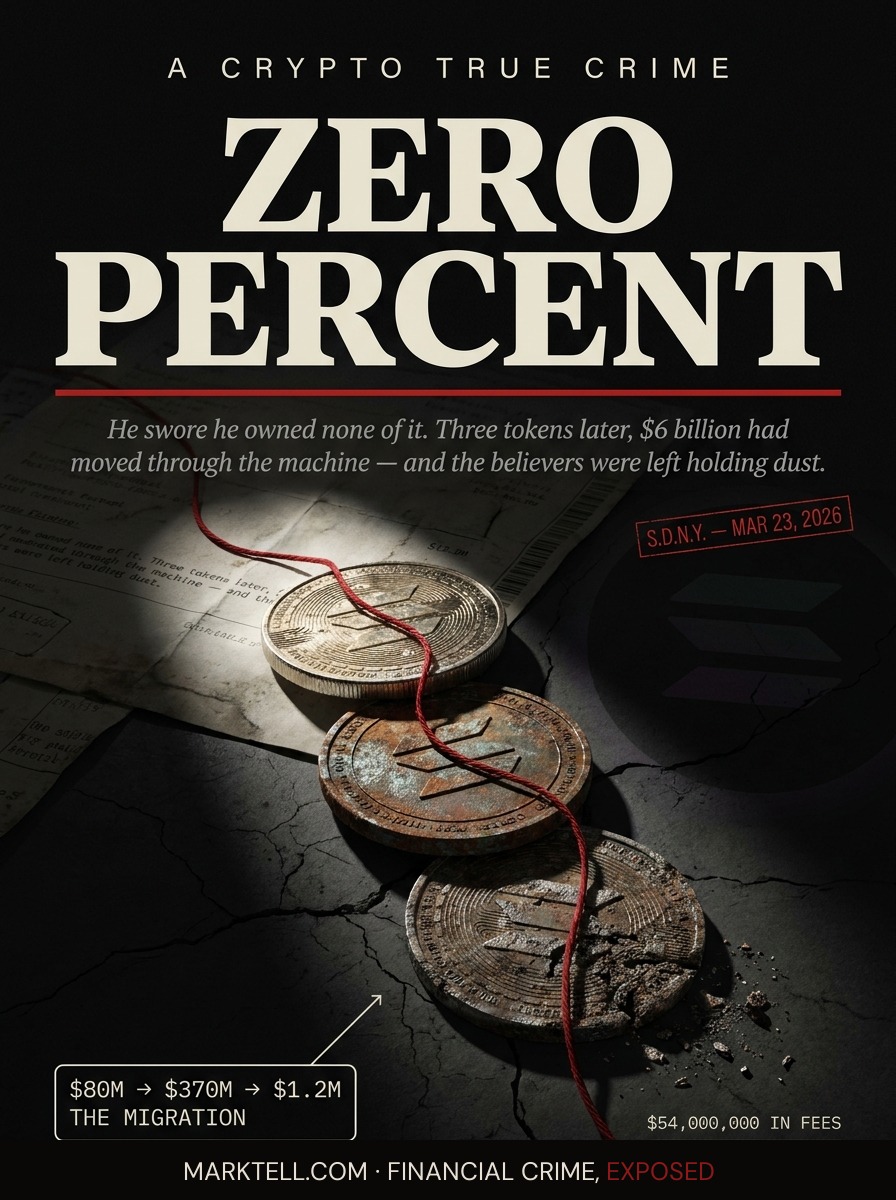
Ben Pasternak built three consecutive crypto tokens, told investors he had no stake in any of them, and walked away with a platform that processed $6 billion in trades while retail holders were left with coins worth fractions of a cent. This is what the machine looked like from the inside.
Picture someone who bought in early.
Maybe she found it on a finance subreddit in January 2025, scrolling on her lunch break, a sandwich going cold on the desk beside her. Maybe she was twenty-four, maybe thirty-seven. Maybe she had been watching the crypto space from a distance for two years, waiting for something that felt different from the meme coins and the obvious garbage. Something with a face on it. A founder with a real track record.
She found one.
Ben Pasternak was twenty-six years old and had already been on Forbes' 30 Under 30 list. Not for crypto. For plant-based chicken. He had co-founded a company called Simulate, sold it in October 2024, and now he was building something in the blockchain space. A platform on Solana called Clout, later renamed Believe. A place where anyone could launch a token tied to their personal brand or project. The pitch was clean. The founder was credible. The technology was real.
She bought in.
She was not reckless. She was not naive in the way the world prefers its victims. She did the thing you are supposed to do. She looked at the founder. She read the pitch. She watched the price move.
She did not know she was reading a script.
---
I. THE FIRST TOKEN
The token was called $PASTERNAK.
Pasternak launched it in January 2025. Before it went live, he made a public statement that would become the load-bearing wall of everything that followed. He said he owned zero percent of the token. No insider allocation. No founder's share. Nothing. The math was simple: if he had no coins, he had no way to dump them on you.
A token allocation is the portion of a new cryptocurrency reserved for the team, founders, or early insiders before public sale. When founders claim zero allocation, they are telling you the playing field is level. No one at the top of the structure is holding a bag they plan to sell into your buy order.
The $PASTERNAK token hit a market capitalization of $80 million on its first day. Market capitalization, in crypto, means the total value of all coins in circulation multiplied by the current price. Eighty million dollars of perceived value, in one day, because a Forbes-listed founder said he had no skin in the game.
Then the price fell.
Not dipped. Not corrected. The complaint filed on March 23, 2026, in the U.S. District Court for the Southern District of New York describes a collapse of more than 95% within a week. The investors who bought in at the peak were holding, by the end of that first week, roughly four cents for every dollar they had put in.
The woman at her desk with the cold sandwich. She was holding four cents.
But Pasternak had a plan. He announced a buyback. A buyback is when the entity behind a token uses its own funds to purchase coins from the open market, reducing supply and theoretically pushing the price back up. He said he would support the holders. He said to stay in.
She stayed in.
That part may be the saddest.
---
II. THE REBRAND
In May 2025, $PASTERNAK became $LAUNCHCOIN.
Not a new project. A renaming. The same platform, the same founder, a new ticker symbol and a new round of promotion. The token reached a peak market capitalization of $370 million. That number is worth sitting with for a moment. Three hundred and seventy million dollars in perceived value built around a platform that had already, five months earlier, delivered a 95% collapse to its first wave of investors.
The first wave was still in the room. They had been told to hold. Now they were watching a new wave arrive.
The press releases got the light. The token price chart got the screenshots. The Solana developer community got the case studies. The collapse of $PASTERNAK got the footnote.
New investors found $LAUNCHCOIN the way investors always find the second act of a story like this. Through the community. Through the chart. Through the fact that the founder had been on Forbes and had sold a real company for real money. The surface was clean.
She was watching from inside, still holding her original position, telling herself the rebrand was the recovery.
What the class-action complaint, filed by investors Joshua Lee and Pierre Montmeas, alleges is something more deliberate. It describes a platform that processed over $6 billion in total trading volume and extracted approximately $54 million in transaction fees. A transaction fee is a small percentage charged each time a trade is made on the platform. Small per trade. Enormous in aggregate.
Six billion dollars moved through the machine. Fifty-four million dollars stayed in the machine.
The investors who thought they were the customers were, by this accounting, the fuel.
---
III. THE MIGRATION
October 2025. The third token.
$LAUNCHCOIN holders were told to migrate to a new token called $BELIEVE. Migration, in this context, means exchanging your existing coins for coins in the new system at a conversion rate set by the platform. The class-action complaint alleges that this migration was not optional in any meaningful sense, and that the conversion rate diluted existing holders by approximately 33%.
Dilution means your share of the total supply got smaller. If you owned one percent of $LAUNCHCOIN, the migration did not give you one percent of $BELIEVE. The math moved against you. The complaint alleges it moved against you by roughly a third.
She migrated. She had already held through the $PASTERNAK collapse. She had already held through the rebrand. She had been told, at each stage, that the next phase was the real one.
By the time the class-action lawsuit was filed on March 23, 2026, the market capitalization of $BELIEVE was approximately $1.2 million. Not $1.2 billion. Not $370 million. One point two million dollars, for a token that had been built on the back of a platform that processed six billion in volume.
If you had bought $LAUNCHCOIN at its peak and migrated to $BELIEVE on the terms the complaint describes, the math is not subtle. It is not a bad quarter. It is not volatility.
Do the math yourself. Then read it again.
---
IV. THE ARCHITECTURE
Here is what the machine looked like from the outside.
A credible founder with a verifiable track record. A public declaration of zero personal stake. A launch with real price momentum. A collapse followed by a support narrative. A rebrand that brought in a new wave of buyers. A forced migration that transferred value away from existing holders. A new token with a new name and a new story.
Here is what it looked like from the inside.
The same structure, three times. Each iteration reset the public narrative while the previous investors were still in the room. The $6 billion in trading volume was not evidence that the platform was working for investors. It was evidence that the platform was working. The fees came from the volume. The volume came from the investors. The investors came from the credibility.
The credibility came from the Forbes list and the chicken company and the clean face on the pitch.
I have seen the architecture before. Not this specific platform. The architecture. The founder with the real-world credential who steps into crypto and uses the credential as the trust mechanism. The zero-allocation claim that functions as a permission slip for retail buyers who would otherwise hesitate. The community that forms around each launch and provides the social proof for the next wave.
I have been in rooms where this was built. Not this room. Rooms with the same blueprints.
The difference between a real project and this alleged structure is not visible in the pitch. It is visible in the vesting schedules, the wallet distribution, and what happens when you ask the founder directly where the fees go. The complaint alleges that nobody outside Pasternak's operation had a clear answer to that last question.
The Southern District of New York is now asking it formally.
Ben Pasternak was indicted in New York for the alleged rug pull. A rug pull, to be precise, is when the developers of a crypto project attract investor funds, inflate the token price through promotion, and then drain or abandon the project, leaving holders with coins that have no remaining value or support. The indictment is an allegation. Pasternak has not been convicted. The case is ongoing.
On April 23, 2026, Pasternak was also arrested on separate charges of second-degree strangulation and two counts of third-degree assault related to an incident on March 31. He pleaded not guilty to those charges as well. His court date is scheduled for June 11. Those charges are distinct from the civil lawsuit and the crypto indictment. Three separate legal proceedings. One name on all of them.
The woman who bought in January 2025 is not part of any of those proceedings. She is not a named plaintiff. She is not in the filing.
She is in the aggregate number. The "hundreds of millions of dollars" in losses the complaint describes. She is somewhere in that sum, invisible, holding $BELIEVE on a platform that had, by the time the lawsuit was filed, a total market value smaller than a mid-range Manhattan apartment.
---
V. THE OTHER ROOM
While the Believe case moves through the Southern District of New York, a different set of victims is waiting in a different queue.
The Department of Justice announced on April 14, 2026, that it had opened a compensation process for victims of OneCoin, a global Ponzi scheme that ran from 2014 to 2019. A Ponzi scheme is a fraud where money from new investors is used to pay returns to earlier investors, with no real underlying business generating the returns. OneCoin defrauded an estimated 3.5 million people worldwide of over $4 billion.
The DOJ has made $40 million in forfeited assets available for distribution. Forty million dollars recovered from a four-billion-dollar fraud. That is roughly one cent for every dollar lost.
The administrator is Kroll Settlement Administration LLC. Victims who purchased OneCoin between 2014 and 2019 and suffered a net loss have until June 30, 2026, to file a petition at www.onecoinremission.com.
The co-founder of OneCoin, Ruja Ignatova, known publicly as the Cryptoqueen, has been a fugitive since 2017. The FBI has offered up to $5 million for information leading to her arrest. She has not been found. Her co-founder, Karl Sebastian Greenwood, pleaded guilty and was sentenced to twenty years in prison in September 2023, along with $300 million in restitution.
The $40 million available now came from that case. From years of prosecution and asset forfeiture. From a co-founder in prison. From a co-founder still missing.
One cent per dollar. Seven years of work. That is what recovery looks like in practice.
The woman who bought $PASTERNAK in January 2025 does not qualify for any of that. Her case is newer, smaller in headline terms, and unresolved. Whether Believe victims will see any compensation is, as of the date of this writing, unknown.
---
VI. WHAT THE RECORD SHOWS
The class-action complaint filed March 23, 2026, is a public document. It names Ben Pasternak, B24 Inc., and the Believe Foundation as defendants. It was filed by Joshua Lee and Pierre Montmeas in the U.S. District Court for the Southern District of New York.
The complaint alleges, in sequence: that the $PASTERNAK token was launched with a false claim of zero founder ownership; that the price collapse was followed by a buyback narrative designed to keep holders in position; that the $LAUNCHCOIN rebrand attracted a new wave of investors without adequate disclosure of the prior collapse; that the $BELIEVE migration diluted existing holders by approximately 33%; and that the platform extracted roughly $54 million in fees while investors suffered losses in the hundreds of millions.
These are allegations. The complaint is not a verdict. Pasternak has not been convicted of the civil claims. The indictment is not a conviction.
What the record does show, without allegation, is the price movement. $80 million market cap on day one of $PASTERNAK. 95% decline within a week. $370 million peak market cap for $LAUNCHCOIN. $1.2 million market cap for $BELIEVE at the time of filing.
Those numbers are not allegations. They are the record.
Read them in order. Slowly.
$80 million. Then four cents on the dollar. Then $370 million. Then $1.2 million.
Three tokens. One platform. One name. One public claim of zero ownership at the start of each cycle.
Nobody outside the operation has seen the internal wallet records. Not yet. Not publicly. The Southern District of New York has subpoena power. What they find will become the record.
What is already in the record is enough to ask the question the complaint is asking.
---
VII. THE PATTERN
I want to be careful here, because the pattern is the most important part and also the most dangerous to describe.
The pattern is not unique to Pasternak. The pattern is the machine. The machine runs on credibility borrowed from outside the crypto space. It runs on a launch narrative that gives retail buyers permission to participate. It runs on a community that provides social proof for each new wave of investors. It runs on a rebrand that resets the story without resetting the structure.
The machine does not require the founder to be dishonest in every statement. It requires only that the structure be designed so that when the price falls, the money has already moved. The investors are left holding the token. The fees have already been collected.
Fifty-four million dollars in fees. On a platform whose flagship token is now worth $1.2 million in total.
That is not a failed project. That is a completed extraction.
I say that not as a legal conclusion. I say it as a description of the math. The legal conclusion belongs to the Southern District of New York.
What belongs to you, reading this, is pattern recognition.
The next version of this machine will not be called Believe. It will not be on Solana, necessarily. It will not have Ben Pasternak's name on it. But it will have a founder with a credential from outside crypto. It will launch with a zero-allocation claim or something that functions like one. It will build a community that provides the social proof. It will rebrand when the first cycle collapses. It will migrate when the second cycle collapses.
And somewhere in the third cycle, someone will be sitting at a desk with a cold lunch, watching a token she has held through two collapses and one forced migration, telling herself the next phase is the real one.
The machine is already being built somewhere. Under a different name. With a different face on the pitch.
The architecture is the same.
She is not stupid. She is not reckless. She is someone who did what you are supposed to do. She found a founder with a real track record. She read the pitch. She watched the price.
She just did not know she was reading the third draft of the same script.
She was not a shareholder.
She was the migration.
- U.S. District Court for the Southern District of New York, Class-Action Complaint, Joshua Lee and Pierre Montmeas v. Ben Pasternak, B24 Inc., and Believe Foundation, filed March 23, 2026.
- U.S. Department of Justice, Announcement of OneCoin Victim Remission Program, April 14, 2026. www.onecoinremission.com.
- Cryptopolitan, "Believe founder fights fraud claims as victims get $40M refund update," Hannah Collymore, April 14, 2026. https://www.cryptopolitan.com/believe-founder-fights-fraud-claims/
- Forbes 30 Under 30 list, Ben Pasternak entry (plant-based food category, Simulate/Nuggs), referenced in source reporting.
- U.S. Department of Justice, Southern District of New York, indictment of Ben Pasternak for alleged crypto rug pull, referenced in source reporting, April 2026.
- Reporting on Ben Pasternak arrest, second-degree strangulation and assault charges, April 23, 2026, Southern District of New York court records, referenced in supplemental research.
- U.S. Department of Justice, Southern District of New York, Karl Sebastian Greenwood sentencing, September 2023, 20 years imprisonment and $300 million restitution, referenced in supplemental research.
- FBI Most Wanted listing, Ruja Ignatova ("Cryptoqueen"), reward up to $5 million, referenced in supplemental research.
- Kroll Settlement Administration LLC, designated administrator for OneCoin remission process, referenced in DOJ announcement April 14, 2026.
Editorial Notice
MarkTell is a true crime publication about financial fraud. Some scenes, dialogue, and sequential details are reconstructed from court filings, enforcement actions, news reports, and public records. Where the public record does not provide exact details, editorial reconstruction is used to convey the documented pattern of events. Names of private individuals may be changed to protect identity. All factual claims are sourced to public documents cited in the Evidence Trail above. MarkTell does not provide investment, legal, or financial advice. Nothing published here constitutes a recommendation to buy, sell, or avoid any investment. Allegations described in active cases have not been adjudicated and defendants are presumed innocent until proven guilty. Readers should conduct their own due diligence before making financial decisions.