Fifteen beds, one Lamborghini, and ten pounds of fentanyl in the trunk
Federal prosecutors say Kristin Draper used Reflections Group Home, a 15-bed facility for at-risk youth in Dayton, Ohio, to wash her boyfriend's fentanyl profits. The Lamborghini SUV he was arrested in, with nearly ten pounds of fentanyl inside, was registered to the group home.
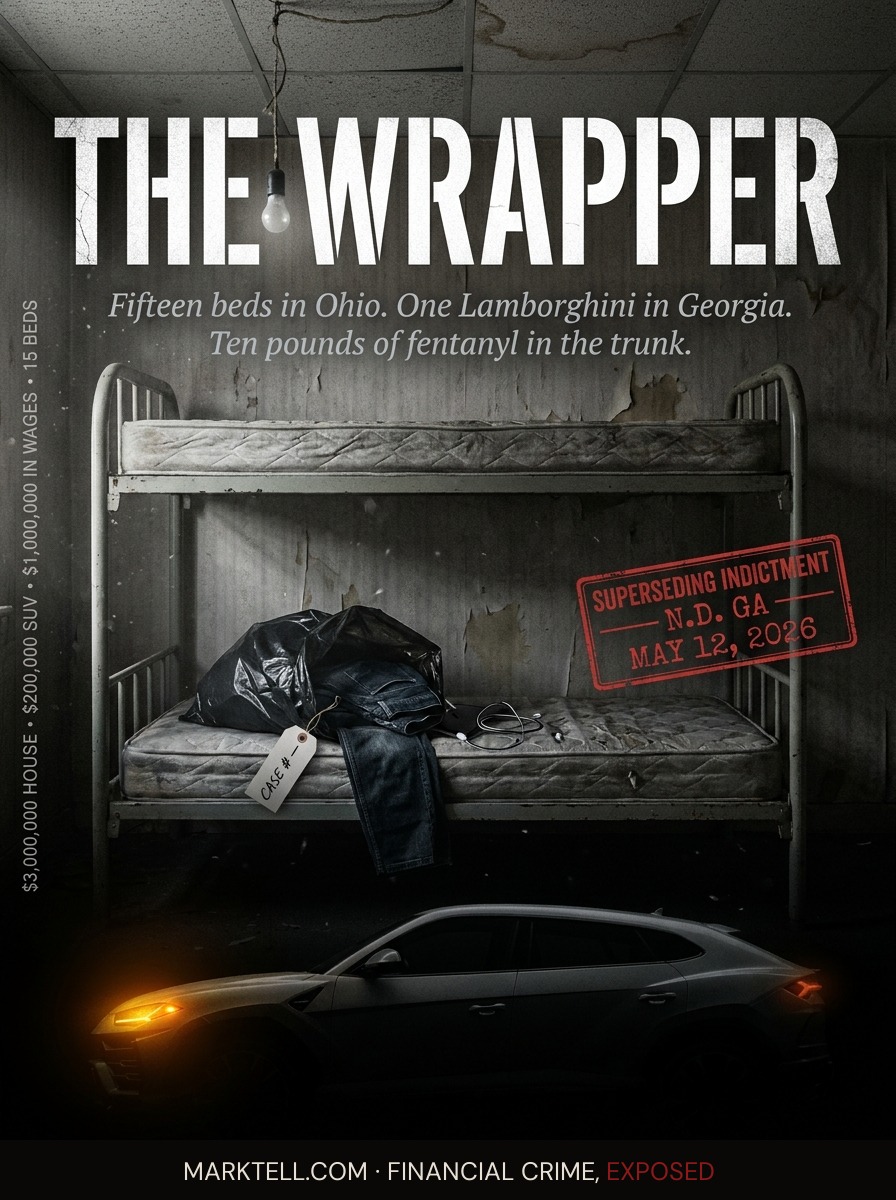
The boy came out of the back seat of a state car holding a black trash bag. Inside the bag was everything he owned. Two pairs of jeans. A phone charger that did not match his phone. A folder with his case number on it. He was fourteen. He had been moved seven times.
Call him Marcus. He is a composite, built from the kind of child who ends up in a 15-bed residential group home in Dayton, Ohio at nine-thirty on a Tuesday night. The caseworker walked him to the door. The door opened. A staff member signed a form on a clipboard. The state car pulled away.
That was the front of the business.
The back of the business, federal prosecutors allege, was a Lamborghini Urus parked nine hundred miles south, in Forsyth County, Georgia, in the driveway of a three-million-dollar house.
The Lamborghini was registered to the children's home.
I
The owner of Reflections Group Home, LLC is a thirty-seven-year-old woman named Kristin Draper. She lives in Alpharetta, Georgia, an Atlanta suburb where the lawns are wide and the garages hold more cars than the houses can plausibly need. Her boyfriend is forty-year-old Antwaun Brown. Brown has prior convictions, state and federal, for trafficking crack cocaine and heroin. That is on his record. That is not alleged. That is adjudicated.
The new charges are different.
On May 12, 2026, a federal grand jury in the Northern District of Georgia returned a superseding indictment naming both of them. Draper was arraigned on May 18, 2026, before U.S. Magistrate Judge Catherine M. Salinas. Brown's arraignment on the superseding count is pending. The charge against Draper is money laundering conspiracy. The charge against Brown is fentanyl trafficking plus the laundering count.
Read the structure of what the government is alleging. Slowly.
Brown was selling fentanyl in the Atlanta area. Draper was running three group homes in Dayton, Ohio, with fifteen beds total, for at-risk youth. The fentanyl money and the group-home money allegedly ran into the same accounts. From those accounts, the indictment says, came a $3 million home in Forsyth County and a Lamborghini SUV valued at more than $200,000.
That is the wrapper. A legitimate business with a humanitarian face, wrapped around cash that came from somewhere else.
The fentanyl was the engine. The beds were the cover.
II
The number that does not sit right is the wage number.
Per the federal investigation, in 2024 Draper drew nearly $1 million in wages and distributions from Reflections Group Home, LLC. A 15-bed facility. Three houses in Dayton. One owner pulling close to seven figures personally.
Do the math the prosecutors must have done.
Residential treatment beds in this country can bill up to $800 per day. Fifteen beds at $800 a day for a full year is roughly $4.38 million in theoretical gross revenue. That is before staff. Before food. Before rent. Before utilities. Before the case managers, the therapists, the overnight workers, the insurance, the licensing fees, the transportation. Before everything that a real group home actually has to spend money on to be a group home.
For one owner to net a million in personal income from that gross, while paying for three houses of fifteen children combined, the rest of the operation has to be very, very thin. Or the operation has to be something else.
The indictment says it was something else.
It says the books of Reflections Group Home were where fentanyl money came to look like wages.
III
Marcus did not know any of this. The kid with the trash bag never knows any of this. He knew the staff member at the door. He knew the bunk he was assigned. He knew the smell of the carpet. He knew what time the lights went off.
He did not know that the LLC that owned the bunk also, per federal allegations, owned a Lamborghini Urus in Georgia.
He did not know that on March 21, 2025, a man named Antwaun Brown was pulled over in that same Lamborghini, in the Atlanta area, with nearly ten pounds of fentanyl inside the vehicle.
Ten pounds of fentanyl is not a personal-use amount. Ten pounds of fentanyl, depending on purity, can kill hundreds of thousands of people. The DEA treats two milligrams as a potentially lethal dose. Do the conversion if you have the stomach for it.
The car was registered to the group home for at-risk children.
That is the sentence the U.S. Attorney's Office wants you to read twice. Theodore S. Hertzberg, the U.S. Attorney for the Northern District of Georgia, said in announcing the case that Draper, "entrusted with protecting at-risk children," allegedly used her position to facilitate money laundering from fentanyl sales. Jae W. Chung of the DEA's Atlanta Field Division said money laundering is what lets criminal organizations "operate in the shadows."
The shadows, in this case, had bunk beds in them.
IV
The wrapper is not a new machine. It is one of the oldest machines in financial crime. You find a business with real revenue and real paperwork. You run dirty cash through it. The cash comes out the other side wearing the business's clothes. The deeper the business's social legitimacy, the better the wrapper works. A car wash works. A restaurant works. A nail salon works.
A children's home works better.
A children's home works better because no auditor wants to be the one tearing into the books of a place that says it is helping at-risk kids. A children's home works better because the funding streams are often opaque, often public, often layered between state systems and private placements and Medicaid waivers. A children's home works better because the residents do not write reviews. The residents do not call regulators. The residents are children the state has already decided do not have anyone in their corner.
That is what makes this particular wrapper, if the allegations hold, sit in the stomach the way it does. The cover identity was not just innocent. The cover identity was protective. The pitch of the business, to the state agencies and county systems sending kids north into those Dayton beds, was: we will keep your children safe.
The same LLC that signed that pitch, federal prosecutors allege, signed the title on the Lamborghini.
V
Georgia regulators have been waking up to the social-services laundromat. In April 2026, the Georgia Department of Community Health put out notice that it was tightening review of Medicaid claims, with a focus on Applied Behavioral Analysis and Structured Family Caregiving as high-risk categories. Earlier in the year, separate Georgia indictments targeted owners of behavioral health centers accused of billing Medicaid for more than $1.4 million in services that were not provided or were performed by unqualified people.
The Reflections case is not those cases. Reflections operates in Ohio, not Georgia, and the federal charge here is not Medicaid fraud. But the family resemblance is the point. The social-services sector, particularly the parts dealing with children, addicts, and the mentally ill, has become the soft underbelly through which large amounts of public and private money move with very little real scrutiny on the other side of the billing code.
That is where the wrappers grow.
VI
Marcus lay in his bunk. The ceiling tile above his head had a brown ring on it from old water damage. The radiator clicked. He could hear two other boys whispering across the room. He had been told this was a safe place. He had been told it for years, at every placement, and each time it had meant something slightly different, and each time he had learned not to trust the word.
He did not know that nine hundred miles south, in a court in Atlanta, a magistrate judge was reading a docket sheet with his home's name on it.
He did not know that the woman whose company name was on the front door of the house he slept in had, the same day, stood in a federal courtroom and been formally charged with conspiring to launder money for a fentanyl operation.
He did not need to know. The point of the wrapper is that the person inside it never needs to know.
VII
There is a temptation, with a case like this, to make it about the cars and the house. The Lamborghini photographs well. The three-million-dollar mansion photographs well. Those are the images that travel.
The image that should travel is the bunk bed.
Fifteen beds in Dayton, allegedly generating a million dollars in personal income to an Alpharetta owner in a single year, allegedly co-mingled in the same accounts as the proceeds of an Atlanta fentanyl operation, allegedly used to title the vehicle the fentanyl was caught riding in.
If those allegations are proven, the kids in those beds were not the customers. They were not the mission. They were the wrapper.
They were the part of the business that made the rest of the business look like a business.
Allegation is not adjudication. Draper has been arraigned. Brown's superseding arraignment is pending. They are entitled to their defense and to the presumption of innocence.
But hold the picture anyway. A boy with a trash bag at a curb in Ohio. A Lamborghini in a driveway in Georgia. The same LLC on both ends of the line.
The state thought it was paying for shelter.
The indictment says it was paying for cover.
- U.S. Attorney's Office, Northern District of Georgia | May 18, 2026 | Press release on arraignment of Kristin Draper, superseding indictment of Antwaun Brown
- Federal grand jury, Northern District of Georgia | May 12, 2026 | Superseding indictment
- AllOnGeorgia | May 2026 | "Owner of group homes for at-risk youth and her drug-dealing boyfriend charged with money laundering"
- Georgia Department of Community Health | April 28, 2026 | Notice on Medicaid Fraud, Waste, and Abuse Prevention; ABA and SFC policy amendments effective July 1 and September 1, 2026
- DEA Atlanta Field Division | May 2026 | Statement by Special Agent in Charge Jae W. Chung
- Prior court records | various | Antwaun Brown state and federal trafficking convictions (crack cocaine, heroin)
Editorial Notice
MarkTell is a true crime publication about financial fraud. Some scenes, dialogue, and sequential details are reconstructed from court filings, enforcement actions, news reports, and public records. Where the public record does not provide exact details, editorial reconstruction is used to convey the documented pattern of events. Names of private individuals may be changed to protect identity. All factual claims are sourced to public documents cited in the Evidence Trail above. MarkTell does not provide investment, legal, or financial advice. Nothing published here constitutes a recommendation to buy, sell, or avoid any investment. Allegations described in active cases have not been adjudicated and defendants are presumed innocent until proven guilty. Readers should conduct their own due diligence before making financial decisions.