Every Year the Map Changes. The Territory Never Does.
BehindMLM's 2026 state of the industry report landed this week, and the numbers inside it describe a world where the same machine keeps getting new paint jobs. Before you forward that invite to someone you love, read what the machine looked like last year.
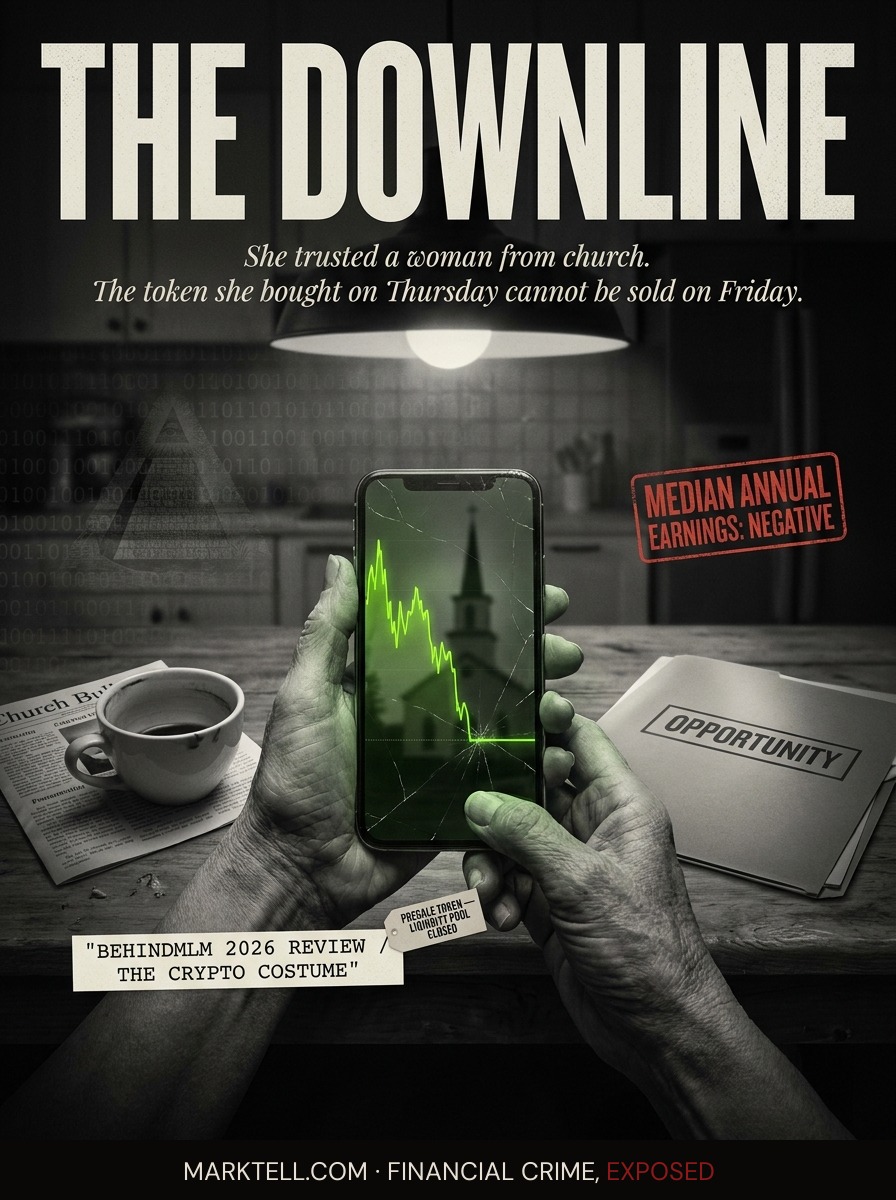
A Chapter from the Archive of Familiar Things
STATE OF THE MACHINE: 2026
I.
The Invitation
She got it on a Wednesday. A voice message, not a text, because the person who sent it knew that a voice message feels more personal. Her name was Diane. Sixty-one years old. Retired from twenty-four years of school district administration in central Pennsylvania. She had a pension that was smaller than she had been told it would be and a daughter in Phoenix she talked to on Sundays.
The voice message was from a woman she had gone to church with for eleven years. The pitch lasted forty-seven seconds. There was a product. There was an opportunity. There was a phrase that Diane had heard before but could not quite place: "multiple income streams." The woman from church said she would explain everything at a dinner on Thursday. She said the company was growing fast. She said the timing was important.
Diane went to the dinner.
I know Diane because I have been to that dinner. I have been on both sides of that table. I have been the woman making the call. I have been the man who trained the woman to make the call. I have been Diane, sitting in the chair at the restaurant, holding the glossy folder, telling myself I was smarter than this while the presentation played on a laptop screen propped against the salt shaker.
The machine that brought Diane to that dinner did not start last year. It did not start the year before. BehindMLM, a site that has tracked the multilevel marketing industry since 2010, published its annual review of the sector this week. What the numbers describe is not a new story. It is the same story the industry has been telling since I was seventeen years old and selling palladium to dentists over a phone in Chicago.
The story is this: the machine is still running.
And it is getting better at looking like something else.
II.
What the Numbers Say
Let me tell you what BehindMLM found when they looked at the industry as it stood heading into 2026.
The dominant recruitment vehicle is no longer a dinner at a restaurant. It is a short video on a phone. The pitch has migrated to wherever attention is cheapest, and right now attention is cheapest on platforms where a thirty-second clip can reach a hundred thousand people who have never heard of the company and do not know that the person making the clip is a distributor. That is the word the industry uses. Distributor. Not salesperson. Not recruiter. Distributor. The language is chosen carefully, because language is where the machine begins.
A distributor is a person who sells products and recruits other people to sell products. The people they recruit are called their downline. That is the network. The distributor earns money two ways: from selling product directly, and from a percentage of whatever the people in their downline sell. The deeper the downline, the more the distributor earns without selling anything themselves.
That structure is legal in the United States if the primary income comes from actual product sales to actual customers who are not also distributors. The Federal Trade Commission, the government agency that polices this space, has said so in guidance going back decades. The legal line is product sales. Cross that line, where recruitment is the real engine and product sales are the justification, and the structure becomes something the FTC calls a pyramid scheme. A pyramid scheme is illegal. It is illegal because it is mathematically guaranteed to fail for the people at the bottom, who are always the majority.
The machine knows where the legal line is. It has been studying that line for fifty years.
What BehindMLM's 2026 review describes is an industry that has become increasingly sophisticated at staying on the visible side of that line while operating on the other side of it. The product is real. The income disclosure is filed. The compliance language is in the back of the starter kit. And the dinner on Thursday is still happening, in living rooms and hotel conference rooms and Zoom calls and Instagram Lives, and the woman from church is still making the forty-seven-second voice message.
The numbers that matter most in any MLM operation are not the ones in the product catalog. They are the ones in the income disclosure statement. An income disclosure statement is a document the company publishes, sometimes voluntarily, sometimes because regulators have required it, that shows what distributors actually earn. Not what the top earners make. What the average distributor makes.
Read those numbers slowly.
In most of the companies BehindMLM tracks, the median annual income for an active distributor, after subtracting the cost of the products they are required to purchase to stay active, is negative. Not low. Not disappointing. Negative. The average participant in these programs loses money. The income disclosure says so. The income disclosure is the document nobody reads before the dinner on Thursday.
III.
The Crypto Costume
The most significant development BehindMLM flagged in its 2026 review is one I want you to sit with for a moment, because it is the part of the machine that is genuinely new. Not new in its mechanics. New in its costume.
The costume is crypto.
Multilevel marketing companies have always needed a product. The product is what separates them, legally, from a pure pyramid scheme. For decades, the products were wellness supplements, skincare serums, essential oils, leggings, cookware. The product had to be something tangible enough that a distributor could hold it up and say: I sell this. This is what I do.
What BehindMLM's review documents is that a growing number of operations have replaced the bottle of supplements with a digital token. A token is a unit of digital currency created by the company itself, often on an existing blockchain network. A blockchain is a public digital ledger, a shared record book that nobody controls, where transactions are recorded permanently. The token lives on that ledger.
The company creates the token. The company sets the initial price. The company sells the token to distributors as part of a starter package. The distributors recruit other distributors who buy more tokens. The price of the token rises as more money enters the system. Early participants sell their tokens at a profit. Later participants hold tokens that are worth less than they paid.
That is not a new financial instrument. That is the same machine with a new power source.
The crypto costume is effective for three reasons. First, crypto markets are volatile enough that a token losing eighty percent of its value in six months can be explained as market conditions rather than structural failure. Second, the technology is unfamiliar enough to most people that the complexity creates a kind of authority. The person who understands blockchain is assumed to know things you do not. Third, the transactions are fast and, for the participants, largely invisible until they try to exit.
Trying to exit is when the machine shows itself.
A liquidity pool is the pot of money that sits behind a token's trading screen. When you want to sell your tokens, you need buyers, or you need a pool of funds that will buy them from you. In many of these operations, the liquidity pool is controlled by the company. The company can restrict withdrawals. The company can impose fees. The company can, in some cases, simply close the pool. When that happens, the tokens do not lose value. They become unredeemable. That is a different thing. A stock that loses value is still a stock. A token you cannot sell is a receipt for a transaction that has already ended.
Diane's daughter in Phoenix sent her a link in February. The link was to a token presale. A presale is when a company sells its token before it is publicly listed on any exchange, at a price lower than the listing price, with the promise that early buyers will profit when the token goes public. The daughter had seen the link in a group chat. She thought it looked legitimate. She asked her mother what she thought.
Diane called me on a Sunday.
IV.
The Five Features
I want to give you the five features of the machine. Not the exciting features. Not the features the presentation leads with. The structural features. The ones that are visible in the public record if you know where to look and what you are looking at.
The first feature is mandatory purchasing. In a legitimate sales operation, you buy inventory when you have customers who want it. In the machine, you buy inventory to stay active. The company calls this autoship, or a monthly commitment, or a qualification requirement. Whatever it is called, it means that your status in the organization, and therefore your ability to earn from your downline, depends on money leaving your account every month whether or not you have sold anything. The product is real. The customer is often you.
The second feature is front-loaded compensation. The highest commissions in the machine are paid on recruitment, not on retail sales. The company will show you a compensation plan with many levels and many ways to earn. Read the fine print. Find the bonuses. The bonuses are paid when someone new joins and buys a starter kit. The starter kit is expensive. The bonus is paid once. The new recruit now needs to recruit to earn.
The third feature is the income disclosure gap. Every company that operates this way is required, in practice if not always by law, to publish what its distributors actually earn. Find that document. It is usually on the company's website, in small type, linked from the compensation plan page. The gap between the income the presentation describes and the income the disclosure reports is the machine's signature. That gap is not a rounding error. It is the business model.
The fourth feature is the exit cost. Leaving the machine costs money. Not just the money you have already spent. Leaving means you stop qualifying for commissions from the people you recruited. Those people, who joined because you invited them, now belong to the upline above you. The relationships you built while building your business belong to the structure, not to you. This is not an accident. The exit cost is designed to keep you recruiting past the point where the math has already answered the question.
The fifth feature is the language of inevitability. Every pitch for every operation I have ever seen uses the same temporal frame. The timing is perfect. The ground floor is closing. The early adopters are already winning. The window is narrow. This language creates urgency, and urgency is the enemy of arithmetic. Urgency is what gets you to the dinner on Thursday before you have looked at the income disclosure. Urgency is what gets you to the presale before you have asked who controls the liquidity pool.
Picture the five features laid out in front of you like a checklist.
If the thing you are being invited to has all five, you are not looking at an opportunity.
You are looking at the machine.
V.
The Parallel That Never Changes
I want to tell you about a company called Fortune Hi-Tech Marketing. It operated out of Lexington, Kentucky, starting in the early 2000s. It sold health products, telecom services, satellite television subscriptions. It had a compensation structure that paid primarily on recruitment. The FTC shut it down in 2013. The settlement required the company's founders to pay back thirteen million dollars. The FTC found that less than one percent of participants earned more than they spent.
Less than one percent.
I want to tell you about Vemma, a nutrition company that recruited heavily on college campuses in the early 2010s. The FTC obtained a temporary restraining order against it in 2015. The FTC's complaint alleged that Vemma's business model was a pyramid scheme, that the company emphasized recruitment over retail sales, and that the vast majority of participants lost money. Vemma settled and restructured.
I want to tell you about the operations BehindMLM tracked in 2025 that are still running in 2026 under new names, in new jurisdictions, with new tokens and new products and new presenters on new platforms, using the same five features I described in the previous section.
The machine does not retire. The machine relocates.
What changes is the costume. What does not change is the structure underneath it. The mandatory purchasing is still there. The front-loaded recruitment bonus is still there. The income disclosure gap is still there. The exit cost is still there. The language of inevitability is still there.
I have been watching this for forty years. The costume changes every three to five years. The machine underneath has not changed since I was standing in a metals room in Chicago, reading from a script taped to my desk, telling a retired schoolteacher in Ohio that platinum was going to protect her savings.
I did not know, at seventeen, that the machine was the machine. I thought I was selling platinum.
That is the thing about the machine. It works best on people who believe in it. Including the people running it.
VI.
What Diane Did
Diane did not go back to the dinner. She asked the woman from church for the income disclosure statement before she signed anything. The woman from church said she would get it to her. She never did.
Diane's daughter in Phoenix did not send money to the token presale. She asked who controlled the liquidity pool. The group chat went quiet. She was removed from the group three days later.
These are small victories. They do not feel like victories when you are living them. They feel like suspicion and awkwardness and the discomfort of saying no to someone you trust. They feel like being the difficult one.
I want to tell you that the machine counts on that feeling.
The machine is not built on greed. I spent years believing it was built on greed. It is not. It is built on trust. It is built on the fact that the woman from church is not lying to Diane. She believes in what she is selling. She believes because the machine is designed to give early participants enough return to create genuine believers, and then to use those believers as its distribution network. The believer is not a villain. The believer is also a mark. She just got there earlier.
That part may be the saddest.
The machine does not need bad people to run. It needs good people who have not yet looked at the income disclosure.
VII.
The Same Machine, the Same Year
BehindMLM's 2026 review will not be the last one. There will be a 2027 review. The numbers will be different. The companies will have different names. Some of the companies tracked in 2025 will be gone, shut down by regulators or collapsed under their own weight. New ones will have appeared, in jurisdictions with lighter oversight, with products that fit the cultural moment, with compensation plans that have been carefully reviewed by attorneys who know exactly where the legal line is.
The review will note the same structural features.
The income disclosure gap will still be there.
The mandatory purchasing will still be there.
The language of inevitability will still be there.
And somewhere, on a Wednesday, a phone will ring. A woman who has known you for eleven years will leave a forty-seven-second voice message. She will use the phrase "multiple income streams." She will say the timing is important.
She will mean it.
She will not be lying.
She will be the machine's voice, speaking in the machine's tense, and she will not know it.
You will know it.
That is the only thing reading this was ever supposed to do.
- BehindMLM, "BehindMLM's State of the Scam 2026," published April 2026, behindmlm.com/mlm/behindmlms-state-of-the-scam-2026/
- Federal Trade Commission, "FTC Action Leads to Shutdown of Fortune Hi-Tech Marketing," press release, January 28, 2013, ftc.gov
- Federal Trade Commission v. Vemma Nutrition Company, Case No. 2:15-cv-01578-JJT, U.S. District Court, District of Arizona, temporary restraining order filed August 17, 2015
- Federal Trade Commission, "Business Guidance Concerning Multi-Level Marketing," January 2018, ftc.gov/tips-advice/business-center/guidance/business-guidance-concerning-multi-level-marketing
- FTC Income Disclosure Statement guidance, incorporated in FTC v. Vemma settlement documents, 2016
- BehindMLM, ongoing company reviews and income disclosure analyses, 2023-2026, behindmlm.com
Editorial Notice
MarkTell is a true crime publication about financial fraud. Some scenes, dialogue, and sequential details are reconstructed from court filings, enforcement actions, news reports, and public records. Where the public record does not provide exact details, editorial reconstruction is used to convey the documented pattern of events. Names of private individuals may be changed to protect identity. All factual claims are sourced to public documents cited in the Evidence Trail above. MarkTell does not provide investment, legal, or financial advice. Nothing published here constitutes a recommendation to buy, sell, or avoid any investment. Allegations described in active cases have not been adjudicated and defendants are presumed innocent until proven guilty. Readers should conduct their own due diligence before making financial decisions.