A twenty five year old in Lititz turned tribal addresses into a $741,000 valve
Krandon Wenger, 25, of Lititz, pleaded guilty to wire fraud after his company K20 Wireless changed subscriber addresses to tribal lands to harvest a higher federal reimbursement. The records moved. The customers never did.
Denise signed her name on a clipboard outside a strip mall on Lititz Pike. Fifty eight years old, home health aide, grandson living with her since her daughter's second deployment. The pen was tied to the clipboard with a piece of dirty string. The woman at the folding table told her the federal program would knock thirty dollars off her internet every month. Bring a utility bill. Bring an ID. Sign here, here, and here.
Denise signed. She brought the bill. She watched the modem blink in her kitchen for the next eighteen months and did not think about it again.
She did not know that somewhere between the folding table and the federal claim file, her address had been changed.
Not her real address. The one on the form K20 Wireless sent to the Federal Communications Commission. On that form, Denise no longer lived on a numbered street in Lancaster County. On that form, she lived on tribal land.
That is the whole story. A field in a spreadsheet. A dropdown. A box checked.
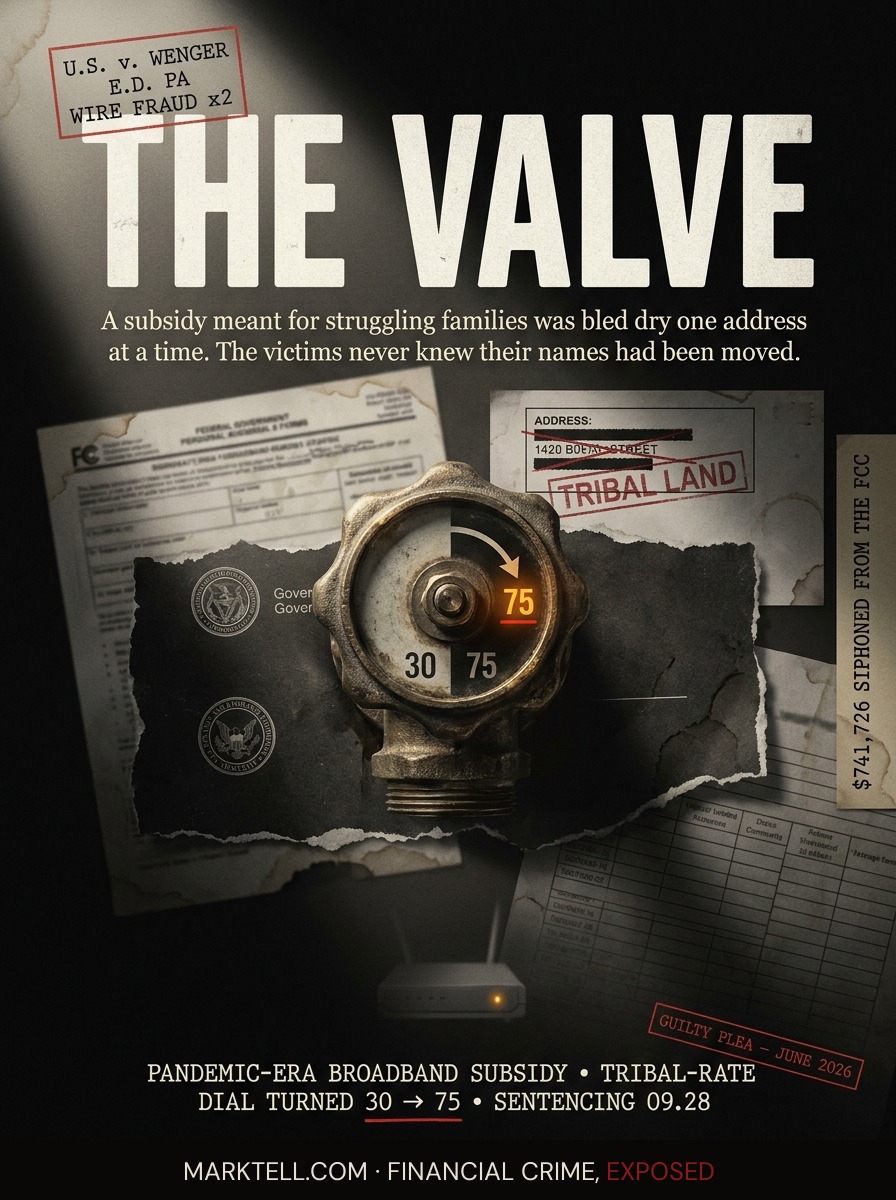
The Affordable Connectivity Program was a pandemic-era subsidy. The federal government paid broadband providers a monthly reimbursement for every low-income household they kept online. Thirty dollars per household. Seventy five dollars per household if that household sat on tribal land. The math was simple. The dial had two settings. Most households were thirty. A few were seventy five.
According to the Department of Justice, Krandon Wenger of Lititz, twenty five years old, ran a company called K20 Wireless, LLC. K20 applied to become an ACP provider in March 2022. The FCC approved them in April. By summer they were enrolling subscribers and submitting monthly claims.
And somewhere in that paperwork, addresses started moving.
Real subscribers in real Pennsylvania towns appeared in K20's federal filings as residents of tribal lands. The reimbursement boxes that should have read thirty read seventy five. The difference, multiplied by subscribers, multiplied by months, came to approximately $741,726 in overpayments from the FCC, according to the DOJ's announcement of the guilty plea.
Picture the valve. A single number on a form. Turn it from thirty to seventy five and the pipe widens. Nobody on the customer end notices because the customer is still getting their thirty dollar discount. Nobody on the federal end notices in real time because the federal end is processing millions of these claims and trusting the certifications. The valve sits between them. Whoever controls the valve controls the difference.
Wenger controlled the valve.
On June 2, 2026, he stood in front of U.S. District Judge Joseph F. Leeson Jr. and pleaded guilty to two counts of wire fraud. Sentencing is set for September 28. The two counts together carry a maximum exposure of forty years. The plea was announced by U.S. Attorney David Metcalf. The FBI and the FCC Enforcement Bureau ran the investigation. Assistant U.S. Attorney Francis A. Weber is prosecuting.
That is the legal record. That is what is adjudicated.
What is harder to put in a filing is Denise.
She did not lose money. The program paid her bill. The discount kept her grandson on a tablet through a school year and a half. From her kitchen, nothing went wrong. Her modem blinked. Her grandson did his homework. The federal money flowed where she had been told it would flow.
But on the paperwork that paid for her connection, she was no longer the person she actually was. She had been moved. Her name had been used as a prop in somebody else's claim. The valve turned, and a portion of what should have stayed in the federal pot fell into a private one, and she never knew the form she signed had been edited after she walked away from the folding table.
That is the cleanest version of this kind of fraud. It does not need a victim who feels robbed. It needs a victim who feels nothing. The government feels the loss. The program feels the loss. The next round of subsidies, the next round of households who might have been served if the pot had not been drained, they feel the loss. Denise just paid her bill.
The Affordable Connectivity Program ran out of money in 2024. Congress did not refund it. Households across the country lost their discounts. Some lost their internet entirely. Whether K20's $741,726 contributed to that exhaustion or simply rode it, the program is gone, and the households that depended on it are back to paying the full rate or going dark.
Read that slowly. A subsidy designed for people like Denise was bled, in part, by a provider who enrolled people like Denise.
The DOJ launched its National Fraud Enforcement Division in April 2026. The SBA's Inspector General has reported more than $2.8 billion in recoveries from pandemic-era fraud. A GAO report from March 2025 found that of three million fraud referrals across pandemic programs, roughly two million could not be acted on because the data was too thin. The valve, in other words, was running in a lot of places. The agencies caught the ones where the documents could be cross-referenced. The FCC's records of tribal land boundaries are public. Match them against the addresses K20 submitted, and the discrepancy was sitting there in a spreadsheet, waiting.
That is how the machine became visible. Not a whistleblower. Not a customer complaint. A field in a database that did not match another field in another database.
Denise still works the home health shift. Her grandson is in fifth grade now. The discount is gone. She pays the full bill. She does not read the federal register and she does not know who Krandon Wenger is.
She signed her name on a clipboard outside a strip mall and walked back to her car. Somewhere between her car and a federal filing, she moved without moving.
That is what the valve does.
It moves the paper while the person stays still.
- U.S. Department of Justice, Eastern District of Pennsylvania | June 2, 2026 | Press release announcing guilty plea of Krandon Wenger
- FOX43 | June 2, 2026 | "Lancaster County man pleads guilty to defrauding government out of more than $741,000 in pandemic assistance funds"
- Federal Communications Commission | Affordable Connectivity Program rules and reimbursement structure | fcc.gov/acp
- Infrastructure Investment and Jobs Act of 2021 | Public Law 117-58
- U.S. Small Business Administration Office of Inspector General | April 7, 2026 | Pandemic relief recovery announcement
- Government Accountability Office | March 24, 2025 | Report on SBA pandemic fraud referrals
- U.S. Department of Justice | April 7, 2026 | Announcement of National Fraud Enforcement Division
Editorial Notice
MarkTell is a true crime publication about financial fraud. Some scenes, dialogue, and sequential details are reconstructed from court filings, enforcement actions, news reports, and public records. Where the public record does not provide exact details, editorial reconstruction is used to convey the documented pattern of events. Names of private individuals may be changed to protect identity. All factual claims are sourced to public documents cited in the Evidence Trail above. MarkTell does not provide investment, legal, or financial advice. Nothing published here constitutes a recommendation to buy, sell, or avoid any investment. Allegations described in active cases have not been adjudicated and defendants are presumed innocent until proven guilty. Readers should conduct their own due diligence before making financial decisions.