A nineteen-year-old, a Rolls-Royce, and 185 Bitcoin that belonged to someone else.
A Canadian teenager pleaded guilty in Miami to laundering $13M in stolen Bitcoin after impersonating Google support to drain a victim's wallet. The traffic stop that ended it started with a white Rolls-Royce.
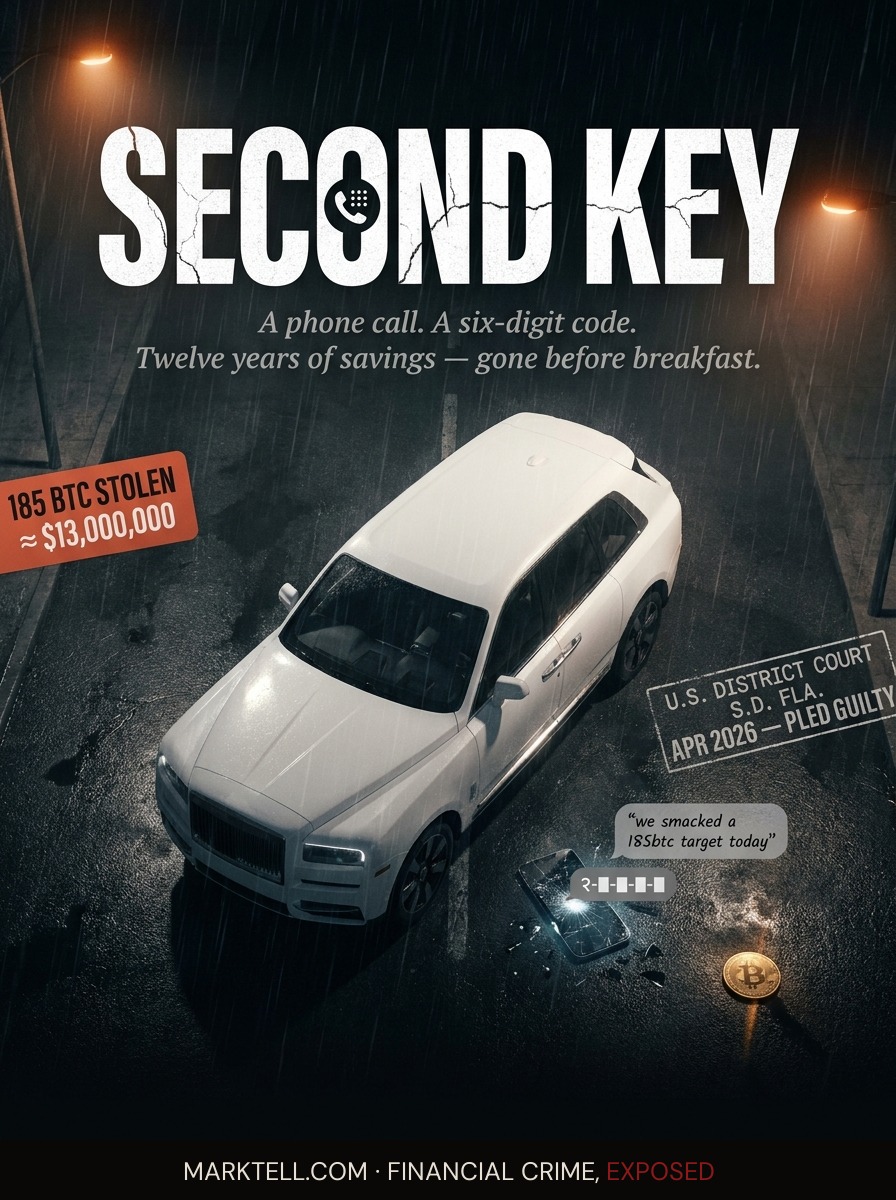
Mark was in his kitchen in California when the phone rang. He was fifty-four years old. He ran a small contracting business. He had been buying Bitcoin since 2014, back when his nephew explained it to him at a holiday dinner and he wrote the word "Bitcoin" on a napkin and looked it up the next morning. He had not bought a lot at first. He bought more later. Over twelve years, in small pieces, he had built it up to 185 coins.
The caller ID said Google.
The voice was calm. Young. American. The voice said there was unusual activity on his account and they were calling to help him secure it. The voice said it would send a verification code to his phone. The voice said please read the code back.
He read the code back.
He read the second one back too.
The voice thanked him and ended the call.
The next morning, at 7:14, he opened his wallet app to check the price. The number where his balance should have been was a zero. He refreshed it. He closed the app and reopened it. The number stayed a zero.
The Bitcoin was gone. All 185 of it. About thirteen million dollars at the price that morning.
I.
The person on the other end of that call, according to the criminal complaint filed in U.S. District Court in Miami in April 2026, was a nineteen-year-old Canadian named Trenton Richard David Johnston. He had entered the United States in October 2024 on a twelve-month tourist visa. He overstayed it. He went to Miami.
The complaint, authored by Homeland Security Investigations Special Agent Ivan Sanchez, alleges that Johnston ran a months-long scheme of impersonating Google support staff to trick crypto holders into reading verification codes off their phones. A verification code is the second key. The first key is your password. The second key is the six-digit number a service sends to your phone to confirm that the person logging in is really you. It is called two-factor authentication, and it is the thing that is supposed to make your account safe even if someone has your password.
If you read the code to a stranger on the phone, the stranger has both keys.
That is what the machine did. It got people to hand over the second key by pretending to be the company that issued it. It is one of the oldest social-engineering tricks in the digital catalog. The complaint alleges Johnston ran it like a service.
II.
After the 185-coin theft, Johnston texted an unnamed accomplice. The complaint preserves the language.
"bro we rlly actually did some crazy a-- s---"
"We actually smacked a 185btc target today."
Smacked. Target. Read it the way he typed it. This was not a teenager who thought he had outsmarted a system. This was a teenager who thought he had hit a person and gotten away clean.
The complaint further alleges that Johnston taught others how to do what he did. He shared his screen over Discord. Discord is a chat platform popular with gamers and crypto communities. The screen-share function lets you broadcast what is on your monitor to whoever is in the channel. The complaint describes Johnston using that function to walk other people through the mechanics of the theft, in real time, while it was happening.
A classroom. The lesson was how to take someone's savings by phone.
III.
The money did not stay as Bitcoin for long. The complaint and subsequent reporting describe what the proceeds bought.
A Lamborghini.
BMWs. More than one.
A private jet.
And, eventually, a white Rolls-Royce Cullinan.
The Cullinan is the SUV version of the Rolls-Royce. It starts around $400,000. It is the car you buy when you want everyone on the road to know what you have.
This is the part of the story where the machine became visible. In March 2026, a sheriff's deputy in Florida pulled the Rolls-Royce over during a traffic stop. Johnston was inside. So were other people. According to the complaint, the other people in the vehicle told the deputy that Johnston had made a fortune scamming crypto holders.
In a Hermes bag in the vehicle, deputies found what they suspected were amphetamine tablets.
He was nineteen. He had been in the country on an expired tourist visa for over a year. He was sitting in a Rolls-Royce Cullinan that the government would later allege was paid for with money taken from a man like Mark.
IV.
Mark filed a report. There is a process for this. You contact the exchange where the wallet was held. You contact the FBI's Internet Crime Complaint Center. You contact local police, who tell you they cannot help. You hire a blockchain forensics firm if you can afford one. You watch the coins move through a series of addresses, into mixers, into exchanges in jurisdictions that do not answer letters. You watch your money walk away in public, on a ledger anyone can read, and you cannot touch it.
As of April 2026, none of the 185 Bitcoin had been recovered. That is what the criminal complaint says. None.
The Bitcoin Mark bought in 2014 for a few hundred dollars a coin was worth around seventy thousand dollars each by the time it was stolen. He had not sold any of it. He had planned to sell some of it the year he turned sixty, to pay off the house. He had planned to leave the rest to his sister's kids.
He told his wife that night. He waited until after dinner.
V.
There was an earlier theft, too. The complaint references a February incident in which a user in California was defrauded of approximately $41,000 in Ethereum. Same pattern. Smaller number. A practice round, or a side job, or just one of many.
This is the part about machines that the people who run them do not want you to think about. A machine is a process that can be repeated. The fact that one teenager allegedly ran the same trick on two different people, in two different states, for two very different amounts, is the point. The machine did not care if it took $41,000 or thirteen million. It ran the same way each time. A phone call. A code. A wallet drained. A car bought.
There are other machines like this one running right now. The voice on the other end of the call will not say it is Google. It will say it is Coinbase, or Binance, or your bank, or the IRS, or your power company. The machine does not care about the costume. The costume is what it puts on to ask you for the second key.
VI.
On June 10, 2026, in U.S. District Court in Miami, Johnston pleaded guilty to one count of conspiracy to commit money laundering. He had turned twenty in custody the month before. As part of the plea, he agreed to be deported to Canada after sentencing. Global Affairs Canada confirmed it is providing consular assistance. His Florida lawyers declined to comment.
The Bitcoin is still gone. The Lamborghini, the BMWs, the jet, the Rolls-Royce, those are physical objects in physical places and the government can seize them. The coins are not. The coins moved through addresses no one has keys to anymore, or addresses that belong to people who will never answer a subpoena.
Mark does not have his 185 coins back. He probably never will.
VII.
Here is the part that is hard to sit with.
The person who took everything Mark spent twelve years building was an eighteen-year-old when he entered this country. He was nineteen when he made the call. He had not finished what most people would consider growing up. He texted his accomplice in the language of someone who had just won a video game.
That is the machine. It does not require expertise. It does not require a finance degree. It does not require a hedge fund or a Ponzi structure or a glossy pitch deck. It requires a phone, a script, a target list, and a willingness to lie to a stranger for two minutes.
The complaint says Johnston was teaching others how to do it. The complaint says he was screen-sharing the technique. That means there are now other people who learned it. That means there are now other phones, other scripts, other target lists.
The lock on Mark's wallet was not broken. The lock worked exactly as designed. The lock asked for the second key. Mark gave it to the voice that asked.
That is the trapdoor in every system built on two-factor authentication. The second factor is only a factor if the person holding it understands that no one, ever, for any reason, should be asked to read it out loud.
Mark understands that now.
He understood it at 7:14 that morning, looking at a zero where thirteen million dollars used to be.
That is the part that did not make it into the complaint.
- CBC News | June 10, 2026 | "Canadian who stole $13M US in crypto bought Lamborghini, BMWs: plea deal"
- U.S. District Court, Southern District of Florida (Miami) | June 10, 2026 | Guilty plea, conspiracy to commit money laundering, U.S. v. Johnston
- Criminal complaint authored by HSI Special Agent Ivan Sanchez | April 2026 | U.S. District Court filing
- Global Affairs Canada | 2026 | Statement confirming consular assistance
- FBI Internet Crime Report | 2024 figures | $9.3B in crypto-related losses cited as industry context
Editorial Notice
MarkTell is a true crime publication about financial fraud. Some scenes, dialogue, and sequential details are reconstructed from court filings, enforcement actions, news reports, and public records. Where the public record does not provide exact details, editorial reconstruction is used to convey the documented pattern of events. Names of private individuals may be changed to protect identity. All factual claims are sourced to public documents cited in the Evidence Trail above. MarkTell does not provide investment, legal, or financial advice. Nothing published here constitutes a recommendation to buy, sell, or avoid any investment. Allegations described in active cases have not been adjudicated and defendants are presumed innocent until proven guilty. Readers should conduct their own due diligence before making financial decisions.