A money exchange in East Ham, a phone in a kitchen, and £190 million looking for a door
A corner money exchange in East Ham was not what it looked like. Behind the counter, prosecutors say, sat one of the doorways into a £190 million global laundering pipeline. This week, the door closed.
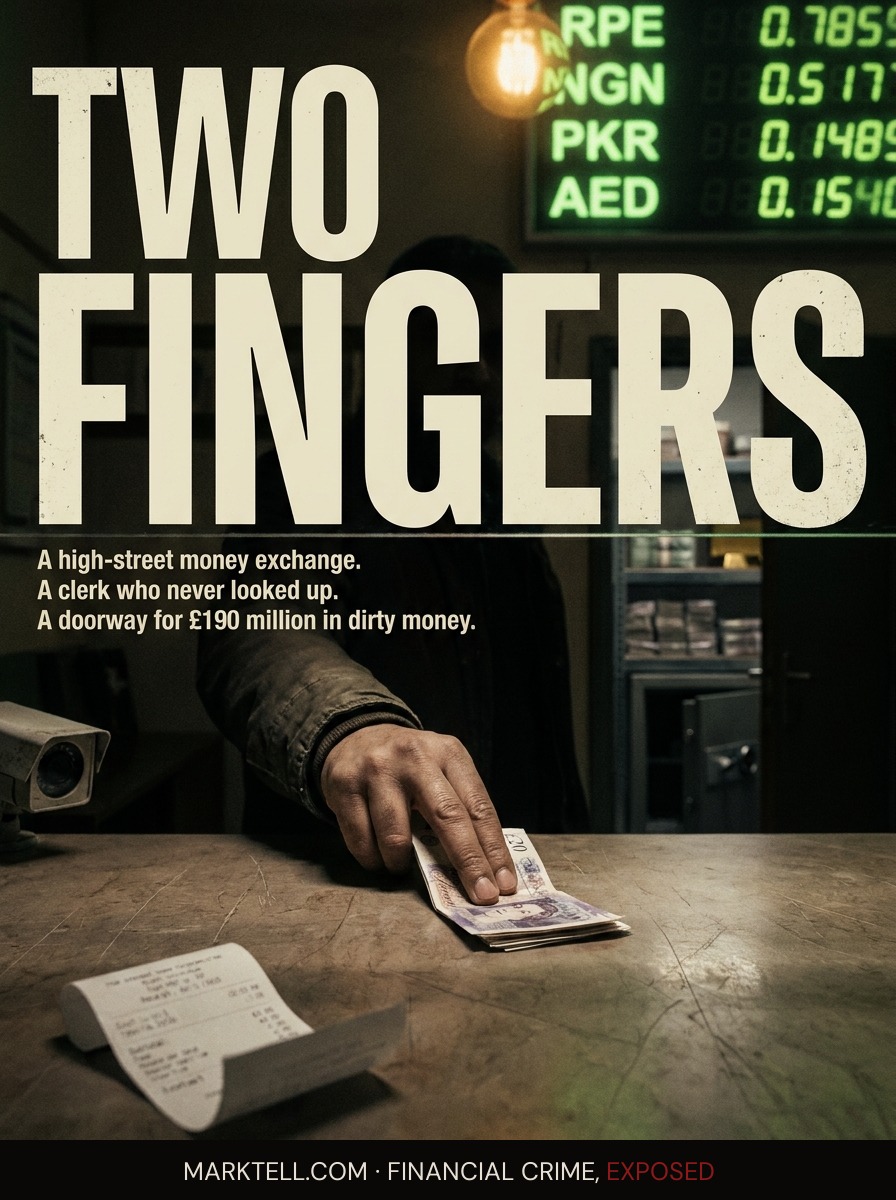
Yasmin counted out the notes on the counter at Rana Money Exchange Ltd, on a stretch of East Ham high street where the awnings overlap and the buses idle. One hundred and eighty pounds. She was sending it to a cousin in Sylhet whose son needed school shoes. The clerk pulled the cash toward him with two fingers, the way you move a card across a table, and did not look up.
She was thirty-eight. She worked at a community center two streets over. She had used this shop, or one like it, for eleven years. The receipt went into her bag. The bag went home. The receipt went into a biscuit tin on the kitchen table, with the others, because her mother had taught her to keep them.
She did not know that the counter she was standing at was, according to City of London Police, a doorway.
Not a metaphorical one. An operational one. A working entrance into a £190 million ($240M USD) global money laundering network. The kind of doorway that takes cash from one world and delivers value to another. The kind that needs a real shopfront, a real till, a real clerk, and a real stream of small ordinary customers like Yasmin to give the door a reason to be open.
This is the story of what was happening on the other side of the counter while she was waiting for her receipt.
I.
On June 11, 2026, two men were sentenced at a London court.
Ali Raza, 43, of Winston Way, Ilford, got six years. Reduced to four years and eight months for a guilty plea and time already served on an electronic tag. He pleaded guilty to laundering £14 million ($17.5M USD) between March 23 and June 12, 2020, through the money service business he ran, Rana Money Exchange Ltd in East Ham.
Adeel Aslam, 42, of Albert Road, Ilford, got three years. Reduced to two years and two months. A jury convicted him of participating in the same activity.
A money service business is the polite name for what most people would call a money exchange shop. It moves cash. It changes currency. It wires remittances. On a UK high street, an MSB sits between a vape store and a kebab grill and serves people who do not have, or do not use, mainstream banks. It is a small piece of financial infrastructure that the formal system does not really see.
That is the feature. Not the bug.
The City of London Police, working through a joint Serious Organised Crime Team with the National Crime Agency, said the £14 million Raza moved was part of a £190 million ($240M USD) global criminal network. During the investigation, they seized over £2.5 million ($3.2M USD) in cash and gold.
Read that slowly. Two and a half million in cash and gold. Not in a vault. Not in an offshore account. In the world. In bags. In safes. In whatever furniture criminals use when they need to put weight somewhere for a few days.
II.
To understand how the door opened, you have to understand how the door was found.
In June 2020, a European law enforcement operation cracked an encrypted phone network called EncroChat. Criminals across Europe had been using it to talk to each other in the belief that nobody could listen. They had been wrong for some time. When the network was taken down, investigators walked away with a library of conversations.
In the UK, the response to that library was called Operation Venetic.
Inside the Venetic material, according to police, were messages from Raza and Aslam, discussing the laundering of funds for organised crime groups. The conversations were not theoretical. They were not boasting. They were operational. The dates lined up with a specific window: March 23 to June 12, 2020. The first months of the COVID-19 pandemic.
While most of Britain was inside, watching the news, the door on the high street was still open. The buses still idled. The clerk still pulled cash toward him with two fingers.
III.
Picture the shop.
Glass front. A printed exchange rate board in the window with rupees, dollars, euros, dirhams. A queue on Fridays. A pen on a chain. A camera in the corner that records everyone except the things that matter. Behind the counter, a back room. In the back room, the parts of the business that are not the business.
The legitimate side of an MSB is real. Yasmin sending £180 to Sylhet is real. The driver sending £400 ($510 USD) to his mother in Lagos is real. The student wiring £60 ($75 USD) to a friend in Karachi is real. These transactions create the noise the laundering hides inside.
The illegitimate side, in this case, was the part where £14 million in dirty cash moved through the same till. Not over a year. Not over five years. Over roughly eleven weeks. Do the math on that. It works out to more than £1.2 million ($1.5M USD) a week. Through a single high street shop. During a national lockdown.
That is not a side hustle. That is the main business with a remittance front.
IV.
The National Crime Agency has a number it uses in its reports. It estimates that around £12 billion in cash-based money laundering occurs in the UK each year. It estimates that the UK enables around £100 billion in high-end illicit finance annually.
Numbers that big stop meaning anything. So bring them back to scale.
£12 billion a year in cash laundering means roughly £230 million ($290M USD) every week. Somewhere. Through somewhere. Through someone's counter. Through someone's back room. Through someone's till.
The Rana Money Exchange case is what one of those weeks looks like when the lights come on. Not all of it. One door. One stretch of high street. Eleven weeks.
There are other doors. Police would say that quietly. The cases not yet brought would say it more loudly if they could.
V.
Back to Yasmin.
She did not know any of this when she handed the £180 across the counter. There was no reason for her to know. Her transaction was clean. Her cousin received the money. The school shoes were bought. The receipt went into the biscuit tin.
When the news of the sentencing came on the radio in her kitchen, on a Thursday morning in June 2026, she was making tea. She heard the address. East Ham. She heard the name of the shop. She set the cup down.
She went to the biscuit tin and took out the stack of receipts. She looked at the ones from 2020. She remembered standing at the counter that spring. She remembered the clerk's two fingers on the cash. She remembered thinking nothing.
That is the cost that does not show up in the seizure totals.
It is not that she lost money. She did not. It is that one of the small institutions she used to trust, one of the boring utilities of immigrant life on a London high street, turned out to have been something else underneath. The door she walked through every few weeks was not just a door for her. It was a door for someone else's £14 million.
She put the receipts back in the tin. She drank her tea cold.
VI.
In the formal record, this case is a win. A guilty plea. A jury conviction. Custodial sentences. Cash and gold seized. A press release from the City of London Police. A line in the annual report.
In the structural record, this case is one node. Raza ran the door at East Ham. Aslam helped run it. The £190 million network they served has not been fully named. The customers who delivered the cash have not all been charged. The places the value ended up have not all been published.
The MSB sector did not collapse. The high streets did not change. The next door is somewhere. It probably looks like the last one. It probably has a printed exchange rate board in the window and a queue on Fridays.
That is the part that should sit heaviest. Not the sentence. The replicability.
VII.
I have stood in rooms where money was being moved that should not have been moved. Not these rooms. Other rooms. Phone rooms. Metals rooms. The rooms had different decorations. The mechanism was the same one every time.
The mechanism is this. You build something that looks like a small ordinary business. You fill it with small ordinary customers. You run the real cargo through the back while the front does its honest work. The honest work is not a cover story. It is the camouflage. Yasmin's £180 was not a side effect of the operation. It was load-bearing.
That is what makes this kind of case so hard to see from the outside, and so hard to feel safe about after the sentencing. The shop is gone. The customers like Yasmin remain. They will find another shop. The shop they find will look exactly like the last one.
Six years for Raza. Three for Aslam. £2.5 million in cash and gold off the table. £14 million accounted for. £176 million ($222M USD), give or take, still unaccounted for inside the wider network.
The door is closed. The hallway is still there.
Yasmin keeps the receipts. She does not know what else to do.
- City of London Police press release | June 11, 2026 | Sentencing announcement re: Ali Raza and Adeel Aslam
- National Crime Agency | public estimates on UK money laundering volumes (£12B cash-based; £100B high-end illicit finance annually)
- Operation Venetic | UK law enforcement response to EncroChat takedown, June 2020
- National Economic Crime Centre | Operation Henhouse 2026 results (557 arrests, £18.1M seized, £9M frozen)
Editorial Notice
MarkTell is a true crime publication about financial fraud. Some scenes, dialogue, and sequential details are reconstructed from court filings, enforcement actions, news reports, and public records. Where the public record does not provide exact details, editorial reconstruction is used to convey the documented pattern of events. Names of private individuals may be changed to protect identity. All factual claims are sourced to public documents cited in the Evidence Trail above. MarkTell does not provide investment, legal, or financial advice. Nothing published here constitutes a recommendation to buy, sell, or avoid any investment. Allegations described in active cases have not been adjudicated and defendants are presumed innocent until proven guilty. Readers should conduct their own due diligence before making financial decisions.