A Bergen County mailbox, a Treasury seal, and twelve and a half million dollars
Federal prosecutors say a Bergen County man helped move $12.5 million in stolen U.S. Treasury checks through a network of bank accounts and shell deposits. The charging documents describe something older than crypto and quieter than a Ponzi: paper, signatures, and a federal seal turned into a laundering machine.
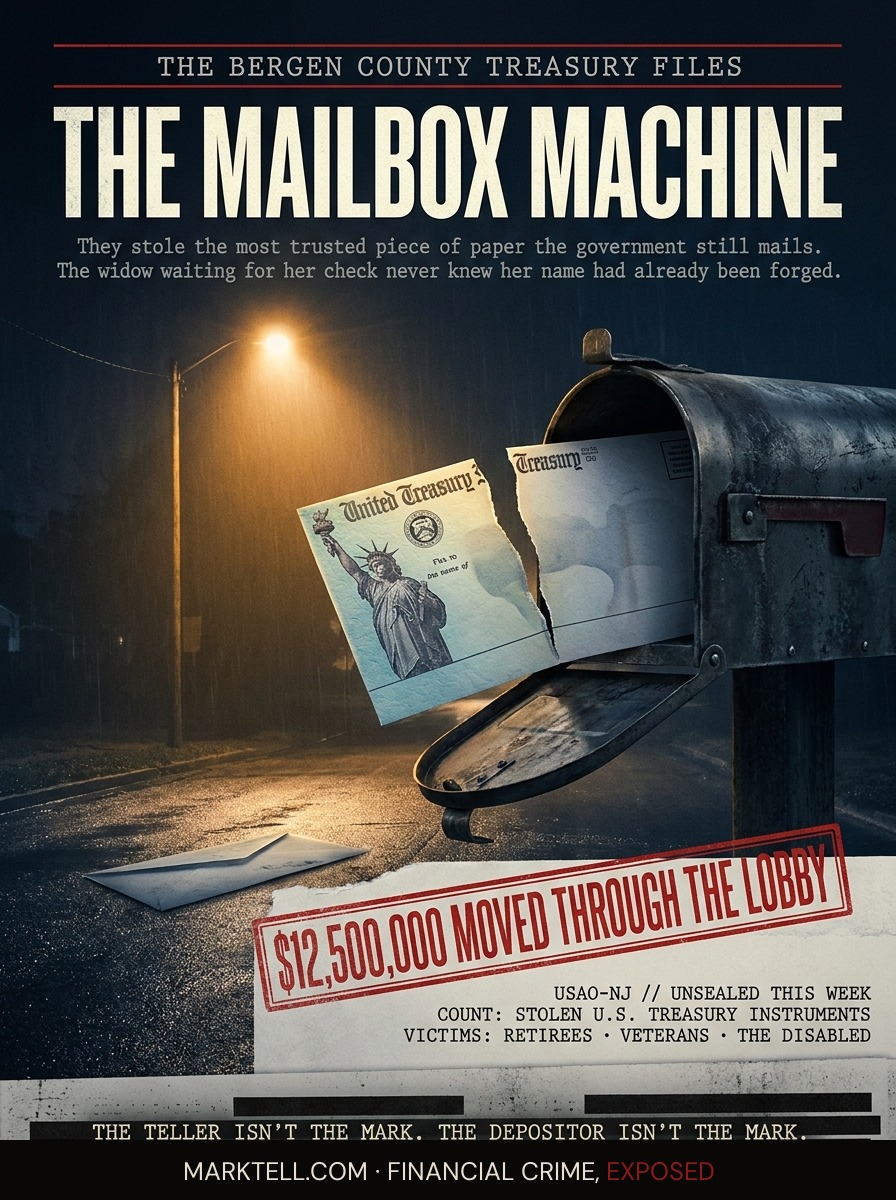
The check arrives in an envelope that does not look like much. Pale blue and white. A printed eagle. The words United States Treasury along the top in a font that has not changed in a generation. Inside, the paper itself carries a watermark you only see when you tilt it under a light. There is a raised seal. There are micro-printed lines along the borders that blur if you try to copy them on a home printer.
It is the most trusted piece of paper the federal government still mails.
That is what makes it worth stealing.
This week, federal prosecutors in New Jersey unsealed charges against a Bergen County man they say helped run a scheme that moved roughly $12.5 million in stolen U.S. Treasury checks through the banking system. The case was first reported by News12 New Jersey. The charges are allegations. Nothing has been proven in court.
But the structure described in the filings is old. Older than crypto. Older than the apps. Older than the shell companies in the Caymans. It is a machine made of paper and signatures and the inside of a bank lobby.
I.
Treasury checks are issued for tax refunds. Social Security. Veterans benefits. Disability. Stimulus payments when those go out. They are sent to the addresses on file with the federal government, which means they are sent to the people who have the least margin in the system. The retired widow. The veteran on a fixed income. The family waiting on the refund to cover the car payment.
When a Treasury check is stolen out of the mail, the person waiting for it usually does not find out for weeks. They call. They are told the check was issued. They are told it was cashed. They are told they will need to file a claim. The claim takes months.
By the time the paperwork moves, the money is gone.
II.
Here is how the laundromat works, in the version the federal complaint describes and in the older versions that came before it.
A check is taken from the mail stream. Sometimes by a postal insider. Sometimes by a thief working a neighborhood. Sometimes by a network buying stolen mail in bulk on encrypted channels. The check is then moved to someone who can cash it or deposit it.
That is where the defendant comes in, according to prosecutors. They allege he helped move stolen Treasury checks through a network of bank accounts, depositing them, cashing them, and pulling the money back out before the federal government could claw it back.
A Treasury check looks legitimate because it is legitimate. The paper is real. The seal is real. The signature is printed. What is fraudulent is the endorsement on the back, the name signed in ballpoint over the printed line, and the account it goes into.
The bank teller sees a federal check. The teller sees an ID. The teller sees a smile. The deposit clears provisionally. By the time the Treasury sends the check back through the system marked stolen, the funds have already been wired out, withdrawn at an ATM, written into a money order, or moved through another account.
The window between deposit and clawback is the machine.
III.
You have to picture the lobby for this to make sense.
A branch in a strip mall. Fluorescent lights. The carpet that all bank carpets are made of. A woman behind the counter with a laminated name tag. The customer slides the check under the glass. He is calm. He has the ID. He has done this before, or someone has done it for him before, and the script is short.
The teller does what the teller is trained to do. She runs the check. She runs the ID. She types the deposit. She hands back a slip.
There is nothing in that interaction that looks like a crime. That is the point. The whole machine is built so that nothing looks like a crime in the moment it happens. The crime is somewhere else, in the mailbox three weeks earlier, or in the database two states away, or in the hands of someone who never enters the lobby at all.
The teller is not the mark. The depositor is not the mark.
The mark is the person whose check never came.
IV.
$12.5 million.
Read that slowly.
That is the figure prosecutors put on the alleged scheme. It is not the figure for one stolen check. It is the figure for the volume that moved through the network the defendant is accused of helping operate. Multiply a single Treasury check, the kind a retiree waits for at the start of the month, by enough repetitions to reach eight figures, and you have the shape of how many envelopes were opened by hands that were not supposed to open them.
We do not yet know, from the public filings, the count of underlying victims. We do not yet know which mailrooms were targeted. We do not yet know who else will be charged. Those answers will come, or they will not, as the case moves.
What we do know is this. Every dollar in that $12.5 million figure was a dollar the federal government meant to send to a specific person. Each check had a name on it. Each name had an address. Each address had a mailbox.
That is the saddest part of the arithmetic.
V.
There is a temptation, when a story like this surfaces, to call it small. Twelve and a half million dollars is a rounding error against the crypto frauds and the private placement collapses that move billions. The defendant is not a celebrity. The instrument is not exotic.
Do not let the smallness fool you.
The Treasury check scheme is one of the most durable financial crimes in the United States. It runs every year. It has run every year for as long as the Treasury has been mailing checks. It runs because the federal mail stream has gaps, because banks process federal paper on trust, and because the people whose checks are stolen are usually the people the system pays least attention to when they call to ask where their money went.
The defendant in Bergen County is one alleged operator. The complaint, if it stands, will close one node in one network in one state in one year.
The machine itself does not stop. It just looks for the next set of hands.
VI.
The check is still arriving in someone's mailbox today. A widow in Paterson. A veteran in Camden. A family in Hackensack waiting on a refund to make rent. The envelope is pale blue and white. The eagle is printed at the top. The seal is raised under the light.
She will open the mailbox tomorrow morning, and the envelope will be there, or it will not.
That is where the case actually lives. Not in the courthouse in Newark. Not in the indictment unsealed this week. In the gap between when the check was mailed and when it was supposed to arrive.
The federal seal is the most trusted mark on American paper.
That is exactly why someone built a machine to steal it.
- News12 New Jersey | May 2026 | "Bergen County man charged in $12.5M Treasury check scheme"
- U.S. Department of the Treasury, Bureau of the Fiscal Service | ongoing | public guidance on Treasury check security features and stolen-check claim process
- U.S. Postal Inspection Service | ongoing | public reporting on mail theft and Treasury check fraud trends
Editorial Notice
MarkTell is a true crime publication about financial fraud. Some scenes, dialogue, and sequential details are reconstructed from court filings, enforcement actions, news reports, and public records. Where the public record does not provide exact details, editorial reconstruction is used to convey the documented pattern of events. Names of private individuals may be changed to protect identity. All factual claims are sourced to public documents cited in the Evidence Trail above. MarkTell does not provide investment, legal, or financial advice. Nothing published here constitutes a recommendation to buy, sell, or avoid any investment. Allegations described in active cases have not been adjudicated and defendants are presumed innocent until proven guilty. Readers should conduct their own due diligence before making financial decisions.