The apartment in Badagry had no signboard. That was the point.
Nigerian officers say they walked into a three-bedroom flat in Badagry and found 106 students enrolled at a university that had no name, no campus, and no accreditation. The degree was one product. The recruitment payout was the other.
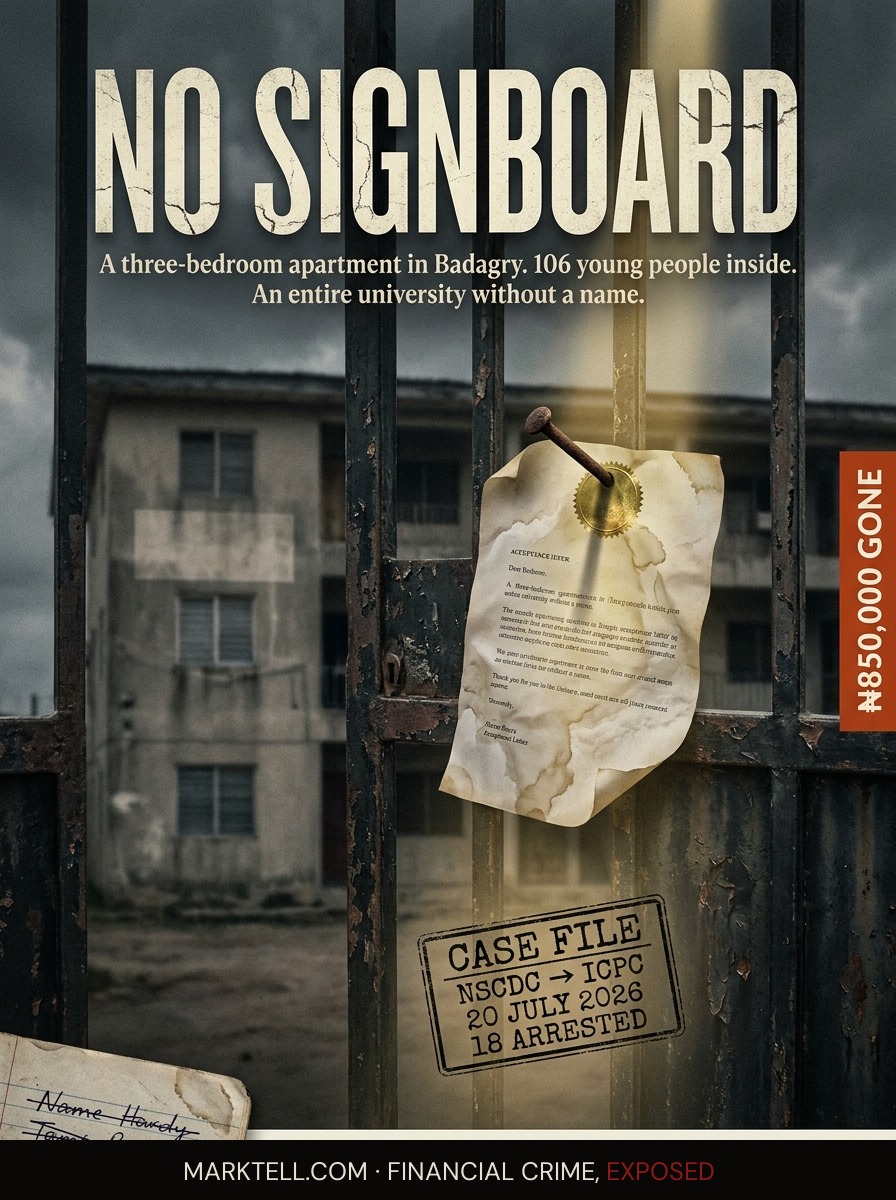
Chika packed the acceptance letter on top of her clothes so it would not crease. She was twenty-one. She was the oldest of four. Her mother had sold a plot of land in their village outside Lokoja to cover the fee, and Chika had folded the receipt for ₦850,000 (about $550 USD) into the back of a Bible on the shelf in the parlor, because that was where important documents lived in her mother's house.
The letter said the institution offered a distance-learning bachelor's degree in business administration, affiliated with a foreign university whose name was written on the letter but which Chika had not been able to find online. She had told her mother the search engines were slow. Her mother had nodded, because her mother trusted her, and because a printed letter with a stamp on it looked like something real.
The bus from Kogi to Lagos took nine hours. The address on the letter was in a place called Imeke, in Badagry, at the western edge of Lagos State, close enough to the Benin border that you could hear the different Yoruba in the market. When Chika arrived, she looked for a campus. There was no campus. There was a three-bedroom apartment behind a metal gate. There was no signboard.
A man opened the gate. He said welcome. He said orientation would begin in the morning.
I.
The apartment had no name on it because a name would have been a paper trail. That was the first thing the Nigeria Security and Civil Defence Corps noticed on Monday, July 20, 2026, when officers moved on the address in Imeke/Ilado, in the Olorunda Local Council Development Area of Badagry. According to the NSCDC's public statements, officers found 106 young people inside. Some accounts put the number at 107. The Corps arrested six suspects tied directly to the operation. In parallel raids that day, twelve more people were arrested on related charges: illegal migration, human trafficking, Ponzi schemes, cross-border crimes. Eighteen in total.
The Lagos State Commandant, Adedotun Keshinro, directed that the suspects be handed over to the Independent Corrupt Practices and Other Related Offences Commission, known as the ICPC. That handoff matters. The NSCDC has arrest authority. ICPC has prosecution authority for corruption-adjacent offenses. The machinery of Nigerian white-collar enforcement moves the file from one desk to another, and the file is what determines whether anyone ever sees a courtroom.
The Corps Public Relations Officer for Lagos State, Oluwaseun Abolurin, described the setup as an institution operating without a name, without registration, without a signboard, and without a recognized campus. It presented itself online as a distance-learning center. It claimed affiliation with a foreign university. It did not name the university in any document the officers could find.
Read that slowly. An entire university without a name.
II.
The fees were the tell.
According to the NSCDC, Nigerian students were told to pay between ₦200,000 and ₦1.5 million (about $130 to $1K USD). Foreign nationals, drawn from Niger, Cameroon, and Togo, paid between $400 and $500. That is a wide band. Real universities do not price by nationality that way. But recruitment operations do, because the price is not the cost of the product. The price is a test of what the mark will bear.
Chika's family paid ₦850,000 ($550 USD). Some of the students in the apartment had paid less. Some had paid nearly twice as much. The variance was not a bug. It was the point. Each student had been quoted a personalized fee based on what the recruiter believed the family could raise. In a country where the National Universities Commission listed 58 illegal universities in September 2025, and had earlier flagged 70 illegal universities and 125 illegal Colleges of Education in 2022, the market for a printed acceptance letter is deep. The market for a printed acceptance letter that costs whatever you can pay is deeper.
But the tuition was only the first product.
III.
The second product was the recruitment.
The NSCDC alleges that inside the apartment, students were told about a second stream of income. If they brought in new students, or new participants in what officers described as an online product-promotion arrangement, they would earn a share. The Corps used the language of Ponzi and chain marketing. In plain English: earlier participants were paid from the fees of later participants. That is the shape of a Ponzi scheme. The educational wrapper was the recruitment tool. The recruitment was the business.
This is the thing that makes the Badagry apartment worth studying. The operators had built two funnels that fed each other. The degree pulled young people in. The referral bonus turned them into salespeople. A twenty-one-year-old from Kogi who had spent her family's land money on tuition had a powerful incentive to convince her cousin to enroll. Her cousin's fee would pay her bonus. Her bonus would make her feel that the money was not lost. It would also convince her that the school was real.
That is how the machine kept the room full.
IV.
Chika sat through the orientation. It was held in the largest of the three bedrooms. There were plastic chairs. There was a projector aimed at a bedsheet on the wall. The presenter talked about the degree program for twenty minutes and about the referral opportunity for two hours. By the end of the session, Chika understood that if she brought in three students at her own fee tier, she would recover her tuition. If she brought in six, she would begin to earn.
She wrote her cousin's name in a notebook. She wrote a girl from her secondary school in the notebook. She wrote a boy from her church.
That part may be the saddest. Not the fee. The notebook.
V.
The raid came on a Monday morning.
The Badagry Area Commander, Chief Superintendent Gbenga Ekunola, led officers to the address. According to the NSCDC's statement, the students inside did not immediately understand what was happening. Some of them believed the officers were there to shut down a legitimate school over a paperwork dispute. Some of them argued with the officers. This is consistent with what the Corps described: victims who did not yet know they were victims.
Six operators were arrested at the flat. The alleged proprietor was among them. The NSCDC has not publicly released the proprietor's name. The 106 students were classified as rescued, not arrested. They were photographed, documented, and in most cases returned to their states of origin or their home countries.
Chika's mother received a phone call on Tuesday from a woman at the NSCDC who spoke gentle English. The woman said Chika was safe. The woman said there had been no university. The woman said the money was gone.
Chika's mother sat down on the floor of the parlor. The Bible was on the shelf above her head. The receipt was still folded inside it.
VI.
Here is what the record supports and what it does not.
It supports that 106 to 107 young people were found inside a three-bedroom apartment in Badagry on July 20, 2026. It supports that 18 people were arrested that day across related operations. It supports that the NSCDC has described the scheme as operating like a Ponzi or chain-marketing arrangement. It supports that the suspects have been handed to ICPC. Allegation is not adjudication. No one has been convicted. The alleged proprietor has not been named publicly. The affiliated foreign university, if it exists at all, has not been identified in the public record.
What the pattern supports is different from what the case file supports.
The pattern is this: in a country where youth unemployment sits high and where a university degree is understood as the only door into the salaried middle class, an operation that sells both a degree and a recruitment income has found two of the most powerful levers a fraud can pull. It sells hope in the morning and it sells hope again in the afternoon. It charges for both.
The National Universities Commission has been publishing lists of illegal universities for more than a decade. The lists get longer. The apartments get smaller. The signboards get taken down.
VII.
Chika came home on a Thursday. She had lost fourteen months. Her mother did not ask her about the money. Her mother made her rice.
The receipt is still in the Bible. Her mother has not decided what to do with it. Throwing it away feels like admitting the land is gone. Keeping it feels like waiting for something that is not coming.
The apartment in Badagry has been sealed. The proprietor is in custody, awaiting whatever ICPC decides to file. The students have gone home to Kogi and Oyo and Niger and Cameroon and Togo, and some of them are still telling their families they were pulled out of a legitimate school by mistake. That is the last thing the machine sells. It sells the story after the story ends.
The signboard was never the point. The absence of the signboard was the point.
That is how you know it was working.
- Blueprint Newspapers | July 22, 2026 | "Lagos: NSCDC rescues 125 victims, arrests 18 in crackdown on fake university, ponzi syndicates"
- Nigeria Security and Civil Defence Corps, Lagos State Command | July 20-22, 2026 | Public statements by Commandant Adedotun Keshinro, PRO Oluwaseun Abolurin, and Badagry Area Commander CSP Gbenga Ekunola
- National Universities Commission | September 2025 | List of 58 illegal universities
- National Universities Commission | August 2022 | List of 70 illegal universities and 125 illegal Colleges of Education
- Independent Corrupt Practices and Other Related Offences Commission (ICPC) | July 2026 | Case handoff from NSCDC
Editorial Notice
MarkTell is a true crime publication about financial fraud. Some scenes, dialogue, and sequential details are reconstructed from court filings, enforcement actions, news reports, and public records. Where the public record does not provide exact details, editorial reconstruction is used to convey the documented pattern of events. Names of private individuals may be changed to protect identity. All factual claims are sourced to public documents cited in the Evidence Trail above. MarkTell does not provide investment, legal, or financial advice. Nothing published here constitutes a recommendation to buy, sell, or avoid any investment. Allegations described in active cases have not been adjudicated and defendants are presumed innocent until proven guilty. Readers should conduct their own due diligence before making financial decisions.