Two hundred and thirty-three checks over nine years, and nobody in Colby saw a thing
Federal prosecutors say a Colby, Kansas controller forged 233 checks and moved $753,575 out of her employer's account over nearly nine years. The alleged machine was one person, one signature line, and a room with no second set of eyes.
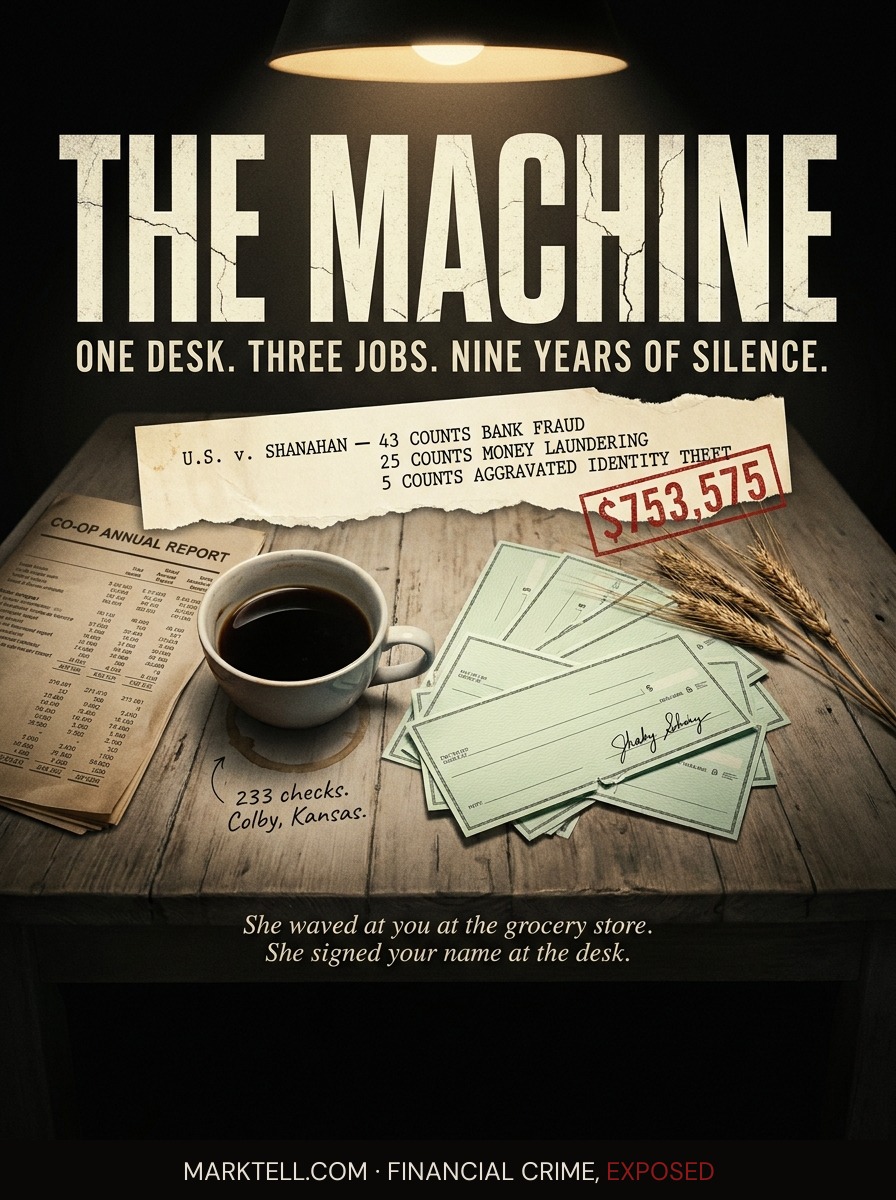
Ray is sixty-eight and he has been a member of the co-op since his father put his name on the books in 1974. He farms wheat outside Colby, Kansas, on land that has been in the family longer than the co-op has existed. Every year in the spring he gets an annual report in the mail. Every year he reads it at the kitchen table with a cup of coffee going cold. Every year the numbers add up.
That is what a co-op is. A pot of money owned by the people who use it. Grain in, fuel out, checks written, checks reconciled, a controller in the office keeping the books straight. In a town of five thousand people the controller is not a stranger. She is somebody's neighbor. She waves at you at the grocery store.
Federal prosecutors now say that for nearly nine years, the person keeping the books at Ray's co-op was writing checks to herself.
The indictment came down on June 30, 2026. Shania A. Shanahan, 39, of Colby. Forty-three counts of bank fraud. Twenty-five counts of money laundering. Five counts of aggravated identity theft. According to the U.S. Attorney's office, Shanahan was the controller and head of the financial division at an agricultural cooperative in Colby that serves its members with grain and fuel. Her job included processing payments, reconciling the bank accounts, and making general ledger entries. That last sentence is the whole story. Read it again.
The person who wrote the checks was the person who reconciled the checks was the person who wrote down what the checks were for.
That is not a job description. That is a machine.
Prosecutors allege that between January 2017 and November 2025, Shanahan forged 233 checks from the co-op's account and deposited them into her personal bank account. They allege she used coworkers' signatures without their knowledge or consent. They allege she then went into the ledger and wrote down the payments as legitimate. Sometimes as payments to herself for reimbursement. Sometimes as payments to real vendors the co-op did business with. The forged check became a real-looking line item. The real-looking line item balanced the bank reconciliation. The bank reconciliation went into the annual report. The annual report went to Ray's kitchen table.
The total alleged take: $753,575.
Do the math. Nine years. Two hundred and thirty-three checks. That is roughly one check every two weeks. That is roughly $3,200 per check. That is a rhythm. That is not a crime of passion. That is a routine.
I have sat at desks like this one. Not this one. Desks like it. I have watched people who controlled the ledger and controlled the reconciliation and controlled the vendor list. I have watched what happens when one person owns all three. Nothing has to hide. The record simply writes itself in the hand of the person who benefits from what the record says.
That is the machine here. It has a name in the accounting textbooks. Segregation of duties. The rule is boring. The person who writes the check is not supposed to be the person who signs the check is not supposed to be the person who records what the check was for. Three sets of eyes. Three signatures. Three people who would have to be in on it for the machine to run.
In the Colby co-op, according to the indictment, one desk did all three jobs.
Ray did not know that. Ray is not an accountant. Ray is a wheat farmer. When he read the annual report he was not auditing internal controls. He was looking at the number at the bottom and asking himself if his co-op was healthy. The number at the bottom said yes. The number at the bottom was written by the hand it was supposed to catch.
Picture the room.
A small office off the main floor of the co-op building. A monitor. Ledger software. A stack of check stubs. A printer that spits out bank reconciliation reports. Someone comes in with a receipt for fuel delivered to a farm outside town. The controller processes the payment. The controller reconciles the account at month-end. The controller enters the general ledger line. Coworkers walk past the door. The grain elevator hums outside the window. Everybody trusts everybody. That is what a co-op is. Trust is the operating capital.
Trust is also the attack surface.
Five counts of aggravated identity theft. That is the piece that makes the room go quiet. Prosecutors are alleging that Shanahan did not just write the checks. She allegedly signed them with the names of coworkers who worked next to her. People who said good morning to her. People who did not know their names were on the bottom of a check for $3,200 going to her personal bank account. That is what aggravated identity theft means in this context. Not stolen from a stranger on the internet. Stolen from the person at the next desk.
The FBI investigated. Assistant U.S. Attorney Katie Andrusak is prosecuting. Shanahan has been indicted, not convicted. She is entitled to the presumption of innocence. The government will have to prove every count. The 233 checks are an allegation. The forgeries are an allegation. The falsified records are an allegation. Allegation is not adjudication. A grand jury voted to charge. A trial jury has not weighed in.
But the fact pattern is worth staring at because it is not rare.
Six months earlier, in December 2025, a CPA named Quintin Flanagin from Colby was sentenced to 48 months for defrauding clients, who were also his relatives, of over $400,000. Same town. Same year. Same structure. One person with signatory access. One person who could move money and record why it moved. In September 2025, two former Wyandotte County District Court bookkeepers were indicted for allegedly stealing $900,000 from the court between 2018 and 2023 by forging signatures. In June 2026, those two received prison sentences. Same state. Same machine.
The pattern is not the person. The pattern is the desk.
Any organization where one human being writes the checks, reconciles the bank account, and enters the ledger line is running the machine. It does not matter if the human being is honest. Ninety-nine out of a hundred are. The machine does not require dishonesty to exist. It only requires the absence of a second set of eyes for dishonesty to become invisible when it arrives.
Ray does not know yet what the co-op will look like after this. Whether membership fees go up. Whether the fuel margin gets thinner. Whether the annual report next spring includes a line item called "recovery of misappropriated funds" and another one called "legal expenses." Whether the person at the next desk who allegedly had her signature forged 233 times sleeps well at night now that she knows her name was on the bottom of a check going somewhere she never authorized.
He does know one thing. The numbers in the annual report he read every year for nine years were not the numbers. They were the numbers the machine wanted him to see.
That is what a co-op is supposed to protect against. A co-op is the small farmer's answer to being one small buyer in a big commodity market. It exists so that people who trust each other can pool the parts of their business that are too big to handle alone. It runs on the assumption that inside the pot, the rules are followed. That the person in the office is not a stranger. That the neighbor is a neighbor.
The indictment does not end the co-op. Co-ops survive this. They bring in outside auditors. They rewrite the controls. They separate the duties. They add a second signature. They add a third. They put the checkbook in a drawer that requires two keys.
The machine keeps running somewhere else. Under another name. In another town. At another desk where one person does three jobs because the organization is small and the payroll is tight and everybody trusts everybody.
Ray will read the next annual report the same way. At the kitchen table. With coffee going cold. Looking at the number at the bottom.
He will believe it a little less.
That may be the saddest part.
- KWCH News | July 1, 2026 | Colby woman indicted on federal charges for allegedly embezzling $750K from co-op
- U.S. Attorney's Office, District of Kansas | June 30, 2026 | Indictment of Shania A. Shanahan, 43 counts bank fraud, 25 counts money laundering, 5 counts aggravated identity theft
- U.S. Attorney's Office, District of Kansas | December 9, 2025 | Sentencing of Quintin Flanagin, CPA, Colby, Kansas
- U.S. Attorney's Office, District of Kansas | September 5, 2025 / June 30, 2026 | Indictment and sentencing of Julia Roberts and Vicki Robinson, former Wyandotte County District Court bookkeepers
- Federal Bureau of Investigation | 2026 | Lead investigating agency, Shanahan case
Editorial Notice
MarkTell is a true crime publication about financial fraud. Some scenes, dialogue, and sequential details are reconstructed from court filings, enforcement actions, news reports, and public records. Where the public record does not provide exact details, editorial reconstruction is used to convey the documented pattern of events. Names of private individuals may be changed to protect identity. All factual claims are sourced to public documents cited in the Evidence Trail above. MarkTell does not provide investment, legal, or financial advice. Nothing published here constitutes a recommendation to buy, sell, or avoid any investment. Allegations described in active cases have not been adjudicated and defendants are presumed innocent until proven guilty. Readers should conduct their own due diligence before making financial decisions.