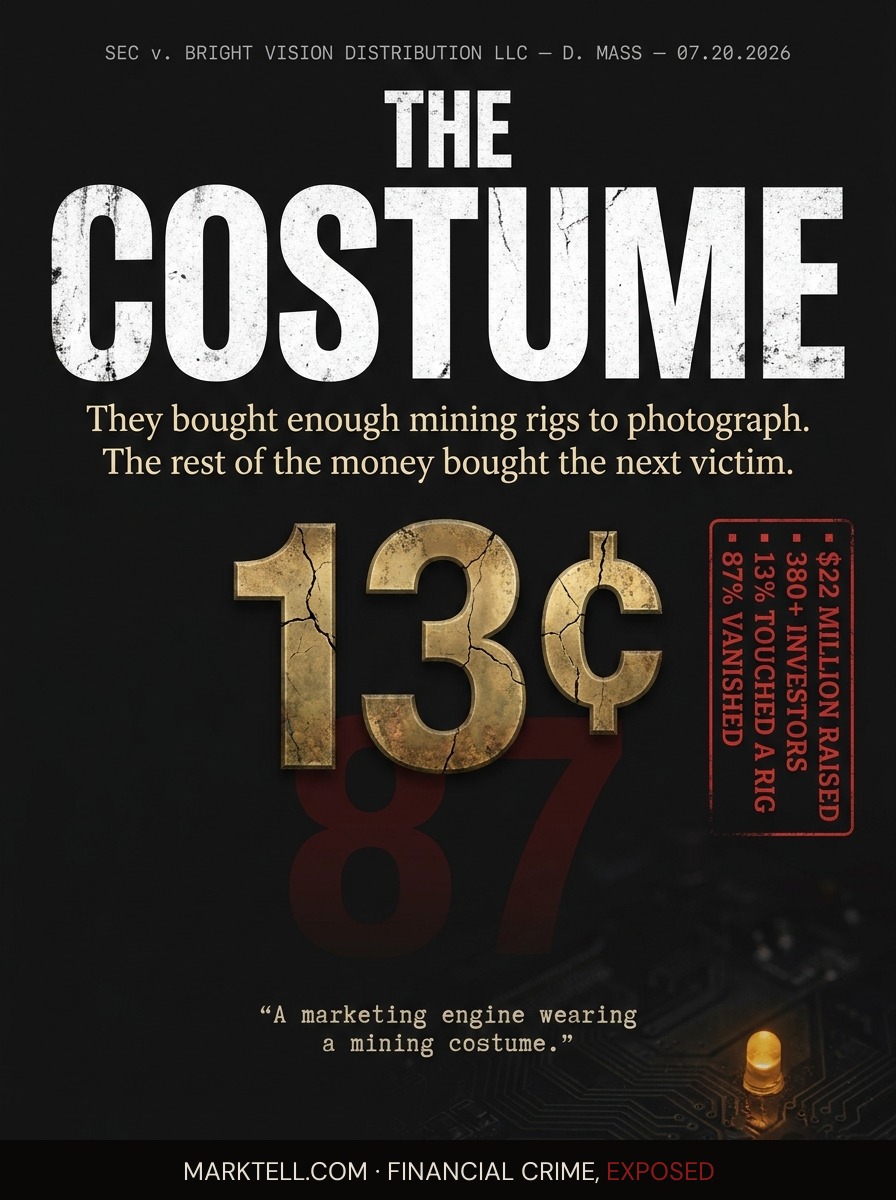
Thirteen cents of every dollar touched a mining rig. The rest built the pitch.
The SEC says Zan Shaikh sold guaranteed monthly returns from a crypto mining operation to more than 380 investors. According to the complaint, only about thirteen cents of every dollar was ever spent on mining.
Marisol did the math at her kitchen table in Tampa.
She was fifty-eight. She had cleaned teeth for thirty-one years. Her husband, Roberto, had died in 2022. The life insurance had cleared. It sat in a savings account earning almost nothing while she tried to decide what he would have wanted her to do with it.
A friend from church told her about a company called Mining Automatic. The friend's brother-in-law was already in. The returns were monthly. The word on the one-pager was guaranteed. The pitch was that you did not need to understand crypto mining to earn from crypto mining. You bought a contract. The company ran the rigs. The rigs ran the math. The math paid you.
Marisol read the one-pager twice. It was clean. It had a logo. It had a Florida address. It had a founder, Zan Shaikh, whose photo was on the site next to language about experience and track record. She wired $47,000. Then she wired more.
For a while, the dashboard did what it said it would do. Numbers went up. A small deposit landed in her account each month. She showed her sister on her phone at Thanksgiving. She used the word safe.
I need to tell you where the money actually went.
According to the complaint the SEC filed in the U.S. District Court for the District of Massachusetts on July 20, 2026, Mining Automatic raised approximately $22 million from more than 380 investors between June 2023 and May 2025. The SEC alleges that only about thirteen percent of that money was used for anything related to crypto asset mining. The rest was largely spent on marketing to bring in more investors, and on Shaikh's personal and unrelated business expenses.
Thirteen percent.
Read that slowly. For every dollar Marisol and 379 other people wired into Mining Automatic, roughly thirteen cents touched a mining rig. Eighty-seven cents went somewhere else. Most of that somewhere else, per the complaint, went into finding the next Marisol.
That is the machine. Not a mining company with a marketing budget. A marketing engine with a mining costume. The rigs were the costume. The costume was expensive enough to be photographed.
Crypto asset mining, plainly stated, is the business of running specialized computers that solve math problems in exchange for newly issued coins. It is capital-intensive. It needs hardware, electricity, cooling, and space. A real mining operation looks like a warehouse full of noise and heat. A fake one looks like a website and a Discord.
The SEC's complaint describes what the company told investors. It described experience Shaikh allegedly did not have. It described a track record the operation could not support. It described the use of funds in a way that did not match where the funds went. When monthly payments began arriving late, the complaint says, investors were given misleading explanations for the delays. This is where the machine starts to hum in a different key. Late payments are the first tremor. The excuses are the aftershock.
Somewhere in early 2025, Marisol logged into her dashboard and the loader spun longer than usual. Then a payment was five days late. Then eleven. Then it was a message about a technical migration. Then it was a message about a regulatory delay. Then it was silence.
She did not lose everything. She lost enough.
The SEC's complaint alleges violations of Sections 5(a), 5(c), and 17(a) of the Securities Act of 1933, and Section 10(b) of the Securities Exchange Act of 1934 and Rule 10b-5. In plain English, those statutes cover selling unregistered securities and lying to investors while doing it. Both Shaikh and Mining Automatic, which is legally registered as Bright Vision Distribution LLC, have agreed to a permanent injunction. That means a court order barring them from doing this again. The dollar figures, the disgorgement of what they took, the interest on it, and the civil penalties on top, will be set by the court later.
None of the underlying fraud allegations have been adjudicated. Both sides settled part of the case without an admission on the merits. That is the legal posture. Allegation is not conviction. It is a filed document with a court number and a set of specific claims that Shaikh has not, on the record, contested with a trial.
I want you to notice something about the thirteen percent.
Thirteen percent is not zero. That is the design. A pure Ponzi with no mining at all is fragile. If a single investor visits the warehouse and finds nothing, the whole story collapses. Thirteen percent buys enough rigs to photograph. Thirteen percent buys a tour. Thirteen percent buys a founder who can say, look, the mining is real. The mining was real. It just was not the business. The business was the marketing.
This is a pattern. When you see an operation that promises guaranteed monthly returns from a technology-heavy investment, and the marketing budget is visible everywhere while the operational footprint is thin, the ratio is doing the work. The ratio is the tell. A real mining company spends most of its money on hardware and power. A marketing engine spends most of its money on marketing.
Marisol has the one-pager in a folder now. She keeps it in the drawer where she used to keep Roberto's paperwork. She showed it to her lawyer. Her lawyer told her about the SEC action and about how long these things take. She asked, in the quiet voice people use when they already know the answer, whether she would get the money back.
The court will decide the disgorgement number. The disgorgement number is not the same as the recovery number. You cannot disgorge what has already been spent. Marketing agencies were paid. Personal expenses were incurred. Unrelated businesses were funded. The complaint says at least $20 million more came in than went back out to investors. That is the hole.
She sat at the same kitchen table where she signed up.
The dashboard still loads, if you go looking for it. The numbers on it no longer mean what they meant. They were never really the numbers. They were the costume the numbers were wearing.
Thirteen cents of every dollar mined anything.
The rest of the dollar was the machine.
- SEC Complaint, SEC v. Zan Shaikh and Bright Vision Distribution LLC d/b/a Mining Automatic | July 20, 2026 | U.S. District Court for the District of Massachusetts
- SEC Press Release / Announcement | July 20, 2026 | sec.gov
- Bitcoin World, "SEC Charges Florida Man And His Firm In $22 Million Crypto Mining Fraud" | July 20, 2026
- Securities Act of 1933, Sections 5(a), 5(c), and 17(a)
- Securities Exchange Act of 1934, Section 10(b) and Rule 10b-5
Editorial Notice
MarkTell is a true crime publication about financial fraud. Some scenes, dialogue, and sequential details are reconstructed from court filings, enforcement actions, news reports, and public records. Where the public record does not provide exact details, editorial reconstruction is used to convey the documented pattern of events. Names of private individuals may be changed to protect identity. All factual claims are sourced to public documents cited in the Evidence Trail above. MarkTell does not provide investment, legal, or financial advice. Nothing published here constitutes a recommendation to buy, sell, or avoid any investment. Allegations described in active cases have not been adjudicated and defendants are presumed innocent until proven guilty. Readers should conduct their own due diligence before making financial decisions.