The treasurer brought the no-risk investment to the board. She also owned the company.
Ashley Benny, a school board treasurer in a Missouri town of a few hundred people, pitched her board on a "no risk" overseas investment. She did not mention she owned the bank account on the other end of the wire.
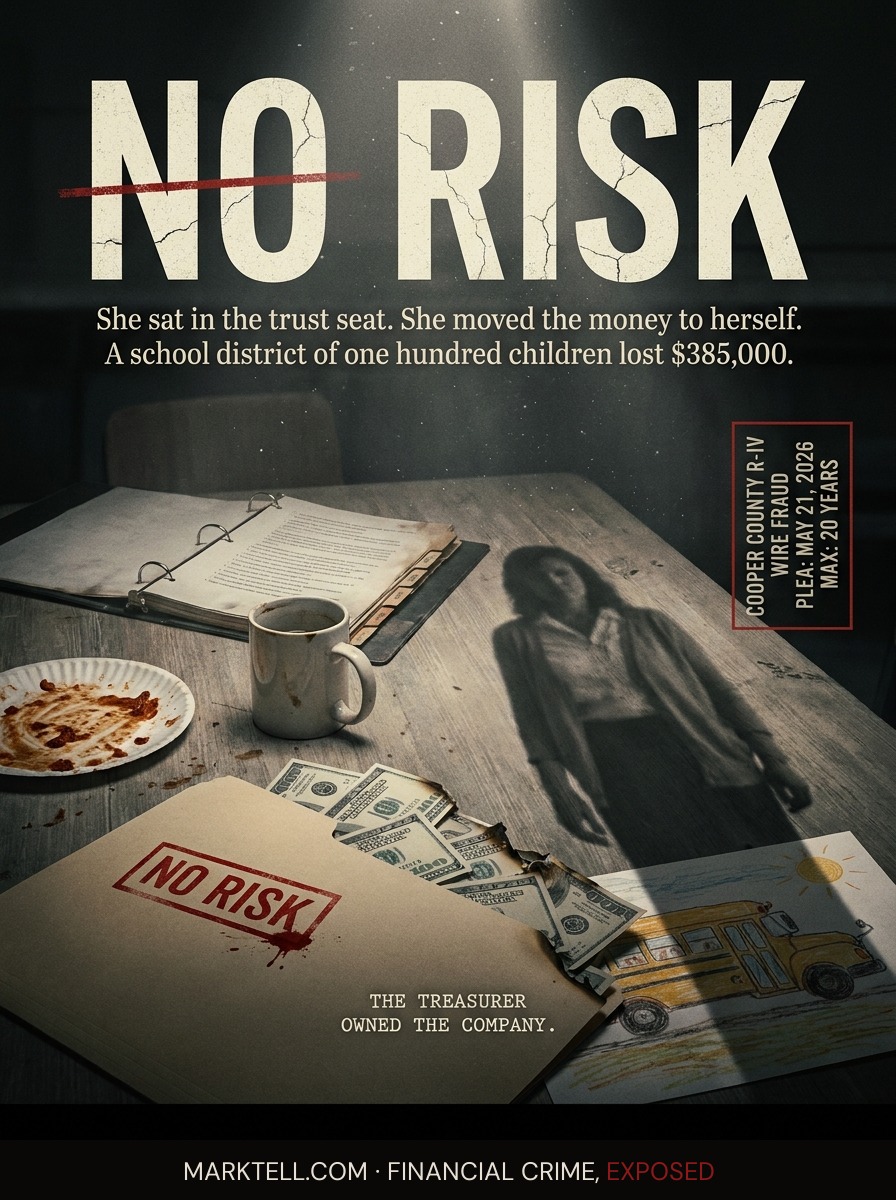
Diane kept the binder in the kitchen, on the corner of the table where her husband used to leave his keys. The binder had a section for board minutes, a section for budget summaries, and a section in the back for the kiln warranty from the art room. She was fifty-eight. She had served on the Cooper County R-IV school board for six years. She volunteered in the cafeteria on chili day. She knew every kid in the district by their last name because in a district of about a hundred students, you do.
The meeting in 2019 was a regular Tuesday. The agenda had the usual items. Bus route. Roof estimate. Then the treasurer stood up and said she had been looking into something for the savings.
The treasurer was Ashley Benny. Forty-one. Lived in Bunceton. The board had asked her to research alternatives for the district's unallocated savings, the money that was just sitting. She had done the research. She had found something.
The word she used, according to what federal prosecutors would later describe, was the word that always gets used in this kind of room. She said the investment carried no risk of loss.
She called it a standby letter of credit. Overseas. A friend had introduced her to it. The way she explained it to the board, the district would put in $385,000 and the structure would do the work. A standby letter of credit, if you have never heard the term, is a banking instrument that promises payment if a deal goes bad. It is real. It is boring. It is used in international trade. It is not, in any normal universe, a high-yield investment vehicle that a small Missouri school district drops a third of a million dollars into through a friend of a friend.
But nobody in the room said that. Because the person presenting it was the treasurer. And the treasurer was their neighbor.
The board voted to send $385,000 to a company called AgFluent.
What the board did not know, and what Ashley Benny did not tell them, was that she had opened the AgFluent bank account. She controlled it. She stood to personally profit from the transfer. The vendor was her. The third party was her. The arms-length transaction had no arms in it.
This is the part that earns the federal charge. Not the bad investment. Not the loss. The omission. The treasurer asking the board to wire money to a company and not mentioning the company was hers.
The wire went out.
II.
Picture the money for a second. Three hundred and eighty-five thousand dollars, in a district where the entire student body could fit on three school buses. That is roof money. That is bus money. That is two years of a teacher's salary. That is the cushion a small district sits on so that when the boiler dies in February the kids still come to school.
The money landed at AgFluent. Then it moved.
According to the plea, $233,000 of it went overseas, into the "standby letter of credit" arrangement that prosecutors describe as a scam. That money is, for practical purposes, gone. Wired across borders, into a structure that was never going to return it.
The rest did not even go overseas. The rest stayed close. It went, the government says, to pay the bills of a co-conspirator. Roughly $60,000 of school district money bought two semi-trucks. Ten thousand dollars went to escrow on a land deal that fell through. Other expenses owed by the co-conspirator got paid out of the same pot.
Read that again. Read it slowly.
A school district in a Missouri town of a few hundred people wired its savings to what its treasurer presented as a no-risk overseas investment. A chunk of it disappeared into the overseas hole. Another chunk paid for trucks. The trucks were not for the district. The land was not for the district. Nothing the money bought was for the district.
The kids in the cafeteria on chili day did not know any of this.
III.
The machine here is small. That is what makes it worth writing about.
There is no boiler room. There is no glossy pitch deck. There is no influencer. There is just a board meeting in a small town, and a treasurer with a side arrangement, and a vote, and a wire.
The mechanism is the oldest one on the floor. The affinity wrapper. The trust loop. You do not check the vendor because the vendor was introduced by someone you know. You do not ask whether the treasurer has an interest in the company because the treasurer is your neighbor and asking would be rude. You do not demand a disclosure form because nobody in town has ever needed one before.
A school district board is not a corporate audit committee. It is a roomful of parents and former teachers and the guy who owns the feed store, sitting around a table after dinner, trying to do right by a hundred kids. The controls are made of trust. When the person sitting in the trust seat is the one moving the money, the controls do not exist.
This is why fraud at small public entities is its own category. The reports that look at K through 12 fraud keep landing in the same place. Most of it happens at the individual school or district level. Most of it involves insiders. Most of it happens where the financial controls were thin because the room was small and everyone knew everyone.
Everyone knowing everyone is supposed to be the safeguard. In this case it was the delivery mechanism.
IV.
On May 21, 2026, in federal court in the Western District of Missouri, before U.S. Magistrate Judge Willie J. Epps, Ashley Benny pleaded guilty to one count of wire fraud.
She admitted direct responsibility for $146,518 of the loss. Under the plea agreement, she must pay full restitution in that amount to the Cooper County R-IV School District. The total amount the scheme cost the district was $385,000. The difference between those two numbers is the part that went somewhere a federal restitution order cannot reach.
Sentencing comes later. Wire fraud carries a statutory maximum of twenty years. What she will actually receive is a different question, decided by a different judge, on a different day.
V.
Diane is not real. Diane is the seat at the table. The seat has been filled, in small school districts across the country, by ten thousand versions of the same person, every Tuesday night for decades. They show up. They read the agenda. They trust the treasurer because the treasurer is sitting two chairs down and they have known her since her oldest was in third grade.
The treasurer in this case knew that. The plea agreement is, in its own dry way, a description of what knowing that lets you do.
A hundred students. Three hundred and eighty-five thousand dollars. One unchecked box on a disclosure that was never asked for.
The smallest rooms have the simplest locks. The simplest locks are the easiest to leave open. And when the person who walks through the open door is the person you trusted to lock it, you do not even hear it close behind them.
- U.S. Department of Justice, Western District of Missouri | May 21, 2026 | Press release on guilty plea of Ashley Benny to wire fraud
- KMZU.com | May 21, 2026 | "Cooper County R-IV School District board member pleads guilty to wire fraud"
- U.S. District Court, Western District of Missouri | May 21, 2026 | Plea proceedings before U.S. Magistrate Judge Willie J. Epps
- Cooper County R-IV School District (Bunceton, Mo.) | public district information | approximate enrollment of 100 students
Editorial Notice
MarkTell is a true crime publication about financial fraud. Some scenes, dialogue, and sequential details are reconstructed from court filings, enforcement actions, news reports, and public records. Where the public record does not provide exact details, editorial reconstruction is used to convey the documented pattern of events. Names of private individuals may be changed to protect identity. All factual claims are sourced to public documents cited in the Evidence Trail above. MarkTell does not provide investment, legal, or financial advice. Nothing published here constitutes a recommendation to buy, sell, or avoid any investment. Allegations described in active cases have not been adjudicated and defendants are presumed innocent until proven guilty. Readers should conduct their own due diligence before making financial decisions.