The signature on the deed was real. The hand that wrote it was not.
A senior conveyancing lawyer at a Singapore firm has been charged with forgery tied to a luxury condominium purchase inside the country's largest money laundering case. The paperwork that made the money clean is now the paperwork the state is unwinding.
I.
Mei Ling was standing on the North East Line, one hand on the pole, the other holding her phone at an angle to catch what was left of the signal. She is fifty-eight. She works as an administrative officer in a tower two blocks from Beach Road, the kind of job where you learn a building by the elevator sounds. She has walked past South Beach Residences almost every workday for six years. She has never been inside a unit. Nobody she knows has.
The Straits Times push notification came through as the train slowed into Dhoby Ghaut. A conveyancing lawyer. Charged with forgery. A property purchase at 28 Beach Road.
She read it twice. Then she read the address again, because the address was the part she recognized.
That is where this story lives. Not in the courtroom. On a phone screen, in a tunnel, held by a woman who has watched a set of luxury condominiums fill up with buyers she has never seen in the lobby, and who is now being told, quietly, in a paragraph of court reporting, that the paperwork for at least one of those units may have been forged.
The machine in this story is the closing table. That is the small, ordinary room where money becomes property. A lawyer, a folder, a pen. A signature on the line. The registry accepts it. The title changes hands. From that moment forward, the money that bought the unit is no longer money. It is a home.
That is the whole trick. That is what money laundering is, in the end. Turning one thing into another thing so the first thing stops being visible.
If the closing table works, the machine works.
The state of Singapore has now charged one of the people who sits at that table.
II.
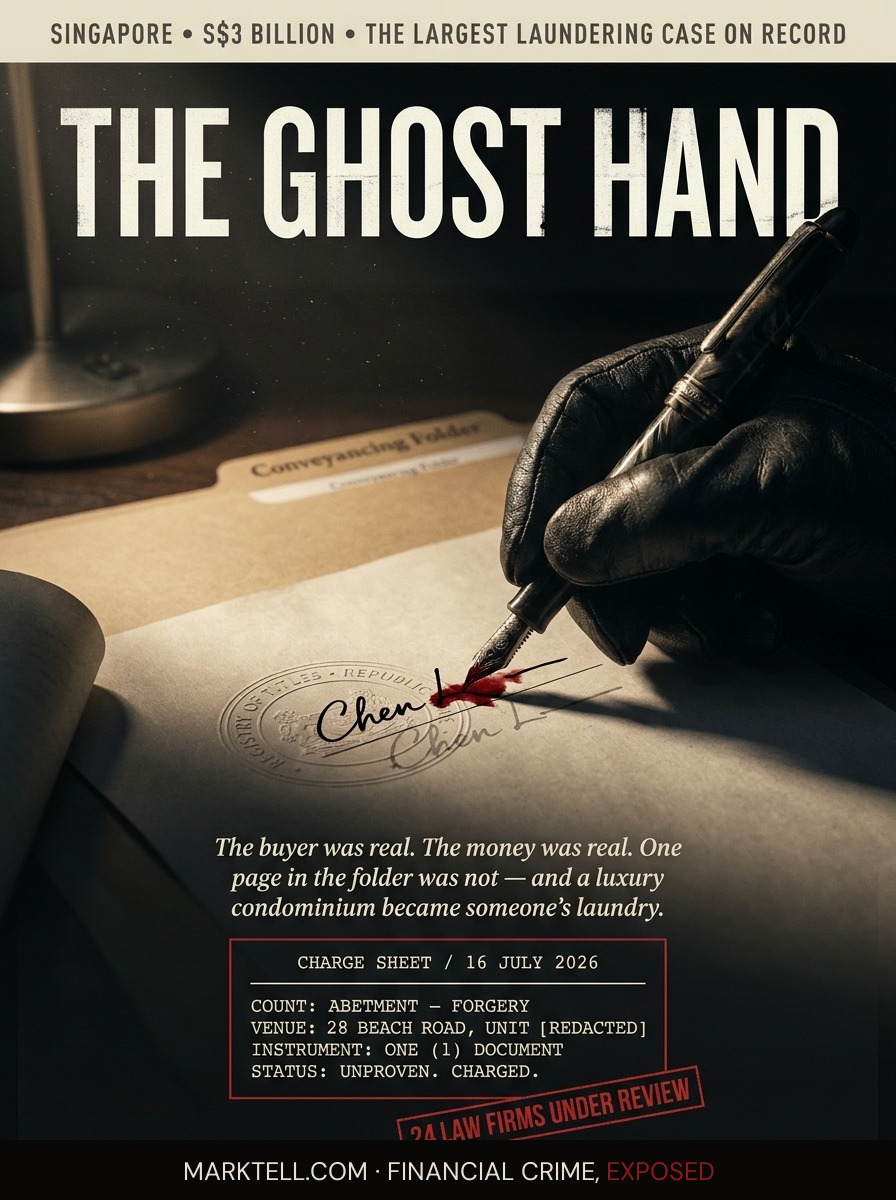
The name in the charge sheet is Chan I-Fei Julia. She is sixty-one years old. She is a director at Sterling Law, a Singapore firm that handles conveyancing, which is the polite word for the paperwork of buying and selling property. She was charged on July 16, 2026, with abetting one Lim Lai Hong to create a false document. The document was signed, on paper, by a woman named Chen Lingling. The date on the document was on or around December 14, 2023. The property was a unit at South Beach Residences.
None of this has been proven at trial. The word to hold in mind is charged. The state has said what it believes happened. It has not yet asked twelve people, or a judge, to agree.
But the charge itself is the news, because of what Chen Lingling is.
She is not one of the ten. The ten are the people the world already knows about. Ten foreign nationals, mostly from Fujian, holding a curious assortment of non-Chinese passports, arrested in a coordinated raid across Singapore on August 15, 2023. They were charged the next day. Between April and June 2024, all ten were convicted. They received sentences ranging from thirteen to seventeen months. They forfeited over S$944 million in assets (about $700M USD). They were deported and barred from returning.
Chen Lingling is described in police statements as an associate of that group. A shareholder in firms holding commercial real estate. Her name is on a S$42 million shophouse (about $31M USD) on North Bridge Road. And, according to the charge unsealed this week, her name was on a condominium purchase at 28 Beach Road that the state now says was closed with a forged document.
Read that slowly.
Not a fake buyer. A real buyer. Real name, real face, real bank account. But somewhere in the stack of paper it takes to close a Singapore property, one page, according to the prosecutor, was not what it claimed to be.
That is the level the machine operates at. It does not need everything to be fake. It just needs one page.
III.
Picture the room. We do not have photographs of the specific closing. Nobody outside the transaction has seen it. But conveyancing in Singapore looks like conveyancing everywhere. A conference table. Tabbed folders. A stack of documents an inch thick, each page a checkpoint. Identity verification. Source of funds declaration. Sales and purchase agreement. Option to purchase. Stamp duty. Caveat. Transfer of title.
Every one of those checkpoints exists to answer a specific question. Who are you. Where did the money come from. Do you have the right to sign this. Do you understand what you are signing. Is anyone forcing you.
The conveyancing lawyer is the person who is supposed to make sure the answers add up. She is the gatekeeper. Not because she is a police officer, but because she is the last professional signature between the money and the title. Once she signs off, the machinery of the state accepts the transaction as clean.
If we got a piece of furniture wrong in that room, we got a piece of furniture wrong. The function of the room we have right. The function is verification. What the state is alleging, in plain language, is that in this one transaction, the verification failed. Or worse. That the verification was the fraud.
The charge names Lim Lai Hong as the person who created the false document. It names Chan I-Fei Julia as the person who abetted the creation. Abetted is a legal word that means, roughly, helped it happen. What the state has not yet said, publicly, is what Chan allegedly knew about where the money came from. That is an open question. It is one of the questions the trial, if it goes to trial, will have to answer.
But zoom out from the one charge for a moment.
The Ministry of Law has been investigating twenty-four law firms in connection with this case. Anthony Law Corporation, Fortis Law Corporation, Legal Solutions LLC and others have been penalized up to S$100,000 (about $75K USD) for anti-money-laundering breaches. Several lawyers have been referred to the Law Society for discipline. Property agents have been fined. Bankers have been convicted. Wang Qiming, a former Citibank relationship manager, was sentenced to two years for forgery and money laundering tied to this same case. Liu Kai, formerly of Julius Baer, faces charges. On June 3, 2026, corporate service provider Wang Junjie pleaded guilty to conspiring with two of the convicted launderers, Su Haijin and Su Baolin, to submit false tax information to the Inland Revenue Authority of Singapore, creating the appearance of a profitable company.
Do the math on that list. Bankers. Lawyers. Property agents. Corporate service providers. Tax filers.
These are not the ten. These are the professionals who sat at the closing table, or the equivalent of it, and moved the pen.
IV.
Mei Ling did not think about any of this while she was reading the notification. She thought about the elevator.
There is a specific kind of quiet in a luxury condominium lobby in Singapore. Marble that absorbs sound. A concierge desk with a screen and a phone. Buyers who arrive and disappear behind an access card. She has watched enough of those buildings to know that you can live next door to a place and never see the people who own the units. That is normal. That is Singapore. Privacy is part of what the price buys.
What is not normal is the idea that behind the marble, in an office two blocks away, a lawyer she has never met sat down with a folder and, allegedly, signed off on a page that had been forged.
That was the part that got into her stomach on the ride home.
Because if that happened once, in one folder, on one December afternoon, then the question is not whether the machine ran. The machine ran. The question is how many times.
That is the ugly question. Not the exciting one. Not the number in the headline. The one about how many folders on how many tables in how many offices had a page in them that was not what it claimed to be.
The state cannot yet answer it. It is working through the folders one at a time.
V.
Here is what the record shows, without editorializing.
Singapore was first alerted to the scheme in 2021. The August 15, 2023 raid seized about S$1 billion (about $740M USD). Subsequent investigation grew the total to S$3 billion (about $2.2B USD), which is why this case is now Singapore's largest money laundering matter on record. Fifteen of seventeen fugitives linked to the case have agreed to surrender S$1.85 billion (about $1.4B USD) in assets. Combined surrendered assets stand at roughly S$2.8 billion (about $2.1B USD). The Monetary Authority of Singapore has imposed S$27.45 million (about $20M USD) in penalties on nine financial institutions for anti-money-laundering failures. The Anti-Money Laundering and Other Matters Act 2024 has since made it easier for prosecutors to prove dealing with criminal proceeds.
Those are the adjudicated numbers. That is what the state has already won.
What is now being charged, one professional at a time, is the layer beneath the ten. The lawyers. The bankers. The agents. The people who did not, on the record, own the assets or move the funds, but who, in the state's allegation, made the ownership and the movement look correct on paper.
Chan I-Fei Julia has not been convicted. She is entitled to a defense. She is entitled to the presumption of innocence. Her firm has not been shuttered. The charge is one count. The document at issue is one document. The property is one condominium.
But that is the point of a machine like this. It does not need everyone to be corrupt. It needs one page. One folder. One signature by a person who, for whatever reason, did not stop.
VI.
Mei Ling got off the train at HarbourFront and walked home. She did not tell anyone at work about the notification the next day. There was nothing to say. She does not own a South Beach unit. She does not know Chen Lingling. She has never met Chan I-Fei Julia. She was not, in any legal sense, harmed.
But something in her had shifted. Read that carefully, because it is the part that matters. The people directly harmed by the S$3 billion machine were, in most cases, in China, or the Philippines, or wherever the unlicensed lending and the online gambling and the scams originally landed. The victims of the underlying crimes are not, mostly, Singaporeans.
The Singaporean who was harmed is the one who used to believe that when a lawyer signed a page, the page was real.
That belief is the country's actual asset. It is what the rulebook is for.
The charge sheet unsealed on July 16 is not, on its own, the collapse of that belief. One charge does not collapse a system. But it is the sound the system makes when a gate that was supposed to hold, according to the state, did not.
The ten launderers are gone. Deported. The money is largely surrendered. The case is, in the narrative sense, resolved.
What is being prosecuted now is the closing table.
The signature on the deed was real. The hand that wrote it, the state alleges, was not.
- The Straits Times | July 16, 2026 | Report of forgery charge against Chan I-Fei Julia in connection with S$3 billion money laundering case
- Singapore Police Force / Commercial Affairs Department | 2023-2026 | Public statements on S$3B money laundering case, arrests, seizures, forfeitures
- Ministry of Law Singapore | 2024-2026 | Public statements on investigation of 24 law firms; penalties imposed on Anthony Law Corporation, Fortis Law Corporation, Legal Solutions LLC
- Monetary Authority of Singapore | 2024 | S$27.45M penalties on nine financial institutions for AML breaches
- Court records | April-June 2024 | Convictions and sentences of the ten foreign nationals (Su Wenqiang, Vang Shuiming, Lin Baoying, Su Haijin, Su Baolin, Zhang Ruijin, Chen Qingyuan, Su Jianfeng, others), sentences of 13-17 months
- Court records | June 3, 2026 | Guilty plea of Wang Junjie, corporate service provider
- Court records | Wang Qiming, former Citibank relationship manager, two-year sentence for forgery and money laundering
- Anti-Money Laundering and Other Matters Act 2024 (AMLA), Singapore statute
Editorial Notice
MarkTell is a true crime publication about financial fraud. Some scenes, dialogue, and sequential details are reconstructed from court filings, enforcement actions, news reports, and public records. Where the public record does not provide exact details, editorial reconstruction is used to convey the documented pattern of events. Names of private individuals may be changed to protect identity. All factual claims are sourced to public documents cited in the Evidence Trail above. MarkTell does not provide investment, legal, or financial advice. Nothing published here constitutes a recommendation to buy, sell, or avoid any investment. Allegations described in active cases have not been adjudicated and defendants are presumed innocent until proven guilty. Readers should conduct their own due diligence before making financial decisions.