The sand-washing company got a bio pipeline. The founder got a chair he didn't sit in.
A KOSDAQ-listed sand-washing firm sprouted a fake bio pipeline in 2018 and vacuumed 35.4 billion won out of small investors. The accomplices got suspended sentences this month. The man who ran it did not show up.
Min-jae was forty-seven and taught English at a cram school in Busan. On a Wednesday lunch break in the summer of 2018, sitting on a bench outside the academy with a triangle kimbap in one hand, he refreshed the KOSDAQ app on his phone and watched the number on "Company A" climb again.
He had bought in three weeks earlier. Not much. Enough that the climb felt like a decision he had made correctly.
The forum post he had read was specific in the way that made it feel true. A Korean company, small, pivoting into bio new-drug development. An overseas fund. The name of the fund sounded American and serious. A pipeline. That was the word the press release used. Pipeline.
Min-jae was not stupid. He had read the disclosure. He had looked at the ticker history. He had done what the guides on the personal-finance blogs told him to do.
What he had not done, because there was no way to do it, was drive to the address on the corporate registry and look at what "Company A" actually was.
Company A washed sand.
That was the business. Sand-washing and sales. Gravel and water hoses and conveyor belts and trucks. A KOSDAQ listing wrapped around an industrial yard.
Somewhere between the yard and the press release, a machine had been switched on.
*
The machine has a shape. Prosecutors have described it in filings and the Seoul Southern District Court has now described it from the bench, at least for two of the men who ran it.
From March through July of 2018, according to the court's findings against the accomplices, false news went out. The company was going into bio. The company had attracted an overseas fund. The company had a pipeline.
From July through December of 2018, the same operation placed 10,541 buy and sell orders through 108 borrowed-name accounts. That is the count in the prosecution's case. Read those two numbers slowly. Ten thousand orders. One hundred and eight accounts opened in other people's names.
That is not trading. That is a keyboard designed to sound like a market.
The point of all this noise was not the noise. The point was the convertible bonds. Convertible bonds are debt that turns into stock at a set price. If you own them and the stock goes up, you convert, you sell into the buyers the news brought in, and you leave.
Prosecutors put the illicit gains at roughly 35.4 billion won (about $26M USD). 19.4 billion won (about $14M USD) from the false-news and false-disclosure phase. Another 16 billion won (about $12M USD) from the manipulation orders.
The Korean press has referred to it, in shorthand, as the "30 billion won bio false-news case."
Min-jae did not know any of these numbers when he was standing outside the cram school. He knew the number on his phone was green.
*
On July 14, 2026, the 15th Criminal Division of the Seoul Southern District Court, presiding judge Roh Yu-kyung, sentenced two of the men.
Lee, forty-three, chief executive of a venture investment firm, got two years and six months in prison, suspended for four years. A fine of 5 billion won (about $3.7M USD). Forfeiture of 2.533 billion won (about $1.9M USD). The court noted that Lee had pushed the press releases out despite internal opposition and had, separately, embezzled 850 million won (about $630K USD) from the operation.
Jeon, the co-defendant, got a comparable suspended sentence and a fine of 25 billion won (about $19M USD).
The court's reasoning for the suspended time, as reported, turned on the finding that neither man had taken the lead. They had run the levers. They had not owned the machine.
The man the court has identified as the owner of the machine is a fifty-three-year-old surnamed Na. He was, according to the prosecution, the de facto owner of Company A. He is alleged to have orchestrated the false-disclosure campaign, to have embezzled 10.7 billion won (about $8M USD) in company funds, and, in October 2019, to have obstructed the Financial Supervisory Service's investigation by presenting fictitious characters and staged scenarios to the investigators.
That last part is worth reading again. When the regulators came, someone allegedly built a set for them. Characters. Scenarios. A play for one audience of one, and that audience was the state.
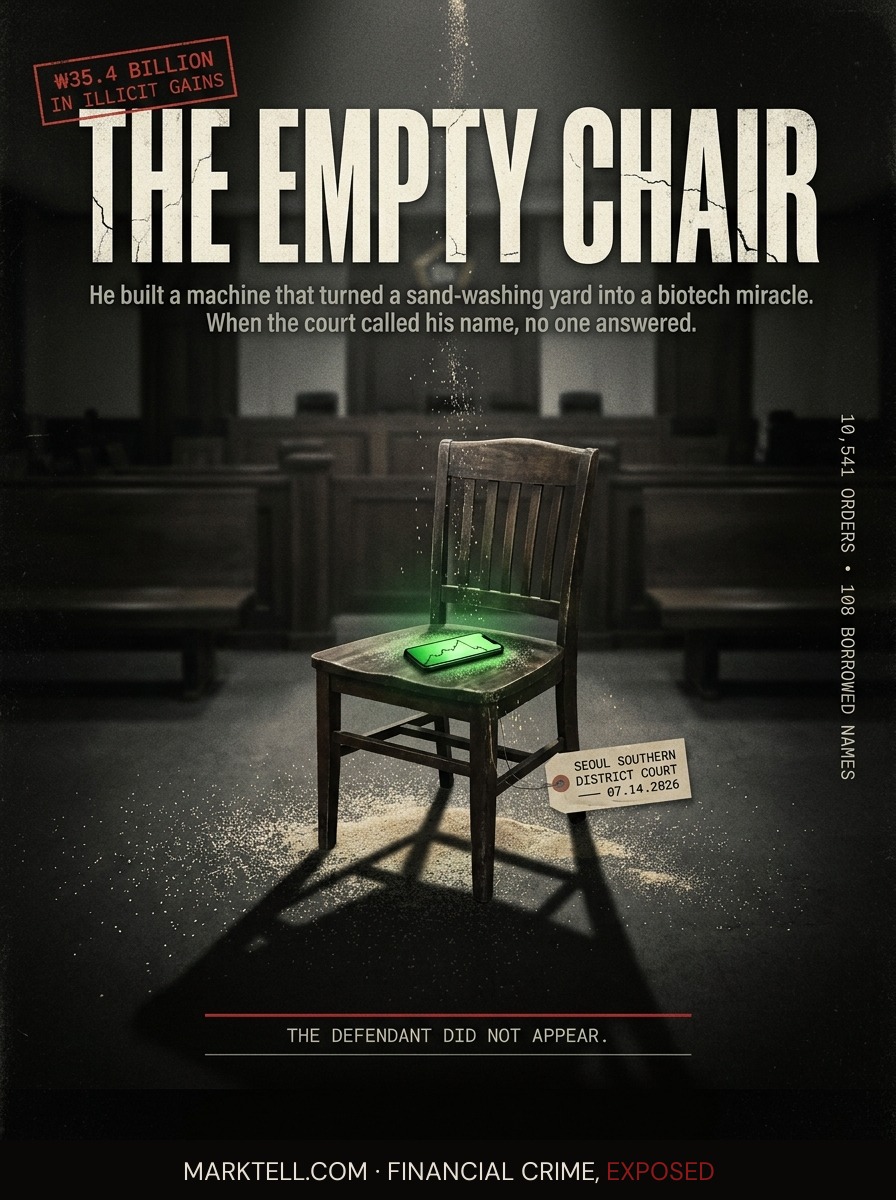
Na has not been sentenced. He was supposed to be. He did not appear. He did not appear again.
That is the news this week. The rest of the machine has been described in open court. The man at the center of it is somewhere else.
*
The Korean market has been trying to catch up with cases like this one for a decade.
As of July 1, 2026, new sentencing guidelines allow for sentences up to life imprisonment for stock manipulation cases where illicit gains reach 30 billion won or more. The base range for that tier is seven to twelve years. Aggravated cases can reach nineteen.
As of May 26, 2026, the cap on whistleblower rewards for reporting manipulation and accounting fraud was abolished. A tipster can now collect up to thirty percent of the illicit gains or penalty surcharges.
Both of those changes are downstream of cases exactly like the one Min-jae bought into. The Well Biotec case, where executives allegedly pumped a stock on claims of participating in Ukraine's reconstruction. The Deutsch Motors case, awaiting a Supreme Court ruling. The Kakao/SM Entertainment fight, still moving through appeal. A separate one-trillion-won case (about $740M USD) that prosecutors opened in June.
The Korean bio-pharma sector has been especially fertile ground. Bio is the perfect wrapper. It has long timelines, opaque science, and a plausible reason for a small company to say big things about its future without producing anything in the present.
A sand-washing firm pivoting to bio is not a business. It is a costume.
*
Min-jae's story ends the way most of these stories end, which is quietly.
When the price collapsed, he did not sell right away. He held, because holding is what the guides tell you to do, and because selling would make the loss real.
By the time he sold, most of it was gone. He does not talk about the number. He teaches the same students. He still refreshes the app sometimes, out of habit, the way you touch a bruise to see if it still hurts.
Somewhere in his saved bookmarks is the original press release. The word "pipeline." The name of the overseas fund that he now knows was a sentence someone typed on a Tuesday.
He was not stupid. He was reading exactly what he was supposed to read, in exactly the venue where he was supposed to read it, published by a company whose ticker was on the KOSDAQ.
That is the design. That is why the machine works.
The two men who ran it walked out of the Seoul Southern District Court on July 14 with suspended sentences and civil-scale fines. The man they say built it did not walk into the courtroom at all.
The chair sat empty. The sand kept washing.
- Asia Economy (아시아경제) | July 2026 | Reporting on the "30 billion won bio false news" stock manipulation case and the mastermind's failure to appear for sentencing
- Seoul Southern District Court, 15th Criminal Division | July 14, 2026 | Sentencing of Lee and Jeon
- Research brief on South Korean sentencing guideline reforms | Effective July 1, 2026
- Research brief on whistleblower reward reform | Effective May 26, 2026
- Related pending cases: Kakao/SM Entertainment appeal (July 23, 2026); Deutsch Motors Supreme Court ruling (expected July 24, 2026); Well Biotec (March 2026); one-trillion-won manipulation case opened June 19, 2026
Editorial Notice
MarkTell is a true crime publication about financial fraud. Some scenes, dialogue, and sequential details are reconstructed from court filings, enforcement actions, news reports, and public records. Where the public record does not provide exact details, editorial reconstruction is used to convey the documented pattern of events. Names of private individuals may be changed to protect identity. All factual claims are sourced to public documents cited in the Evidence Trail above. MarkTell does not provide investment, legal, or financial advice. Nothing published here constitutes a recommendation to buy, sell, or avoid any investment. Allegations described in active cases have not been adjudicated and defendants are presumed innocent until proven guilty. Readers should conduct their own due diligence before making financial decisions.