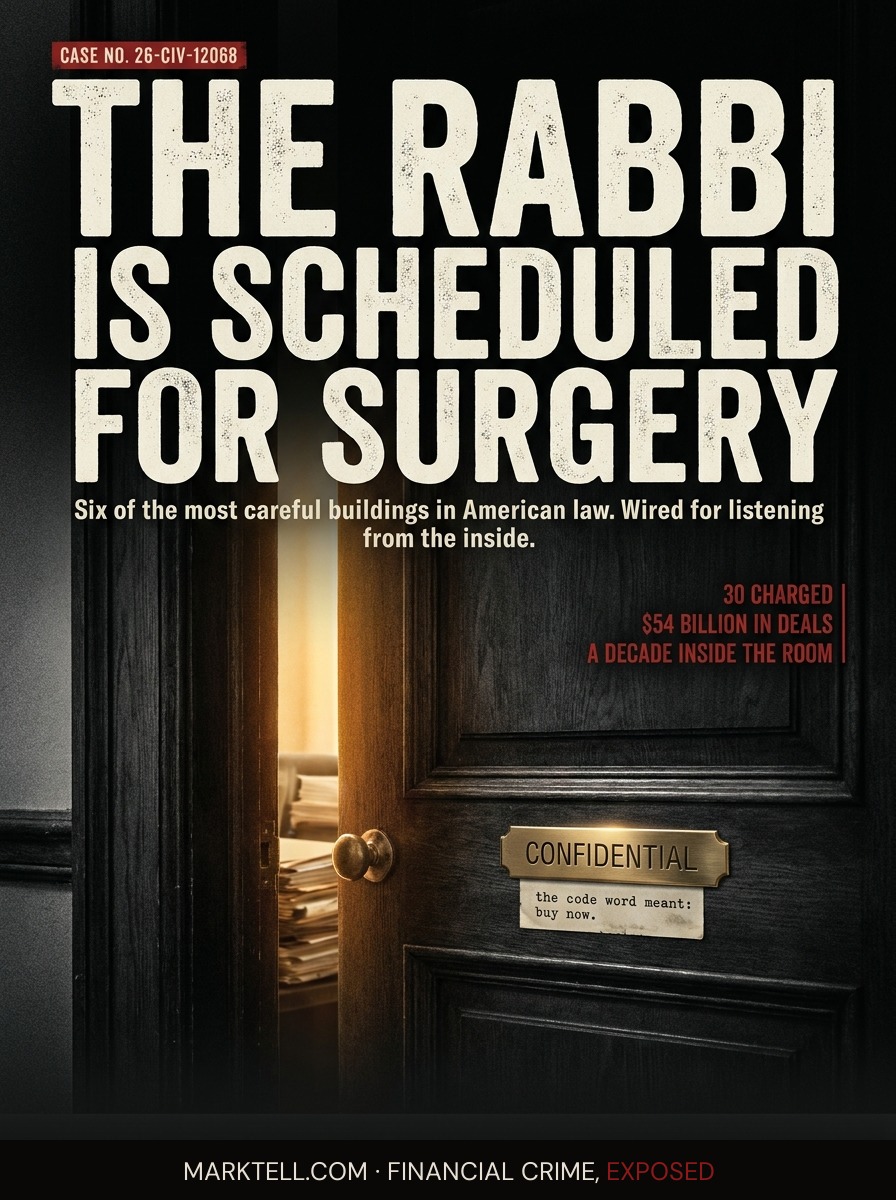
The rabbi was scheduled for surgery. That meant the merger was about to close.
Federal prosecutors say two attorneys turned confidential merger files at Sidley, Latham, Goodwin, and three other firms into a decade-long trading tip line. This week, two more men are set to plead guilty.
Ellen read the complaint at her desk on a Thursday afternoon in May, and by the third page her hand had gone still on the mouse.
She had been a paralegal at Boston M&A shops for twenty-two years. She was fifty-eight. Her desk was the desk of someone who takes the work seriously. Two monitors. A binder clip organizer. A framed photo of a niece at graduation. A coffee mug that said something a former partner had given her as a joke a decade earlier and that she kept because throwing it out felt like throwing out the decade.
The complaint was the SEC filing from May 7, 2026, Case No. 26-civ-12068, filed in the U.S. District Court for the District of Massachusetts. Twenty-one individuals named. She scrolled. She recognized deal shapes. Cigna and Express Scripts. Johnson & Johnson and Actelion. Amazon and iRobot, the deal that had died. She had not touched those files. But she had touched files like them, at firms like the ones now listed as victims: Sidley Austin. Latham & Watkins. Goodwin Procter. Wachtell. Weil Gotshal. Willkie Farr.
Six of the most careful buildings in American law. Wired for listening from the inside.
That is the machine here. Not a pump. Not a boiler room. A wiretap. Except the wire was a man. Several men, if the government is right.
I.
Here is what prosecutors and the SEC allege happened between 2018 and 2024.
Two lawyers who had been college classmates set up a channel. One was Nicolo Nourafchan, a Yale Law graduate who worked as a corporate M&A attorney at Sidley Austin, then Latham & Watkins, then Goodwin Procter, from 2013 through 2023. The other was Robert Yadgarov, a personal injury lawyer in New York.
Nourafchan sat inside the deal rooms. Yadgarov sat outside them. That was the geometry.
According to the SEC complaint, Nourafchan misappropriated material nonpublic information from his firms about pending mergers and acquisitions and passed it to Yadgarov, who moved it into a network of traders and middlemen. The traders bought before the announcements. The stock moved. The profits came back as kickbacks. Cash. Hundreds of thousands of dollars, the government alleges, at a time.
The Department of Justice says the ring generated tens of millions of dollars in illicit profits and traded ahead of nearly thirty major transactions across a decade. Thirty individuals were charged criminally. Twenty-one were named in the SEC's parallel civil case.
The mechanics of concealment are the part that reads like a novel. Burner phones. Encrypted messaging apps. Clandestine meetings. A vocabulary of code words. Deals were called "flights." A merger announcement was described as a "rabbi" scheduled for surgery. If you knew what those phrases meant, you knew when to buy.
If you did not know, you were the market.
II.
Ellen kept scrolling.
She thought about the document rooms she had built over the years. The way access is supposed to work at a firm like the ones in the complaint. Deal teams get badges. Badges open folders. Folders log downloads. The systems are supposed to notice when someone pulls too much, too fast, at the wrong hour, from the wrong device.
They did not notice. Not for years.
That is not a technology problem. That is a trust problem. A firm of two thousand lawyers running on the assumption that the person inside the folder belongs inside the folder. That assumption is a lock made of a handshake.
Nourafchan, the complaint alleges, walked through that lock every time he opened a client file. He was allowed to be there. The system had no way to tell the difference between a lawyer doing his job and a lawyer taking the file home in his head.
Read that slowly. The most valuable material nonpublic information in the American economy sits behind a lock that assumes the lawyer will not tell.
For most lawyers, most of the time, the assumption holds. That is the only reason the system works at all. That is also why, when it fails, it fails at scale.
III.
The first crack was Gabriel Gershowitz.
Gershowitz had been a lawyer at Weil Gotshal, then DLA Piper, then Willkie Farr. In February 2025 he pleaded guilty. He agreed to cooperate. Prosecutors do not announce the shape of a case like this until they have a witness who can walk them through the vocabulary. Gershowitz walked them through it.
By May 6, 2026, nine individuals had already pleaded guilty in related cases. On May 6 and May 7, the DOJ and the SEC unsealed the charges against the broader group. Thirty and twenty-one, respectively.
On June 1, 2026, in federal court in Boston, Nourafchan and Yadgarov and more than a dozen other defendants pleaded not guilty. That is the current posture for them. Not guilty. Presumed innocent. Their trial has not happened.
And on July 29, 2026, according to Reuters, two more men were scheduled to plead guilty this week. That makes eleven cooperators, if the pleas are entered as reported. The government is walking up the chain the way a prosecutor walks up any chain. Small fish, medium fish, then the two men at the top who have said, on the record, that none of this is true.
Ellen read the July article on her phone on the train home. The two names of the men pleading this week meant nothing to her personally. But she understood the arithmetic. Every plea is a witness. Every witness is a hallway light coming on.
IV.
The victim question in an insider trading case is a hard one for a general reader, so let me put it in plain language.
When someone trades on information the rest of the market does not have, the rest of the market is the mark. The retail investor who bought Express Scripts the week before the Cigna deal at the fair price the market believed in was buying against a counterparty who knew. That counterparty was not smarter. That counterparty was inside the room.
The $54 billion Cigna and Express Scripts deal. The $30 billion Johnson & Johnson and Actelion deal. The abandoned $1.4 billion Amazon and iRobot bid. These are not abstractions. Every share that traded in the run-up traded in a market where one side had the answer key.
That is who the mark is here. Not one grandmother. A market. Millions of small decisions made in the dark against a handful of people holding a flashlight.
Ellen thought about that too. She thought about her own 401(k). She thought about the index fund inside it. She thought about how many of these deals had touched that fund on the way through and how she would never know, exactly, what she had paid for someone else's flight.
V.
The law firms named in the complaint have released statements. Latham & Watkins and Goodwin Procter, among others, confirmed their victim status and said the alleged conduct violated their policies. That is the correct posture and it is almost certainly true. Firms do not organize schemes like this. Individuals do.
But the vulnerability the case exposes belongs to the firms, and to the profession.
The industry response so far has been technical. Least privilege access. Permissions tied to HR systems. Real-time alerting on unusual downloads. All of that is good and all of that is late. The tools existed in 2018. They existed in 2013 when Nourafchan started at Sidley. The gap between what a firm could do and what a firm did do is where the alleged decade lived.
Somewhere, right now, at a firm not named in this complaint, a lawyer is downloading a deal file to a personal drive because the badge system will let him. That is not an accusation. That is a description of the ordinary operating condition of the industry the government just charged thirty people out of.
VI.
Ellen closed the laptop that Thursday evening in May and sat at her kitchen table for a while without turning on the light.
She thought about the young associates she had trained. The care she had taken with document numbering. The lecture she gave every new hire about the confidentiality wall. The pride she took in a clean data room.
She thought about the assumption underneath all of it. The assumption that the person on the other side of the wall would not sell the wall.
That was the machine. Not the trades. Not the burners. Not the coded rabbi scheduled for surgery. The assumption itself. Six of the best-run buildings in American law running on a lock made of a handshake, for a decade, allegedly, while two lawyers turned client confidence into cash.
Two more men will plead guilty this week. The trial of the two named as orchestrators has not happened. Allegation is not adjudication. Those cases remain open.
But the machine is already visible.
It was always visible. It was just running quietly, inside the buildings we told ourselves were sealed.
- Reuters | July 29, 2026 | "Two men to plead guilty in insider trading case tied to law firm tips"
- U.S. Securities and Exchange Commission | May 7, 2026 | Complaint, Case No. 26-civ-12068, U.S. District Court for the District of Massachusetts
- U.S. Department of Justice, U.S. Attorney's Office for the District of Massachusetts | May 6, 2026 | Announcement of charges against 30 individuals
- Reuters and related reporting | June 1, 2026 | Not guilty pleas entered in federal court in Boston
- Prior guilty plea | February 2025 | Gabriel Gershowitz
- Public statements from Latham & Watkins and Goodwin Procter confirming victim status
Editorial Notice
MarkTell is a true crime publication about financial fraud. Some scenes, dialogue, and sequential details are reconstructed from court filings, enforcement actions, news reports, and public records. Where the public record does not provide exact details, editorial reconstruction is used to convey the documented pattern of events. Names of private individuals may be changed to protect identity. All factual claims are sourced to public documents cited in the Evidence Trail above. MarkTell does not provide investment, legal, or financial advice. Nothing published here constitutes a recommendation to buy, sell, or avoid any investment. Allegations described in active cases have not been adjudicated and defendants are presumed innocent until proven guilty. Readers should conduct their own due diligence before making financial decisions.