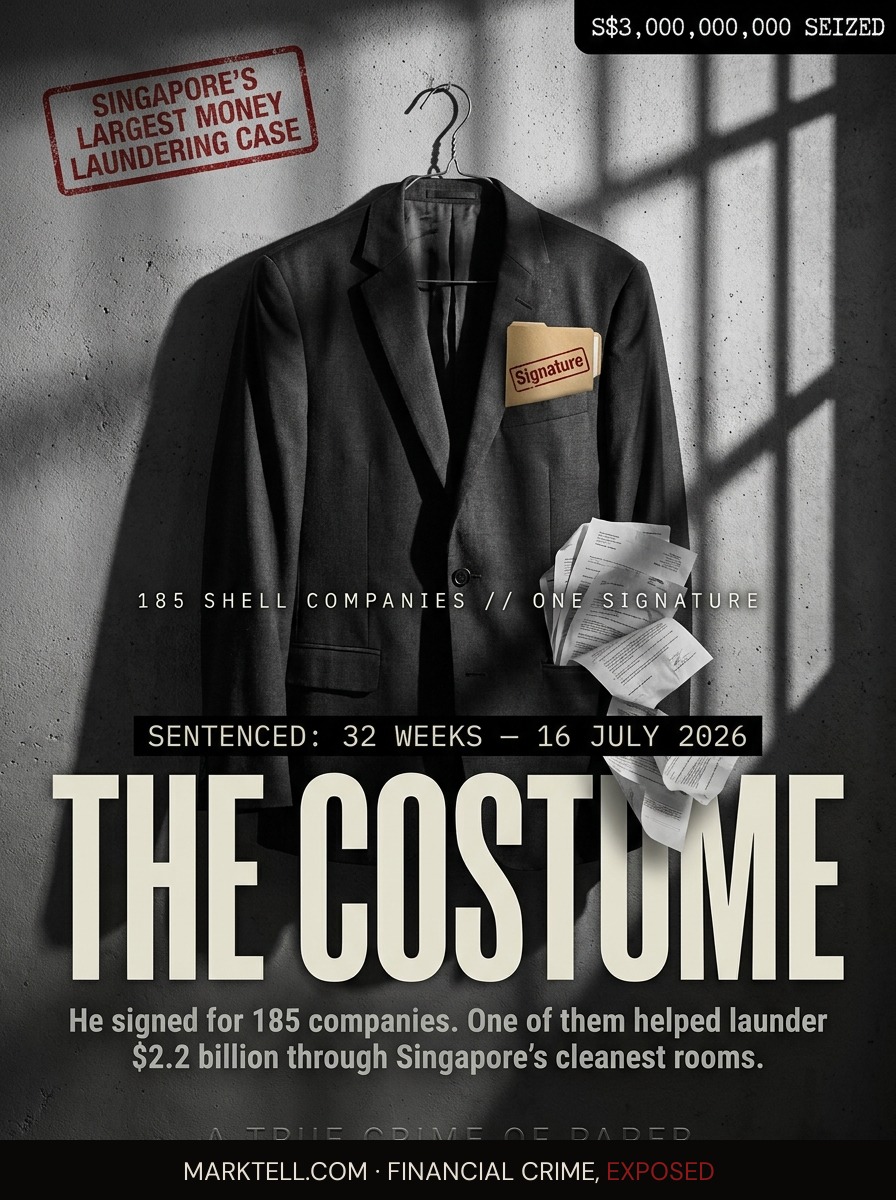
The paperwork looked like a company. It was a costume.
Wang Junjie ran a corporate services firm that manufactured the appearance of a real business for men moving suspect money through Singapore. On July 16, 2026, a court gave him 32 weeks. The paperwork he signed is still in the file.
Adeline was thirty-eight and had been doing enhanced due diligence for six years the morning the Yihao Cyber file crossed her desk. It was a Tuesday in early 2021. She remembers because she had brought in a thermos of kopi from the hawker centre downstairs and the lid had leaked a ring onto the folder.
The folder was thin. That was the first thing that should have bothered her. A company applying for corporate banking services with revenue in the low seven figures should generate more paper than this. But the paper it did generate was clean. A certificate of incorporation. A director's resolution. Audited financial statements with a set of numbers that were unremarkable in the way real numbers are unremarkable. A signature from a nominee director. A Singaporean name. Wang Junjie.
She approved the file. She was not lazy. She was doing her job the way the system was built to have her do it. The system was built to trust the signature.
That is where this story lives. Not in the S$3 billion. Not in the gold bars or the handbags or the row of German cars. In the signature.
I.
The costume shop.
Singapore sells itself as a clean room. Glass towers, clean rules, clean signatures. A place where a wealthy foreigner can put his money and know it will be treated the way jurisdictions are supposed to treat money. That reputation is the product. The country trades on it the way a Swiss watchmaker trades on a name stamped into a case back.
To keep the room clean, Singapore built a layer of professionals. Lawyers. Accountants. Corporate service providers, or CSPs. A CSP is the shop that helps you set up a company. They handle the incorporation, they file with ACRA (that is the Accounting and Corporate Regulatory Authority, Singapore's companies registrar), they can supply a nominee director if you need one, they file your taxes with IRAS (the Inland Revenue Authority of Singapore, the country's tax office). They are supposed to be the gatekeepers. They see the client's face. They ask the questions. They are the reason the signature on the folder means something.
Wang Junjie ran a CSP called LW Business Consultancy. Court documents show he was the director or secretary of at least 185 companies. Read that number slowly. One hundred and eighty-five. That is not a services firm. That is a wardrobe.
II.
The client.
Around 2020, a man named Su Haijin needed a costume. Su was one of ten foreign nationals who would be arrested in August 2023 in what became the largest money laundering case in Singapore's history. The seized assets started at S$1B (about $740M USD at the time) and eventually swelled to over S$3B (about $2.2B USD). Luxury cars, handbags, liquor, gold bars, ornaments, properties across the island.
Su wanted permanent residency in Singapore. To be eligible for PR the way Su wanted to be eligible, it helped to have a real business here. Something that employed people. Something that made money. Something that looked like the reason a country would want to keep you.
Su did not have that. What Su had was money whose origin the courts would later find unlawful.
So he needed a company that could be dressed up to look like the reason. Enter Yihao Cyber Technologies. On paper, a tech firm. In court records, Wang Junjie later admitted the company had no genuine revenue and no staff in Singapore. It was a suit hung on a hanger.
Wang's job was to make the suit fit. Between 2020 and 2022, according to prosecutors, he fabricated financial figures for Yihao Cyber, submitted false representations to IRAS, and forged business agreements. The figures were approved by Su Haijin. Wang signed.
III.
What Adeline saw.
Come back to the folder on the desk with the coffee ring.
When Adeline opened it, she saw a set of financials that told a story. A modest tech company. Some revenue. Some expenses. A little profit. Nothing loud. Nothing that would trigger a second look. The auditor's stamp. The director's signature.
That is the whole trick. The costume is not flashy. The costume is boring. Flashy paper gets flagged. Boring paper gets filed.
The compliance framework banks operate under, called anti-money laundering rules, or AML, is designed to catch anomalies. Unusual patterns. Sudden spikes. Cash from strange places. The Yihao Cyber file had none of that because Wang had built it not to. He knew what the anomalies looked like because he knew what boring looked like. That is what a CSP does for a living.
Adeline was not stupid. She was one node in a chain that was supposed to have other nodes. The auditor was supposed to have looked. The CSP was supposed to have known his client. IRAS was supposed to receive real numbers. The chain assumed each link was doing its work. Wang was the link that failed on purpose.
MAS, which is Singapore's central bank and financial regulator, has since imposed penalties totaling S$27.45M (about $20M USD) on nine financial institutions for AML breaches connected to the case. The Ministry of Law took action against four law firms. The regulator wrote a paper about weak compliance culture. The word they used was "systemic."
That is a word that means: it was not one Adeline. It was many.
IV.
The costume rack.
Wang's firm had 185 companies. Yihao Cyber was one. Xinbao Investment Holdings, belonging to another of the convicted foreigners, Su Baolin, was another. Court records establish Su Baolin was sentenced in April 2024 to 14 months' jail. He and the nine others were sentenced between 13 and 17 months. They were deported. They are barred from returning.
Picture a rack of 185 suits. Some may have belonged to legitimate small businesses. Some almost certainly did. That is how a CSP works. Most of the work is real. The costumes hang on the same rack. That is the point. You cannot tell which suit hides a body until you check the pockets.
Nobody outside that firm has seen the intake meetings. Not really. But we know what CSP intake looks like. A conference room in a serviced office. A translator sometimes. A stack of forms. Passport copies. A signature card. A fee schedule. Nothing about the room announces what is happening. That is why it works. The predator here is not a man in a mask. The predator is a stack of paperwork the country trained itself to trust.
V.
The count.
On June 3, 2026, Wang pleaded guilty to conspiring to cheat IRAS with false filings and to breaching his duties as a nominee company director. On July 16, 2026, a Singapore court sentenced him to 32 weeks in jail. Roughly seven and a half months.
The prosecution had asked for eight to ten months. The defense asked for three to four. The court split the difference closer to the state's number.
Read the sentence against the case it sits inside. Ten foreigners moved S$3B (about $2.2B USD) through this country. They got 13 to 17 months. The man whose signature made their companies look real got 32 weeks. A conveyancing lawyer named Chan I-Fei Julia, 61, a director at Sterling Law, was charged the same day Wang was sentenced. The allegation is forgery, that she abetted the creation of a false document tied to a property purchase by an associate of one of the convicted foreigners. Allegation only. The case is open.
A former relationship manager, Wang Qiming, was sentenced in October 2025 to two years for forgery and money laundering. On July 9, 2026, MAS issued a 16-year prohibition order against him. A colleague, Liu Kai, got a 7-year order.
Add it up. Not the exciting way. The ugly way. The Singapore that emerges from these filings is not a country that was fooled once. It is a country whose gatekeepers were, in specific and provable cases, on the inside of the room.
VI.
What Adeline lost.
Adeline is not real. She is built from the shape of the problem, and the shape of the problem is her.
But there are real Adelines. There are compliance officers who processed these files, who approved these accounts, who filed these tax returns, who signed off on these property transactions, who did their jobs the way their training and their software and their supervisors told them to do their jobs. Some of them will be disciplined. Some will not. Many will lie awake this year and think about a folder they opened on a Tuesday and a signature they trusted.
That part may be the saddest part. Because the country asked her to trust the signature. The system was built on the trust. When the signature was manufactured, so was everything downstream of it.
VII.
The costume returns.
The Corporate Service Providers Act 2024 came into force on June 9, 2025. It now requires every CSP to register with ACRA and meet AML obligations. Breaches carry significant fines. The National Anti-Money Laundering Strategy came out in October 2024. Three pillars. Prevent. Detect. Enforce.
These are the right moves. They are also the moves you make after the horse is not just out of the barn but has been shipped, sold, and reincorporated in three other jurisdictions.
Wang Junjie will serve his 32 weeks. Somewhere in the Registry of Companies, filings still exist under names he signed. Somewhere, a rack of suits with nobody in them. The country will keep selling itself as clean. It has to. The reputation is the product.
Adeline will open another folder next Tuesday. The financials will look boring. The signature will look real.
That is the machine. It runs on boring.
The costume is still on the rack.
- The Straits Times | July 16, 2026 | "$3b money laundering case: 32 weeks' jail for man who cooked financial figures for shell companies"
- Monetary Authority of Singapore | July 9, 2026 | Prohibition Orders against Wang Qiming and Liu Kai
- Singapore Ministry of Law | 2025 | Enforcement actions against four law firms and one lawyer
- ACRA | January 18, 2024 | Cancellation of Wang Junjie's registration and LW Business Consultancy
- Singapore National Anti-Money Laundering Strategy | October 2024 | AML/CFT Steering Committee
- Corporate Service Providers Act 2024 | Effective June 9, 2025
- Singapore court records | April 2024 | Sentencing of Su Baolin
- Singapore court records | 2024 | Sentencing of ten foreign nationals (13-17 months)
- Singapore court records | October 2025 | Sentencing of Wang Qiming
- Singapore court records | June 3, 2026 | Wang Junjie guilty plea
- Singapore court records | July 16, 2026 | Wang Junjie sentencing; Chan I-Fei Julia charge
Editorial Notice
MarkTell is a true crime publication about financial fraud. Some scenes, dialogue, and sequential details are reconstructed from court filings, enforcement actions, news reports, and public records. Where the public record does not provide exact details, editorial reconstruction is used to convey the documented pattern of events. Names of private individuals may be changed to protect identity. All factual claims are sourced to public documents cited in the Evidence Trail above. MarkTell does not provide investment, legal, or financial advice. Nothing published here constitutes a recommendation to buy, sell, or avoid any investment. Allegations described in active cases have not been adjudicated and defendants are presumed innocent until proven guilty. Readers should conduct their own due diligence before making financial decisions.