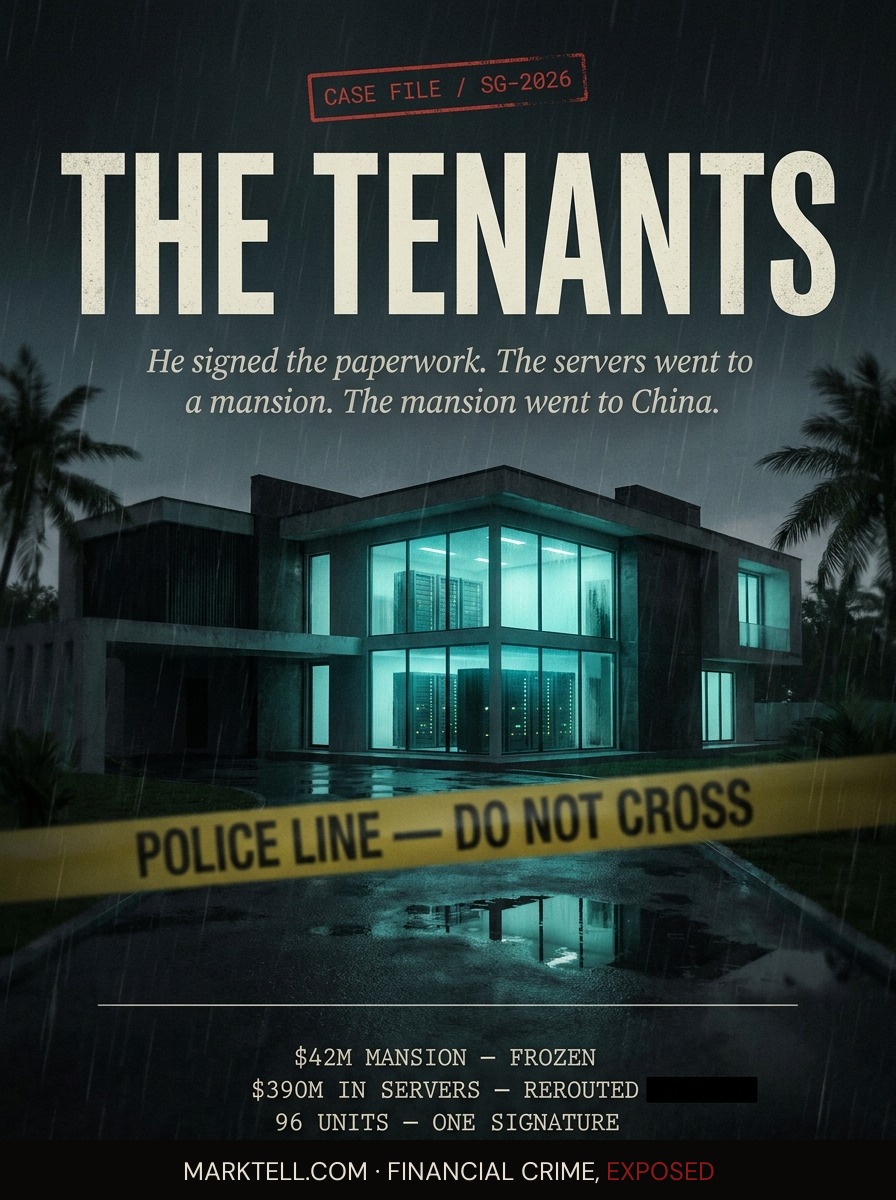
The mansion cost forty-two million. The servers were the tenants.
Singapore police say four people ran hundreds of millions in banned Nvidia AI servers through Singapore shell companies to buyers in China. The house they bought with the proceeds is now evidence.
Daniel is thirty-four years old and he works in a compliance office in a Dallas suburb where the air conditioning runs even in February. He is the man who signs the end-user certifications. That is the small piece of paper that says the server going out the door is going to the customer named on the invoice and no one else.
He signed a batch in late 2023. Ninety-six units. Big ones. The kind with the Nvidia sticker on the front and a price tag that made his hands cold the first time he saw one. The buyer was a Singapore entity. The end-user was a Singapore data center whose name he had never heard before. The paperwork was clean. The wire cleared. The pallets left the dock.
He forgot about it the way you forget about a shift you worked two years ago.
Then, this week, his general counsel walked into his office and closed the door.
I.
The room the readers cannot see.
The Singapore police issued a prohibition of disposal order on July 1, 2026, against a mansion valued at SGD 55 million, which is about $42 million USD. That means the house cannot be sold, cannot be moved, cannot be borrowed against. It sits. It is now evidence.
The owner of the mansion is a man named Wei Zhaolun Alan. He is fifty years old. He is the CEO of a Singapore company called Aperia Group. On July 6, 2026, according to Singapore authorities, he is expected to face a new money laundering charge for allegedly using approximately SGD 38 million (about $29M USD) in criminal proceeds to buy the house.
There is a separate charge involving US$4.5 million (SGD 5.8M) sitting in his personal bank accounts.
There is a third asset. A bank account holding SGD 1 million (about $772K USD). Frozen.
That is the visible part. The house. The account. The four names on the charge sheet.
The invisible part is what those numbers were made of.
II.
The pipe.
The United States restricts the sale of advanced Nvidia AI chips to China. The rules landed in October 2022 and got tighter in 2023 and 2024 and tighter again on June 1, 2026, when the Commerce Department said Chinese and Macau companies need export licenses even when they buy through overseas subsidiaries.
The rules do not stop demand. They price it.
A banned Nvidia DGX B300 server sells for about US$400K in the United States. According to recent reporting, the same unit is moving on the Chinese black market for up to US$1.1 million. That is not a markup. That is a machine running.
The machine needs an elbow joint. A place where the pipe bends. Somewhere the server can be pointed at one country on the paperwork and moved to another country in the container.
Singapore, per the US Department of Justice, has become one of those elbows. Nvidia's own numbers tell part of the story. Singapore has been booked as roughly 28% of Nvidia's revenue in recent periods. Only about 1% of the actual chip deliveries went to Singapore itself.
The other 27% went somewhere. The paperwork said one thing. The pallets went somewhere else.
That is what Singapore authorities allege the four people on the charge sheet did.
III.
The names on the sheet.
Four individuals. Three Singaporean. One Chinese national.
Lim Jenny, 51, listed as CFO. Woon Guo Jie Aaron, 41. Wei Zhaolun Alan, 50, the CEO. Li Ming, 52, the Chinese citizen.
Four companies. Aperia International. Two other firms in the Aperia Group. And a fourth entity called Luxuriate Your Life, which sounds like it should be selling scented candles.
The allegation, per Singapore police, is that these individuals and companies bought servers from Dell, Super Micro Computer, and Asus and misrepresented who the servers were for. The scale is not small. About US$250 million in servers from Dell. About US$140 million from Supermicro. Roughly $390 million in hardware moving through paperwork that authorities now allege was false.
The servers contained Nvidia AI GPUs. The kind that are supposed to stay in a small list of countries. Not China.
Woon, Wei, and Li were arrested in the first quarter of 2025. The charges have been growing since.
IV.
How the pipe got noticed.
In late 2024, a Chinese AI company called DeepSeek released a frontier language model that was too good for what China was supposed to have.
The math on their claimed hardware did not close. Analysts started asking what they were actually running on. US investigators started pulling the thread. The thread ran through Singapore.
Investigators looked at who had been buying US-made AI servers in Singapore. They looked at whether those servers had ever actually arrived at the addresses on the end-user certifications. They looked at bank records. They looked at property records.
They found a mansion.
That is the sequence, in the order it happened. A Chinese AI model that should not have existed. A trail of shipping paperwork. A Singapore address that was, in some cases, allegedly a front. A house.
Nvidia's CEO Jensen Huang has said publicly, most recently on June 26, 2026, that building an AI data center out of smuggled chips is a dead end. No support. No repairs. When something breaks, it stays broken.
That may be true. It also may not matter. The buyers on the other end of the pipe are not calling Nvidia's help desk. They are running the boxes until they die and then buying more.
V.
The signature.
Daniel goes home that Thursday and does not eat dinner. He sits at his kitchen table with a printout of the charge summary and reads it twice. His name is not on it. His company's name is not on it. But his signature is on the end-user certificate for a shipment that Singapore police now allege never went to the named end-user.
He does not know if his shipment was one of the ones in the case. His counsel is looking. The DOJ has not called him. The DOJ has not called anyone at his company yet. That does not mean they will not.
He thinks about the day he signed the batch. He thinks about how the paperwork looked. It looked correct. The address existed. The company had a website. The wire cleared through a real bank. Everything a compliance officer is supposed to check, he checked.
That is what the pipe is designed to do. Present a version of itself that passes the checks. The checks are not stupid. The checks were built to catch obvious things. The pipe was built to not be obvious.
He does not sleep well after that.
VI.
What the mansion means.
You could look at the mansion and think it is the story. The forty-two-million-dollar house. The frozen accounts. The CEO with US$4.5 million in his personal account allegedly connected to criminal proceeds.
It is not the story.
The story is that the mansion is the smallest room in the building.
The building is a global trade in restricted AI hardware that Singapore police say has moved hundreds of millions of dollars in servers to buyers who were not supposed to have them. The building is a Chinese black market where a US$400K server sells for US$1.1M. The building is a set of end-user certifications signed by compliance officers in Texas and California and Ireland who did their jobs and got taken anyway.
The mansion is the receipt.
Receipts are useful. Singapore prosecutors will now try to walk that receipt back through bank records, through shell company filings, through shipping manifests, through the signatures on the end-user certs. That is how these cases get built. Slowly. Backward. From the house to the pipe.
On June 30, 2026, Taiwanese investigators raided the offices of Super Micro Computer, Albatron Technology, and Chief Telecom in a related probe. Nine individuals are under investigation there for allegedly forging documents to ship servers.
The pipe has more than one elbow.
VII.
The tense.
Daniel still works in the same office. His company still ships servers. The paperwork still comes across his desk. He still signs the end-user certs, because that is the job.
He signs them slower now. He reads the address twice. He looks up the company on his own, not just on the databases the compliance software checks. He asks questions he did not use to ask.
None of that will save him if his signature is on one of the shipments in the case. He knows this. He signs anyway. Because if he stops signing, someone else will sign, and that person will be exactly as careful as he was two years ago.
That is the part that keeps him awake.
The pipe is not a person. Wei Zhaolun Alan is not the pipe. He is, allegedly, one operator inside it. Singapore courts will decide what he did. The pipe will keep running whether he is convicted or not. It will find a new elbow. It will find new signatures.
The mansion cost forty-two million. The servers were the tenants. The tenants have already moved out.
- Tom's Hardware | July 2026 | "Singapore cops seize $42 million mansion, freeze $772k bank account of suspected Nvidia AI GPU smugglers"
- Singapore Police Force | July 1, 2026 | Prohibition of Disposal Order (as reported)
- US Department of Commerce | June 1, 2026 | Tightened export control rules on advanced AI chips
- Nvidia public statements | June 26, 2026 | Jensen Huang on smuggled chip data centers
- Reuters/industry reporting | June 25, 2026 | DGX B300 pricing on Chinese black market
- Reuters/industry reporting | June 30, 2026 | Taiwan raids on Supermicro, Albatron, Chief Telecom
- US Department of Justice public materials | 2024-2026 | Singapore as transshipment point designation
- Nvidia public financial disclosures | 2024-2025 | Singapore revenue vs delivery ratio
Editorial Notice
MarkTell is a true crime publication about financial fraud. Some scenes, dialogue, and sequential details are reconstructed from court filings, enforcement actions, news reports, and public records. Where the public record does not provide exact details, editorial reconstruction is used to convey the documented pattern of events. Names of private individuals may be changed to protect identity. All factual claims are sourced to public documents cited in the Evidence Trail above. MarkTell does not provide investment, legal, or financial advice. Nothing published here constitutes a recommendation to buy, sell, or avoid any investment. Allegations described in active cases have not been adjudicated and defendants are presumed innocent until proven guilty. Readers should conduct their own due diligence before making financial decisions.