The IPO said the related-party deals would stop. The filings say they did not.
A short seller says EquipmentShare's founders quietly ran a network of undisclosed related entities that pulled at least $77 million out of the company after an IPO that promised the opposite. The stock lost more than a third of its value. The lawsuits started the next week.
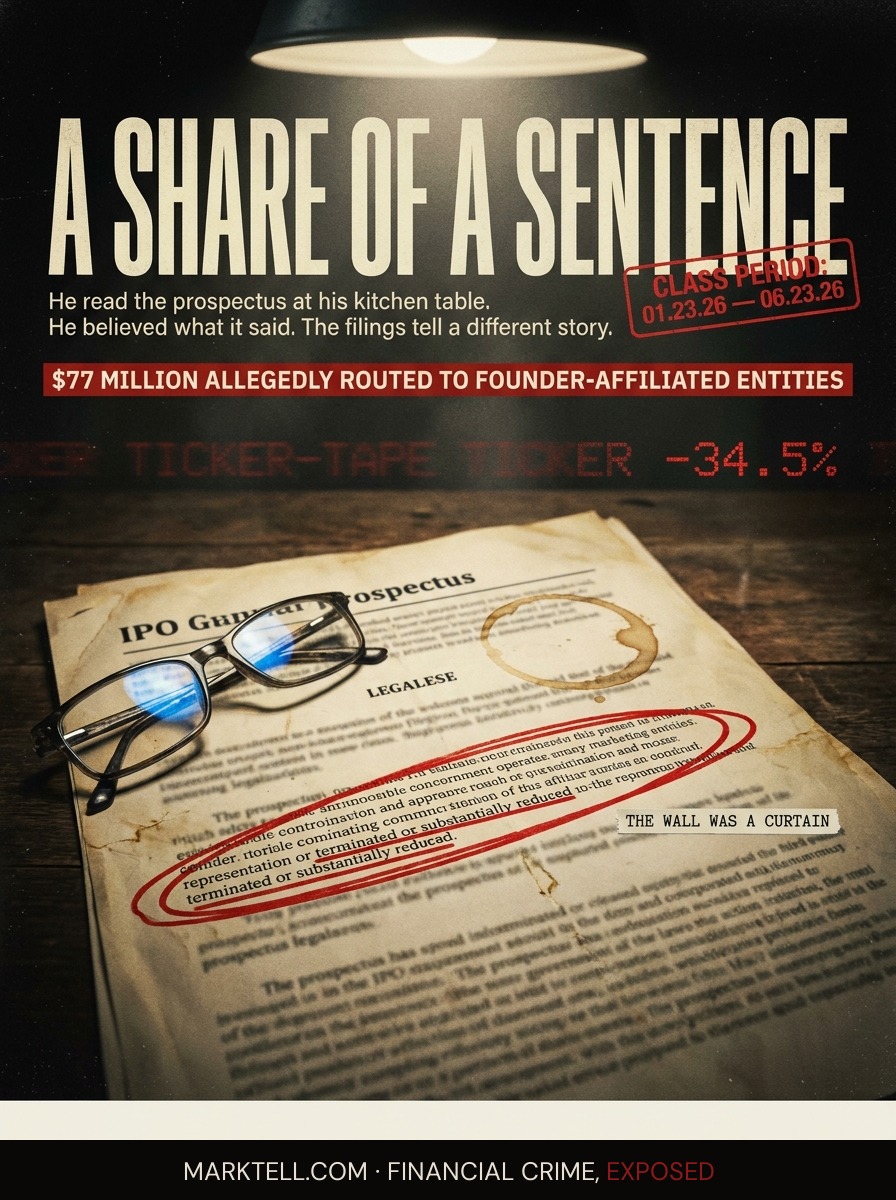
Daniel bought four hundred shares on the first day.
He was fifty-eight, a project manager for a mid-sized general contractor in Cincinnati, and he had been renting from EquipmentShare's yards for three years. He knew the T3 tablets in the cabs. He knew the app. He knew the salespeople by first name. When he saw the IPO coming in January 2026, he did what people in his position do. He read the prospectus on his laptop at the kitchen table the night before the bell.
Coffee going cold. Reading glasses on. His wife already asleep.
He got to the part about related-party transactions. Every prospectus has one. Every founder-led company has some version of the founders doing business with themselves before they go public. What Daniel read was the sentence that made him comfortable. The company said, in effect, that those deals would be wound down. Terminated or substantially reduced. That was the phrase people in his industry passed around. It sounded like a cleanup. Like the company was moving from garage to grown-up.
He bought at $24.50. January 23, 2026.
That is the story of how Daniel got in the room.
I.
Here is what a related-party transaction actually is. Strip the phrase of its suit and tie. A related-party transaction is when the people who run the company do business with entities they also own on the side. The company pays the entity. The entity pays the founders. Sometimes the entity is a supplier. Sometimes it is a leasing company. Sometimes it is a shell that touches money on the way through.
None of that is automatically illegal. What is required is that the company tells shareholders it is happening, tells them how much, and tells them who benefits. The disclosure is the whole ballgame. Without the disclosure, a public company is a private wallet with a ticker on top.
EquipmentShare went public with a story. The story was that it was a technology-forward rental platform, an "asset-light" evolution of a heavy industry, and that the founders, Jabbok and Willy Schlacks, had built it out of Missouri into more than sixty locations. In 2023 the rental business did $1.9 billion, according to public reporting. The IPO priced 30.5 million to 35 million Class A shares at $24.50. The Schlacks brothers kept, per the filings, more than 80 percent of the voting power.
That is the room Daniel walked into.
II.
On June 24, 2026, a short-seller called Umibōzu Research published a report titled "EquipmentShare: Relentless Self-Dealing, a Tech Veneer, and the Missouri 'Cult' That Started It All."
Daniel saw the headline on his phone at lunch. He was sitting in his truck outside a job site with a chicken sandwich in a paper bag. He opened the report because the ticker on his brokerage app had already started to move.
The report alleged something specific. It said the founders had used a capital vehicle called the OWN program, which was pitched to the public as a way to fund fleet expansion off the balance sheet, and that inside that program, fees and payments were flowing to three entities the market did not know about.
EZ Equipment Zone. Bevel Financial. Armada Fleet Management.
The report alleged the founders own and manage Bevel and Armada. It alleged that at least $77 million had been directed to founder-affiliated entities through these arrangements. It said the true figure could run substantially higher.
That day the stock fell 6.62 percent to $22.30. The next day it fell another 11.7 percent to $19.69. In the following weeks it traded as low as $16.06. More than 34.5 percent off the IPO price.
Daniel did the math in his truck. He did not need a calculator.
III.
Here is what the OWN program is, in the language of a person who does not work in finance.
Rental companies own a lot of equipment. Excavators. Skid steers. Boom lifts. That equipment sits on the balance sheet and eats capital. So instead of owning all of it, the company sold some of the equipment to outside investment vehicles. Those outside vehicles then leased the equipment back to EquipmentShare, which put it on its rental platform and rented it out to contractors like Daniel.
The pitch to the market was capital efficiency. The company grows without carrying the weight of every machine.
The pitch to Daniel was a story of a modern company.
The allegation is that inside the plumbing of that program, money moved through entities the founders controlled. Not the outside investors. Not the customers. The founders. And the IPO paperwork, according to the complaints now being filed, did not tell the public that this was still happening. It told the public the opposite.
Read that slowly.
The paperwork said the related-party arrangements would be terminated or substantially reduced. The short seller alleges they were not.
IV.
Multiple law firms filed or announced class actions and investigations across July 2026. Bleichmar Fonti & Auld. Pomerantz. Block & Leviton. Howard G. Smith. Frank R. Cruz. Robbins. Rosen. Schall. The class period is defined in the complaints as January 23, 2026, through June 23, 2026. That is the window Daniel bought into. The lead plaintiff deadline is September 21, 2026.
None of this has been adjudicated. A short-seller report is a short-seller report. It is written by people with a position. That position is that the stock goes down. The complaints filed by the plaintiffs' firms are, at this stage, allegations. The company, based on the record I reviewed, has not publicly answered the specific accusations in the Umibōzu report.
That is the current shape of the room.
But here is the pattern to notice, because pattern is what protects you next time.
When a founder-led company goes public and holds most of the voting power, the disclosure page is the only wall between the shareholder and the founder's other pockets. If the disclosure is honest and complete, the wall stands. If the disclosure is incomplete, the wall is a curtain. The shareholder is looking at a curtain and thinking it is a wall.
Daniel thought it was a wall.
V.
Sit with this.
A public company's shareholders have exactly one thing that separates them from the founders' private life. That thing is the language on the disclosure pages. Not the CEO's charisma. Not the growth story. Not the app on the tablet in the cab. The paragraph on the S-1.
The allegation, in plain English, is that the paragraph was not the truth.
VI.
Daniel still has the shares. He has not sold. He does not know what he is going to do. He does not read prospectuses at the kitchen table anymore. He reads the news alerts on his phone during lunch, and he does the subtraction, and he puts the phone face-down on the passenger seat.
He was not stupid. He was in the industry. He rented from them. He liked the platform. He read the paperwork.
He read what they wrote. He believed what they wrote.
That was the transaction. Not the shares. The belief.
The complaint alleges the belief was sold under false pretenses. The court will decide the legal question. But the human question, the one Daniel is holding in the truck, has already been answered.
He thought he was buying a share of a company.
He was buying a share of a sentence.
- Business Wire | July 24, 2026 | BFA Law class action announcement re: EquipmentShare.com, Inc.
- Umibōzu Research | June 24, 2026 | "EquipmentShare: Relentless Self-Dealing, a Tech Veneer, and the Missouri 'Cult' That Started It All"
- EquipmentShare.com, Inc. | January 2026 | IPO S-1 registration statement and offering materials (NASDAQ: EQPT, $24.50 per share)
- Class action complaints filed July 2026 | Bleichmar Fonti & Auld LLP; Pomerantz LLP; Block & Leviton; Law Offices of Howard G. Smith; Law Offices of Frank R. Cruz; Robbins LLP; Rosen Law Firm; The Schall Law Firm
- Public trading data | June 24-25, 2026 and subsequent weeks | NASDAQ price history for EQPT
Editorial Notice
MarkTell is a true crime publication about financial fraud. Some scenes, dialogue, and sequential details are reconstructed from court filings, enforcement actions, news reports, and public records. Where the public record does not provide exact details, editorial reconstruction is used to convey the documented pattern of events. Names of private individuals may be changed to protect identity. All factual claims are sourced to public documents cited in the Evidence Trail above. MarkTell does not provide investment, legal, or financial advice. Nothing published here constitutes a recommendation to buy, sell, or avoid any investment. Allegations described in active cases have not been adjudicated and defendants are presumed innocent until proven guilty. Readers should conduct their own due diligence before making financial decisions.