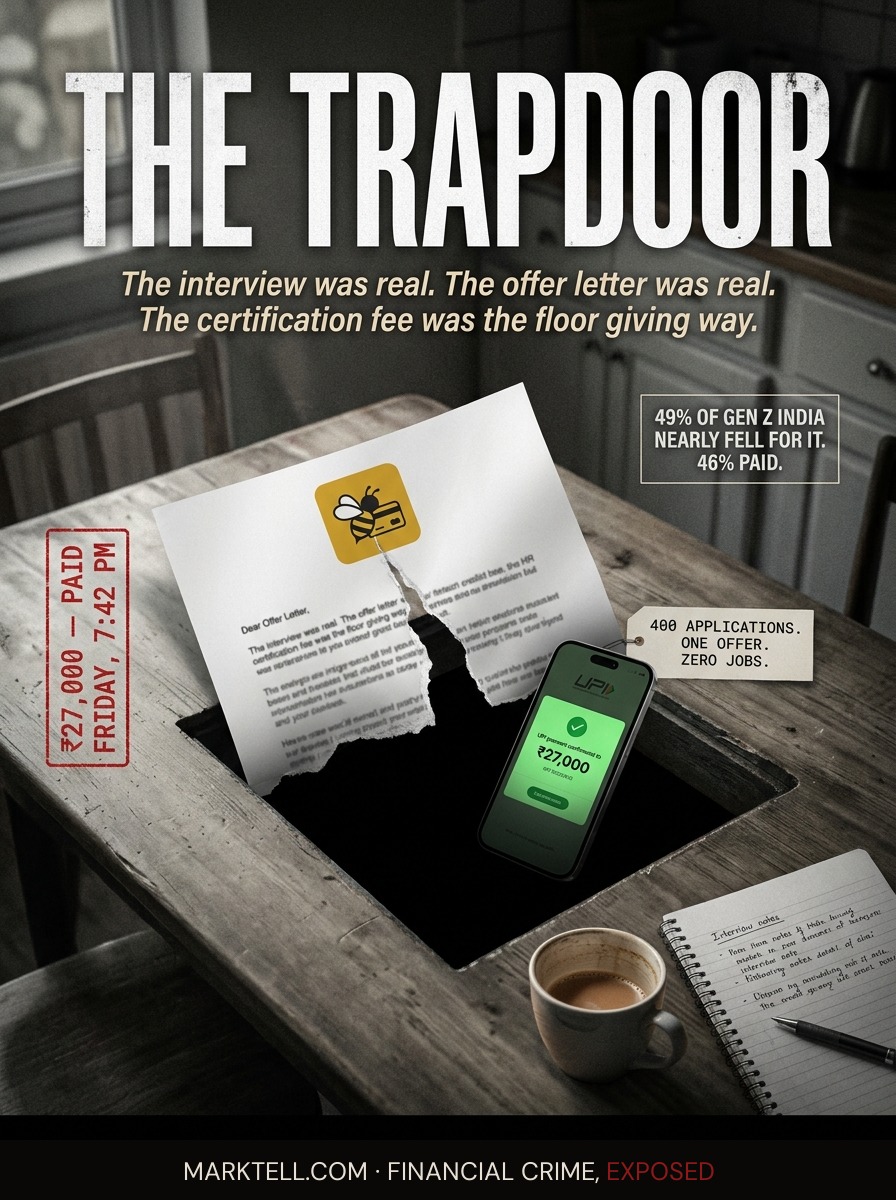
The interview was real. The offer letter was real. The ₹27,000 certification was the trapdoor.
A Bengaluru job seeker sat through three interviews for a KreditBee data analyst role that did not exist. The offer letter arrived on Wednesday. The ₹27,000 certification demand arrived on Friday.
Priya read the offer letter twice before she noticed the email address.
It was a Wednesday afternoon in Bengaluru. She was sitting at the kitchen table where she had eaten breakfast for twenty-four years, the laptop open to a PDF with a KreditBee logo at the top and a signature block at the bottom that said the sender's name and title but ended in a Zoho Mail address, not a kreditbee.com one.
She noticed it. She read past it.
She had been looking for work for six months. Four hundred applications. She kept a spreadsheet. Most of the applications ended in silence. A few ended in a form rejection three weeks later. This one had ended in three rounds of interviews on Google Meet, the last one with a woman who introduced herself as a hiring manager and took notes while Priya walked through a case study about loan default prediction. That interview had lasted forty-seven minutes. Priya remembered the length because she checked the clock when she logged off and told her mother she thought it had gone well.
The offer letter arrived two days later.
Data Analyst. ₹6.5 lakh per year (about $7,800 USD). Bengaluru office. Start date in three weeks. The KreditBee logo was crisp. The formatting was clean. The language sounded like an HR department.
The paragraph about the certification was on page two.
Prior to onboarding, the letter said, all analysts were required to complete a data science certification from a training partner. The cost was ₹27,000 (about $320 USD). The amount would be reimbursed in full with the first month's salary. Payment link below.
Priya read that paragraph three times.
I.
Here is what the record shows about KreditBee.
It is a real fintech company. Founded 2016 in Bengaluru by Madhusudan Ekambaram, Karthikeyan Krishnaswamy, and Vivek Veda. It operates through KrazyBee Services, which is registered with the Reserve Bank of India as a non-banking financial company. That is the license required in India to lend money at scale. KreditBee gives small personal loans to young professionals through an app. It makes money on interest and fees.
It does not make money on certification fees from job applicants. No legitimate Indian employer does. That is not how Indian labor law works. That is not how any labor law works.
The person impersonating KreditBee knew this. That is why the ask was buried on page two of a document that looked correct on page one.
II.
The machine here is not complicated. What makes it work is the ratio of real to fake.
Most job scams are obvious. A message on WhatsApp from a number nobody recognizes. A grammar mistake in the first sentence. A request for money in the first exchange. The reader closes the tab.
This machine did none of that. The job posting was on a legitimate platform. The recruiter had a LinkedIn profile with connections. The first interview was a screening call. The second was a technical round with a case study. The third was a behavioral round with someone who spoke like a hiring manager and asked follow-up questions that showed she had read the case study.
Priya spent, by her own count, more than four hours interviewing for this job. She prepared for another six. She researched KreditBee's loan products. She studied their credit scoring approach. She practiced answers to questions about handling missing data.
The interviews were real work. That is the point. By the time the offer letter arrived, she had invested enough of herself in the process that the ₹27,000 line item felt like a formality standing between her and the outcome she had already earned.
That is the trapdoor. Everything above the floor is real. The floor gives way at one specific point, and the point is placed so late in the walk that turning back feels like the failure.
III.
The payment page was on a domain called numpyverse.com.
The KreditBee logo was pasted at the top. Below it, a form for name, email, offer letter reference number, and payment. The payment options were UPI, net banking, and card. The amount was fixed at ₹27,000.
There is no legitimate business at numpyverse.com. The name borrows from NumPy, the Python library that every data science student in India knows. That is not an accident. A candidate applying for a data analyst role would recognize the name and read it as adjacent to something real.
Priya paid on Friday evening. UPI. The confirmation email arrived within minutes. It came from the same Zoho address that had sent the offer letter.
She told her mother that night. Her mother asked why the certification cost money if the company was paying her. Priya explained the reimbursement clause. Her mother did not push.
IV.
The reimbursement did not arrive.
There was no first paycheck to be reimbursed against, because there was no job. The start date came and went. The address in the offer letter, when Priya checked the KreditBee careers page, did not match the address on the actual KreditBee office. The recruiter's number, when she called it the following Wednesday, rang twice and went to voicemail. The mailbox was not set up.
She called the main KreditBee HR line. She was polite. She read out the offer letter reference number. The person on the other end asked her to send the letter to a verification email address, then called back forty minutes later.
The letter was not real. The recruiter was not real. The hiring manager who had taken notes for forty-seven minutes was not a KreditBee employee. KreditBee had never made her an offer. KreditBee did not, under any circumstance, charge job applicants for certification.
Priya sat at the kitchen table again. The laptop was open to the same PDF. Nothing had changed on the screen. The logo was still crisp. The formatting was still clean. The language still sounded like an HR department.
Only the meaning had changed.
V.
Priya is not alone in the country she is standing in.
An Indeed survey published July 9, 2026 found that 75% of Indian job seekers were now ignoring legitimate listings because they could not tell the fraudulent ones apart. A LinkedIn Job Search Safety Pulse report from May 2026 found that 49% of Gen Z professionals in India had nearly fallen victim to an online job scam. 46% reported actual financial loss.
Read those numbers slowly.
Nearly half of an entire generation of Indian professionals has been through some version of Priya's Wednesday. Not almost. Nearly half.
An EY study from May 2025 found that 88% of the offenders driving India's employment fraud spike in the financial services sector were experienced professionals. Not amateurs. Not one-off opportunists. People who knew the industry, who knew what a real offer letter looked like, who knew where the ratio of real to fake had to sit for the trapdoor to hold.
The machine is not one person running one scam out of one apartment. It is a category of business, run by people who used to work near where the real hiring happens, who understand the process well enough to counterfeit its documents, and who have identified the precise emotional moment in a six-month job search when a candidate will pay ₹27,000 without calling the main HR line first.
That moment is the moment right after the offer arrives.
VI.
Priya did not lose ₹27,000. She did.
But that is not what she lost.
She lost six months of the belief that if she prepared enough, if she practiced enough, if she took enough notes, the process would eventually work. She lost the version of Wednesday where the offer letter meant what it said. She lost the moment at the kitchen table where she told her mother the interview had gone well and her mother had believed her, and she had believed herself.
The ₹27,000 is recoverable in theory. She filed a complaint on the national cyber crime portal. She called her bank. The money moves fast in these cases and it moves through accounts that empty faster. The recovery statistics are not good.
What she cannot file a complaint about is the four hundred and first application. That one is harder to send.
The trapdoor was built for that too. Every candidate who walks through this machine and comes out the other side becomes, statistically, a candidate who applies less confidently to the next real job. The Indeed number is not just about the fraudulent listings. It is about the ones the fraudulent listings have poisoned.
The machine takes ₹27,000 from one applicant and, on the way out, takes something smaller from every applicant who hears about it.
The offer letter is still on Priya's laptop. She has not deleted it. She says she wants to remember what a fake one looks like, so she will recognize the next one.
She will recognize the next one. It will not look like this one.
That is the other thing about the machine. It rebuilds. The next domain will not be called numpyverse. The next fintech being impersonated will not be KreditBee. The next certification fee will not be ₹27,000. The ratio of real to fake will be tuned to whatever the next six-month job seeker has been trained by the last scam to check for.
The floor will give way at a different point.
Priya will be looking at the last one.
- r/Scams | July 2026 | https://www.reddit.com/r/Scams/comments/1v646j9/in_fake_kreditbee_data_analyst_job_scam_real/
- Indeed India Job Seeker Survey | July 9, 2026 | Cited in research brief
- LinkedIn Job Search Safety Pulse | May 2026 | Cited in research brief
- EY India Employment Fraud Study | May 2025 | Cited in research brief
- KreditBee company record | founded 2016 | RBI NBFC registration via KrazyBee Services
- KreditBee careers and terms of service | kreditbee.com
Editorial Notice
MarkTell is a true crime publication about financial fraud. Some scenes, dialogue, and sequential details are reconstructed from court filings, enforcement actions, news reports, and public records. Where the public record does not provide exact details, editorial reconstruction is used to convey the documented pattern of events. Names of private individuals may be changed to protect identity. All factual claims are sourced to public documents cited in the Evidence Trail above. MarkTell does not provide investment, legal, or financial advice. Nothing published here constitutes a recommendation to buy, sell, or avoid any investment. Allegations described in active cases have not been adjudicated and defendants are presumed innocent until proven guilty. Readers should conduct their own due diligence before making financial decisions.